
 Μake us preferred on Google
 The Greek summer is not what it was. Climate change has changed it irrevocably. This time around, Greece has escaped the brutal heatwave bearing down on Western Europe, but scientists are sounding the alarm. Over the past few decades, the country’s heatwaves have changed shape entirely. They come around more often, they show up earlier, and they last much longer than they used to.
“We are talking about a new climate reality,” said Dr. Dimitra Founda, research Director at the Institute of Environmental Research and Sustainable Development of the National Observatory of Athens, speaking to Ta Nea.
The numbers are stark. Drawing on the observatory’s historical archive, Founda said the country logged roughly five times as many heatwaves in the three decades from 1996 to 2025 as it did in the period before. The count of individual heatwave days has climbed even faster, up sevenfold since 1995, because the episodes themselves now drag on far longer than they used to. Furthermore, the decade from 2006 to 2015 actually saw more separate heatwaves than the one that followed, yet the years since 2016 piled up far more hot days, because each spell lasted longer. Scientists call this stubborn refusal to break “persistence,” and Founda said it has become one of the defining, and most dangerous, traits of the modern Greek heatwave.
A break from the past
Heatwaves used to be short. More than 65% of them lasted just three or four days, and while the occasional outlier broke the pattern, such as the long spell of 1945, the truly punishing events were rare. The killer heatwave of July 1987 in Athens, when temperatures held above 40 degrees Celsius for eight days running and the death toll mounted, is one such event that has been etched in the collective national memory.
Today’s heatwaves outlast even that. They now routinely run past the 10-day mark, which is what happened in the summer of 2021 and 2023. In 2024 the situation was even more dire. The heatwave lasted from July 8 to July 24, with the temperature exceeding 37 degrees Celsius for 17 days in a row, the longest such stretch ever logged, according to Founda. The summer of 2025 brought another long siege: eight days from July 21 to July 28, where the thermometer pushed past 40 degrees Celsius.
These findings come from the National Observatory of Athens climate archive, an unbroken daily temperature record for the Athens area going back to the 19th century and one of the oldest and most valuable of its kind in southeastern Europe. It shows that intense heat is nothing new in Greece, but in the past it came rarely, often with several quiet years in between.
Arriving earlier each year
Another worrying trend for scientists is the fact that heatwaves appear earlier in the summer. Greece saw a brief but severe heatwave in June 1916, when temperatures in Athens reached 43 degrees Celsius, a reading that remained the city’s highest on record for nearly a century. It was finally surpassed during the Balkan heatwave of 2007, when the observatory’s historic Thiseio station in central Athens recorded 44.8 degrees Celsius. The 1916 episode, however, was an anomaly. Almost every heatwave recorded occurred in July or August, and apart from that year, June heatwaves were effectively unknown, Founda said.
However this is no longer the case. Since the fierce early heatwave of June 2007, extreme heat in the first weeks of summer has returned again and again: in 2010, 2016, 2017, 2021 and once more in 2025, often climbing past 40 degrees Celsius. Longer heatwaves arriving earlier in the year, Founda said, are an urgent new problem, one with grave consequences for human health and for the natural world.
Fewer cool nights
Another worrying change in the heatwave patterns observed is that the heat no longer lets up after dark. The 1987 heatwave scorched Athens for eight days, but the nights at least brought relief. That is no longer the case, as temperatures now stay high around the clock, denying the body the overnight recovery it needs to shake off the day’s strain, Founda said.
A study she presented with Dr. Giorgos Katavoutas at the 17th International Conference of Meteorology, Climatology and Atmospheric Physics (COMECAP 2025) in Cyprus, which tracked consecutive hours of thermal stress in Athens against the Universal Thermal Climate Index from 1960 to 2024, puts the trend in numbers. In the 1960s, a summer might offer as many as 65 nights free of thermal stress. Since 2020, some summers have brought as few as 15 genuinely comfortable ones.
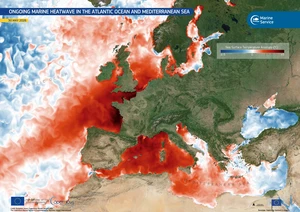
Greece is not alone in this. Heatwaves are becoming more frequent and more intense across much of the world, and the extreme heat now gripping Western Europe, a region largely unprepared for it, is the most recent example. For scientists, it reinforces a growing concern about whether the planet will remain livable in the coming decades without a decisive move away from the emissions driving the warming.
Source: Ta Nea