 Μake us preferred on Google
 Greece and Saudi Arabia have taken a decisive step toward deepening their energy partnership, following a three-day visit by Greek Minister of Environment and Energy Stavros Papastavrou to Riyadh. The talks laid the groundwork for Greece to serve as a key entry point for the transfer of green energy from Saudi Arabia to Europe, reinforcing Athens’ strategic role in the continent’s evolving energy architecture.
With Riyadh determined to retain its energy leadership well into the next decade—and currently accounting for roughly one-sixth of global energy production—the two sides agreed on a shared vision: positioning Greece as a hub for transporting Saudi-produced renewable energy and, in the longer term, green hydrogen to European markets.
The plan foresees energy flows reaching countries such as Germany and Austria via Greek territory, offering a land-based alternative at a time when global shipping routes face growing constraints.
According to informed sources, feasibility studies for the Saudi Greek Interconnector—designed to carry renewable electricity from Saudi Arabia to Greece—are expected to be completed by the end of the second quarter of 2026.
The project will be developed through a special-purpose joint venture between Greece’s Independent Power Transmission Operator (IPTO) and Saudi Arabia’s National Grid, with equal participation from both sides. Key aspects of the initiative are set to be revisited in ministerial-level contacts later this month, as well as during a forthcoming bilateral meeting planned for April, with the venue yet to be confirmed.
Beyond electricity, the next phase of cooperation will focus on the transport of green hydrogen to Europe, a project embedded in a longer-term strategy that again places Greece at the center of a Saudi-backed energy corridor into the EU.
This emerging network, linking the Middle East with Europe, complements the East-Med Corridor—already under construction and forming part of the broader IMEC vision—highlighting Riyadh’s long-term geopolitical and energy planning, as well as the pivotal role reserved for Greece. Notably, the two countries mark 100 years of diplomatic relations this year.
From Athens, officials describe the relationship with Riyadh as a strategic partnership underpinned by careful planning and growing economic substance. The timing of Papastavrou’s visit was also seen as symbolic, coming exactly one year after Prime Minister Kyriakos Mitsotakis traveled to Saudi Arabia for the inaugural meeting of the High Council of Strategic Cooperation, which set in motion several flagship projects now advancing toward implementation. Among them is the ESEN telecommunications cable linking Greece and Saudi Arabia, in which Greece’s Public Power Corporation holds a 25% stake.
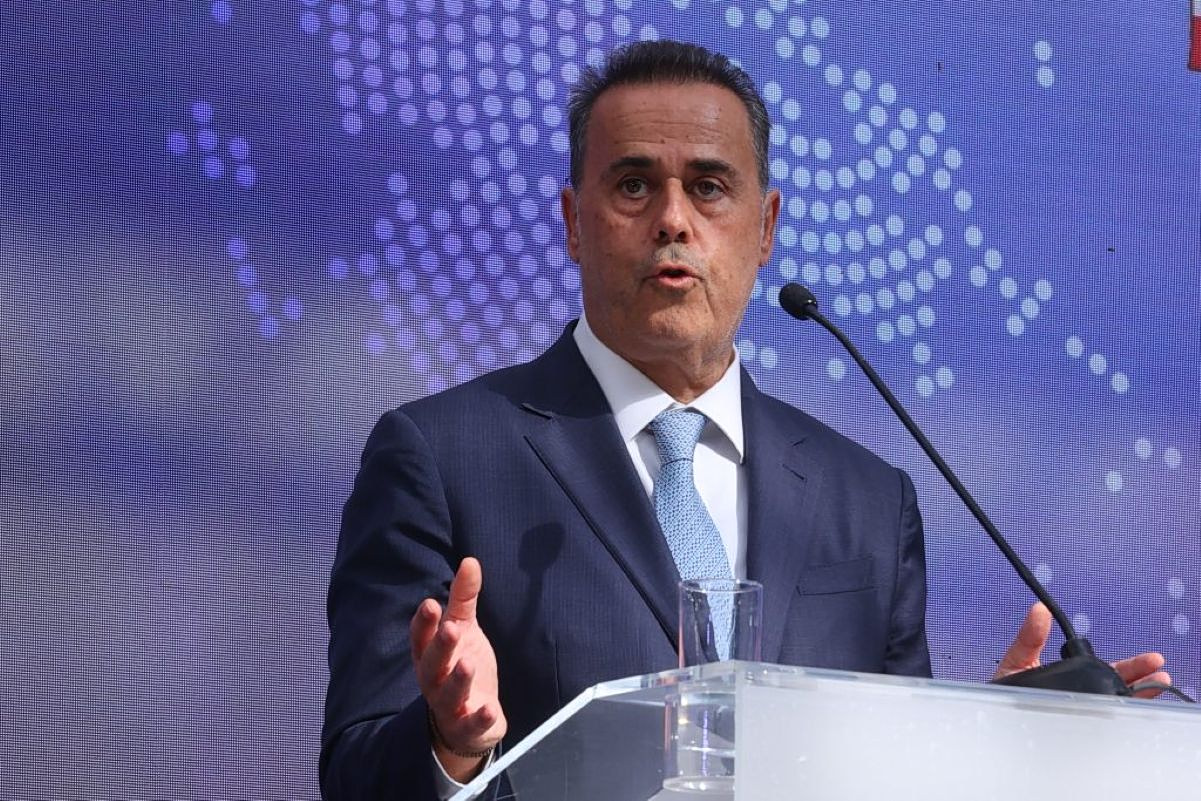
During his meetings in Riyadh, Papastavrou underlined the resilience and breadth of the bilateral partnership, rooted in a shared vision for energy autonomy. He also highlighted Greece’s potential in mineral resources and rare earths.
Speaking at the Future Minerals Forum 2026, the minister noted that Greece ranks among Europe’s leading producers of bauxite, perlite, and copper, while aspiring to become the EU’s sole supplier of gallium—a critical material for technology, aerospace, defense, and digital applications.
Together, these developments signal a broader strategic alignment, with energy, infrastructure, and critical resources forming the backbone of a rapidly expanding Greece–Saudi Arabia partnership.