 Μake us preferred on Google
 In the Lebanese city of Baalbek, monumental Roman ruins have stood for more than two thousand years as witnesses to a glorious past. Among ancient temples, myths, and present-day tensions, the city unveils one of the most breathtaking archaeological landscapes in the Middle East.
Leaving Beirut
One autumn morning we left Beirut, the beautiful yet wounded capital of Lebanon, heading toward the archaeological site of Baalbek.
Anyone visiting Beirut should know that almost every private car can also function as a taxi. You simply stand on the sidewalk, raise your hand, and a driver will stop and ask where you’re going. You name your destination, bargain briefly over the price, and off you go.
A few days earlier we had been lucky enough to meet Amin this way—a courteous 30-year-old who soon became our personal driver. Thanks to his knowledge, we were able to explore parts of Beirut that are not easily accessible to ordinary tourists.
Beirut, Lebanon’s capital and largest city, sits on a Mediterranean peninsula at the foothills of the Lebanon Mountains. With around 2–2.5 million people in the wider metropolitan area, it is a lively and cosmopolitan city once known as the “Paris of the East.”
It is also a city that endures wounds, heals them, and continues to captivate visitors with its beauty, culture, and the warmth of its people. In the previous days we had walked through neighborhoods devastated by the massive Beirut port explosion of August 2020, where shattered building facades still stand as reminders of the tragedy. We also visited districts struck by Israeli attacks in 2024.
You quickly realize that despite decades of crises, Beirut remains determined to lift its head and move forward after every disaster.
The Road to Baalbek
Our meeting with Amin was set for nine in the morning. He explained that the distance to Baalbek was about 90 kilometers, but delays were likely due to traffic and security checks at several checkpoints along the route. The journey, he warned, could take two to three hours.
We took the highway toward the Bekaa Valley, following the road that leads to Damascus. Until we crossed the mountains east of Beirut, the traffic was overwhelming.
At two Lebanese army checkpoints we were asked to show our passports and state our destination. After brief checks, we were allowed to continue without difficulty.
Soon we descended into the Bekaa Valley—a vast fertile plain filled with vineyards, farmland, and small villages. The road was generally good. We stopped briefly for coffee in Chtaura before continuing directly to Baalbek, arriving around 11:30 a.m.
Baalbek is a city of roughly 85,000 residents, built right next to—and partly around—the archaeological site. Its population includes Shiite and Sunni Muslims, as well as Christians, mainly Orthodox and Maronite. Many Syrian refugees from the Syrian civil war also live here.
The city is widely considered a stronghold of Hezbollah and has therefore been targeted repeatedly by Israeli attacks. Despite this, the archaeological site remains open to visitors most of the time.
Among the Ruins of Ancient Heliopolis
The archaeological site of Baalbek is one of the most impressive ancient complexes in the world and has been listed as a UNESCO World Heritage Site since 1984.
Researchers believe the area has been inhabited since the Paleolithic era, with evidence of human presence dating back at least 9,000–11,000 years. During the Phoenician period the site was considered sacred to the god Baal, from whom the city takes its name.
After the campaigns of Alexander the Great, the city became known as Heliopolis. Under Roman rule it evolved into one of the largest and most magnificent religious complexes of the Roman Empire, dedicated to the triad Jupiter, Venus, and Mercury—the so-called Heliopolitan Triad.
As you enter the site, you cannot help but be struck by the immense scale of the temples and how remarkably well preserved many of them remain.
The Temple of Jupiter
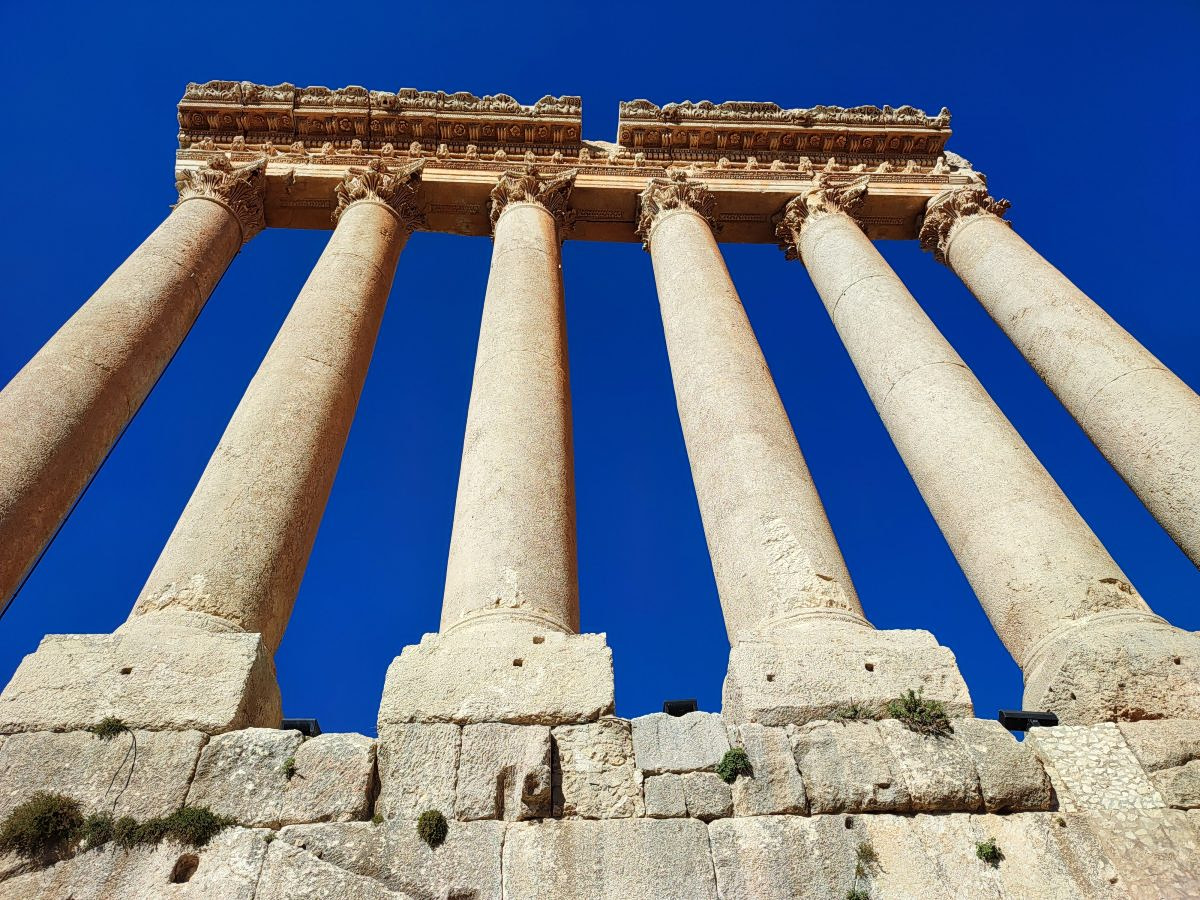
Our tour begins at the Temple of Jupiter (Baalbek), the largest Roman temple ever built.
Originally it had 54 Corinthian columns, each 20–22 meters tall. Today only six remain standing. The temple rises on a massive platform and dominates the entire complex.
It is the central and most awe-inspiring monument of Baalbek and one of the greatest achievements of imperial Roman architecture.
The temple was dedicated to Jupiter Heliopolitanus, a fusion of the Roman god Jupiter with the Phoenician deity Baal, associated with solar attributes.
Construction likely began in the late 1st century BC during the reign of Emperor Augustus and continued through the 1st century AD, with further modifications until the 3rd century AD.
The architect and the emperor who commissioned it remain unknown. The temple measured roughly 90 meters long and 35–40 meters wide, while its total height exceeded 30 meters. In antiquity it also functioned as an oracle.
Each column’s base measured about 2.5 meters in diameter, making them the largest classical columns ever built.
The temple stands on a vast artificial terrace surrounded by gigantic stone blocks that still leave visitors breathless with their sheer size.
Standing before the six remaining columns, one truly feels the overwhelming power of the ancient Roman Empire.
The Temple of Bacchus
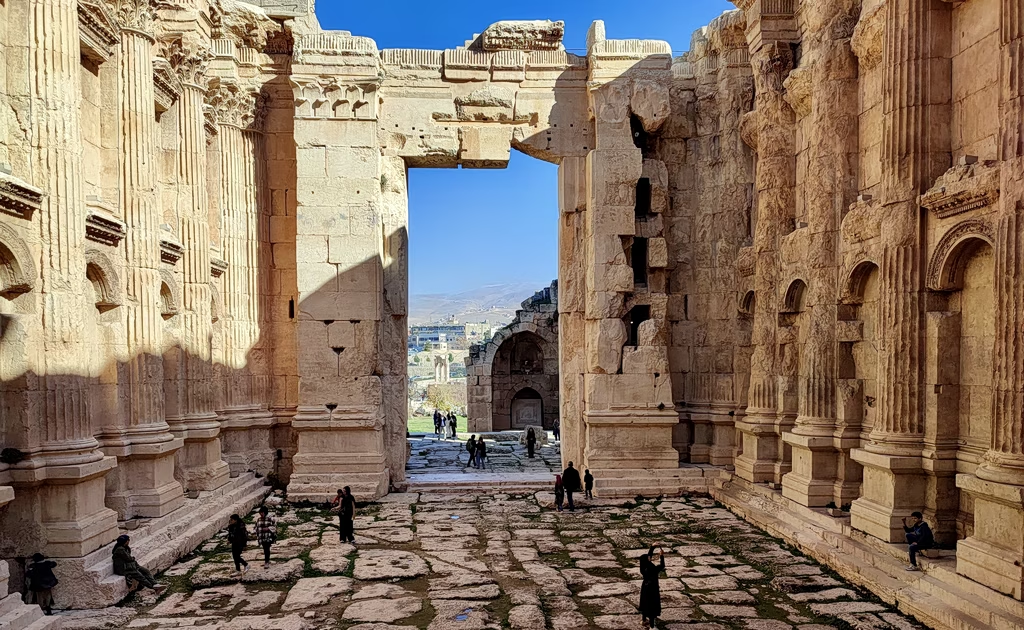
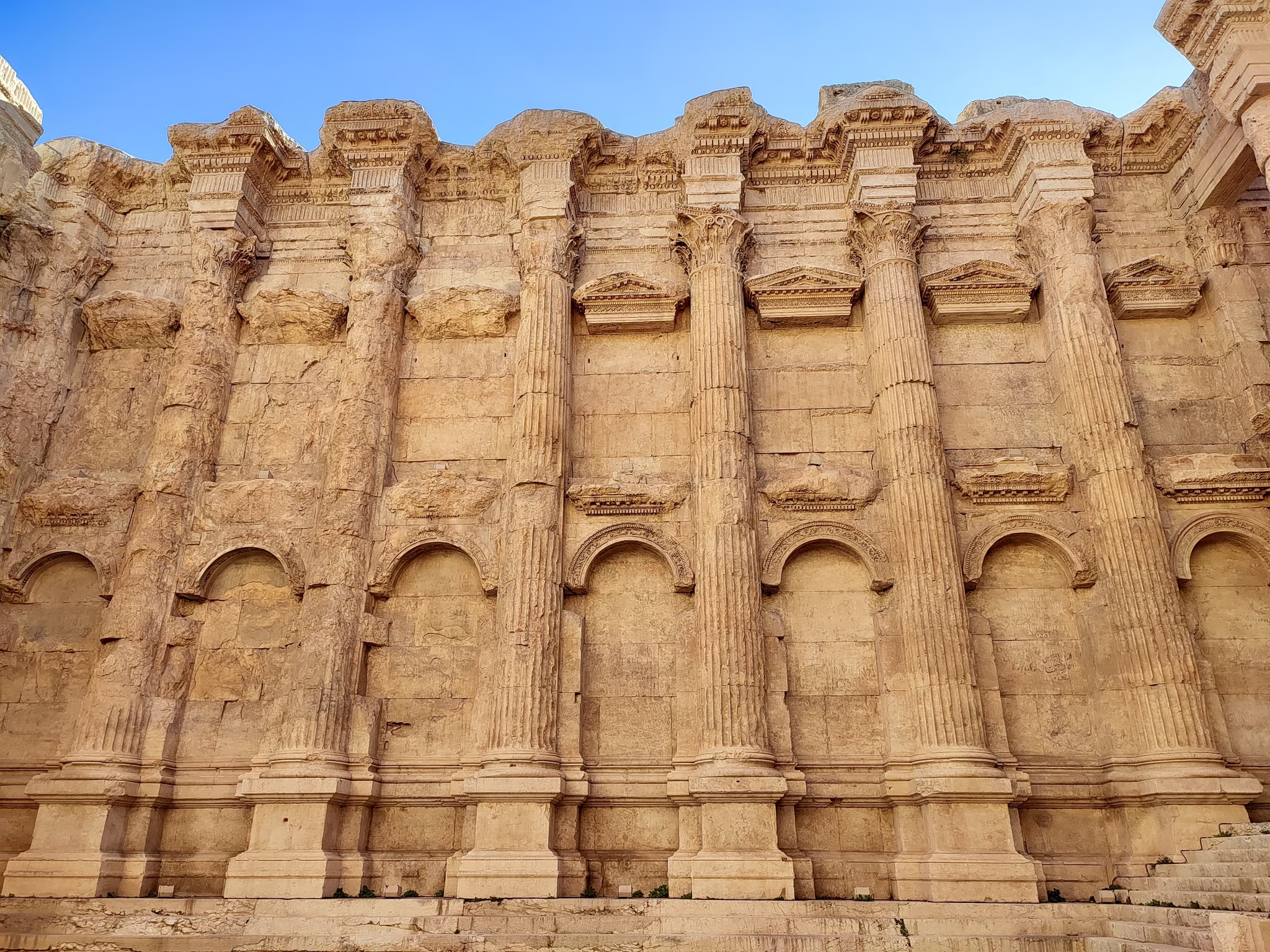
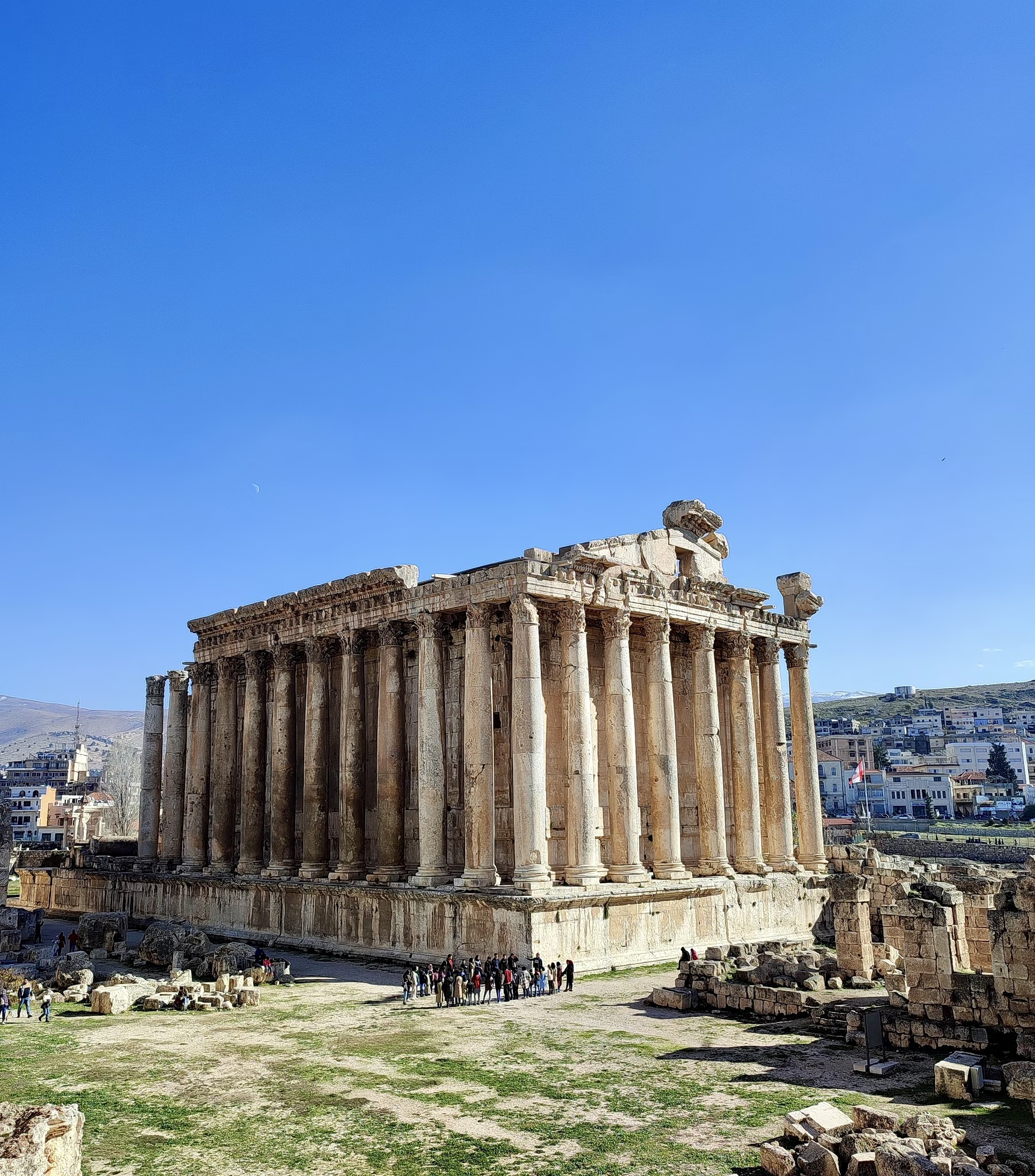
We continue to the Temple of Bacchus (Baalbek), one of the best-preserved Roman temples anywhere in the world.
Richly decorated with sculptures, it is considered a masterpiece of Roman architecture.
The base platform on which the temple stands is built from three colossal monolithic stones—each around 20 meters long and four meters high, weighing approximately 800 tons. Even today scholars marvel at how such enormous blocks were transported and positioned without modern machinery.
The Temple of Venus
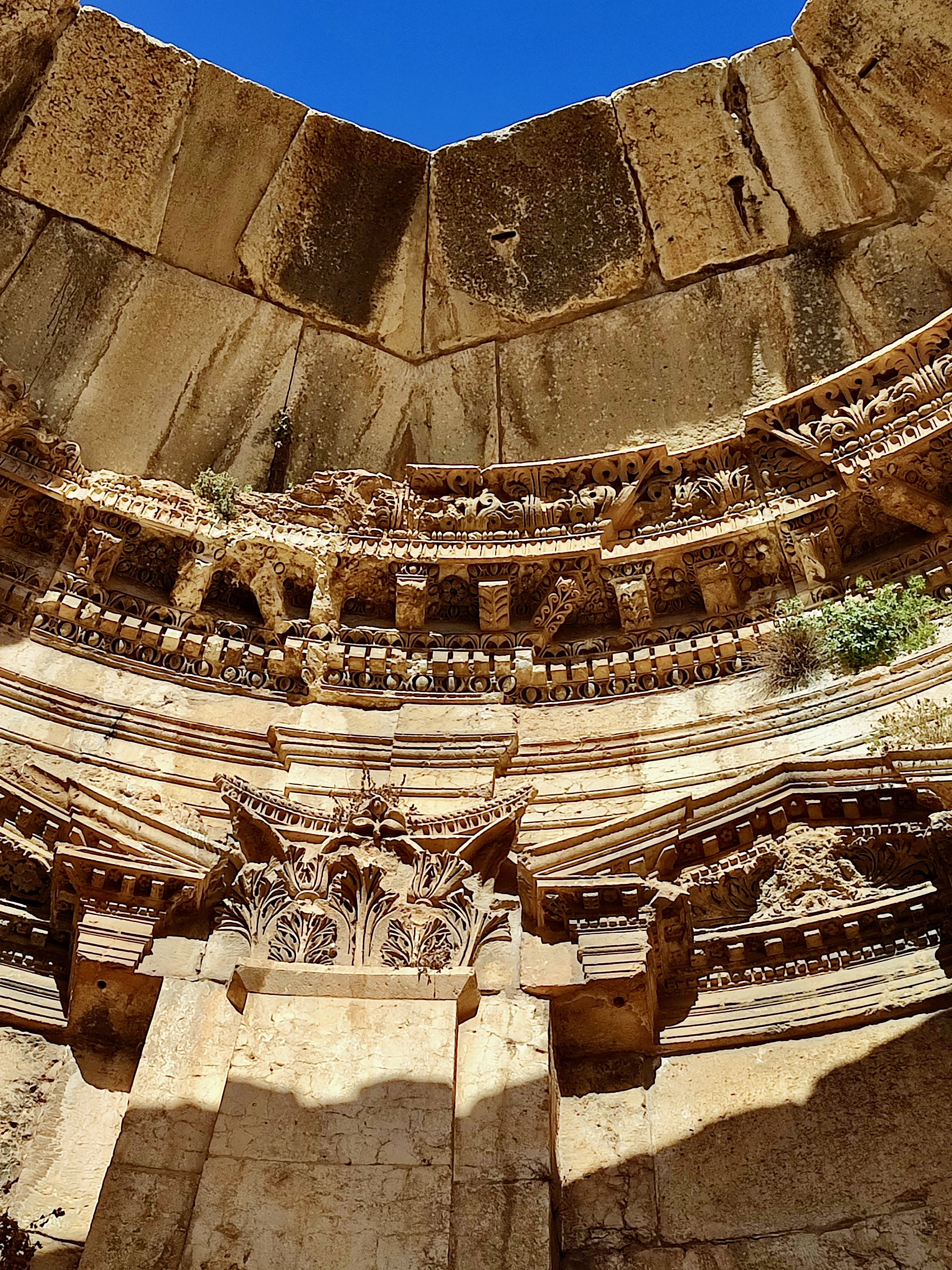
The Temple of Venus (Baalbek), also known as the Circular Temple, is one of the most intriguing monuments of the site.
Unlike the monumental temples of Jupiter and Bacchus, this temple is smaller, more elegant, and architecturally distinctive.
It was built in the 3rd century AD, probably during the late Roman period.
The temple was dedicated to Venus of Heliopolis, associated with local Phoenician deities such as Atargatis, the goddess of fertility and love.
During the Byzantine era the temple was converted into a Christian church dedicated to Saint Barbara, who remains the patron saint of the region today.
Some scholars question whether the temple was truly dedicated to Venus and suggest it may have honored the goddess Fortuna. However, most agree on the Venus attribution due to the decorative symbols—doves and seashells, traditional symbols of the goddess.
The temple stands about 200 meters from the main complex, near a colonnaded street and a small temple dedicated to the Muses.
Amid Baalbek’s colossal monuments, the Temple of Venus feels like a jewel—an example of Roman creativity and harmony. Its delicate details and symbols of love and beauty make it particularly photogenic, especially against the open sky.
Visitors can walk directly among the ruins of all three temples, offering a rare sense of intimacy with antiquity that is often impossible at archaeological sites in the West.
The site is well maintained, allowing visitors to admire these wonders both from a distance and up close. Political instability in Lebanon has meant that—at least during our visit—the site was relatively quiet, making the experience even more powerful.
A Walk Through the City
After leaving the archaeological site, we wandered through the narrow streets of Baalbek. We enjoyed delicious cheese pies and herb pastries—said to be the best in Lebanon—and visited the Orthodox church of Saint Barbara Church (Baalbek).
According to tradition, Saint Barbara was born here.
The modern Greek Orthodox church belongs to the Greek Orthodox Patriarchate of Antioch through the Diocese of Zahle and Baalbek.
Despite the small Christian population in Baalbek—about 300–500 people, mainly Melkite Catholics, Maronites, and Orthodox Christians—the church remains active.
The Baalbek Festival
Every summer the site hosts the Baalbek International Festival, the oldest and most famous cultural festival in the Middle East, with a history spanning more than 70 years.
Those who have attended describe it as a unique experience where ancient history meets modern art.
The festival was first officially organized in 1956 under the patronage of Lebanese President Camille Chamoun. From its earliest years it attracted international performers—opera, ballet, symphonic music, and theater—and became a symbol of Lebanon’s cultural “golden age.”
Artists who have performed here include the legendary Lebanese singer Fairuz, Egyptian diva Umm Kulthum, jazz virtuoso Miles Davis, and Sting, among many others. International ballet companies, orchestras, and opera productions from Europe, the United States, and the Arab world have also taken part.
The festival was suspended between 1975 and 1996 because of the Lebanese Civil War. During that time the ruins suffered damage but were not completely destroyed.
In 1997 the festival resumed, focusing initially on Lebanese artists but gradually welcoming international stars again, including Jean-Michel Jarre.
We left Baalbek with a sense of emotional uplift—but also with a quiet concern about the future of this extraordinary archaeological site.
For centuries it has withstood not only the passage of time but also the storms of human history.
Whether it can continue to endure both remains a question only the future will answer.