The Greek National Opera is travelling to New York for the first time with its Orchestra to present a unique concert at the historic Carnegie Hall (Stern Auditorium / Perelman Stage), featuring exceptional works by Greek composers, inspired by the oeuvre and figure of Nikos Kazantzakis. On 15 October 2026, through the concert titled Nikos Kazantzakis: An Odyssey in Music, the Greek National Opera will present a panorama of Greek art music to New York audiences, featuring emblematic works by Manos Hadjidakis, Mikis Theodorakis, Nikos Skalkottas, Dimitri Mitropoulos, and Giorgos Koumendakis.
Internationally acclaimed Greek maestro and Graz Opera Chief Conductor Vassilis Christopoulos will lead the orchestra. The performance will feature the world-renowned mezzo-soprano Anita Rachvelishvili and Greek soprano Maria Kostraki, accompanied by the GNO Orchestra and the Manos Hadjidakis Ensemble. The concert is made possible by a grant from the Stavros Niarchos Foundation (SNF) to enhance the Greek National Opera’s artistic outreach and is part of the celebratory events marking SNF’s 30 years of grantmaking.

Maria Kostraki. Photo: Y. Gutmann

Anita Rachvelishvili. GNO photo: A. Simopoulos
Nikos Kazantzakis—the most translated Greek author worldwide—has been one of the most timeless and rich sources of inspiration for Greek musical creation throughout the 20th and 21st centuries. Through music and film, his work has reached the far corners of the Earth, making him one of the most recognizable literary figures worldwide. His works, such as Zorba the Greek, Captain Michalis, Christ Recrucified, The Last Temptation, and Ascetics, have brought Greek culture across the entire planet. His oeuvre, profoundly philosophical and tragic, yet also deeply rooted in the people and grounded in experience, addresses central themes such as freedom, fate, faith, and human transcendence. The poetic and dramaturgical power of his writing has drawn prominent Greek composers, who have sought to musically convey the intensity, reflection, and existential pulse inherent in Kazantzakis’ universe through their settings.
His indirect contributions to the musical repertoire span at least five different genres: symphonic music, opera, ballet, theatre music, and film music. Compositions inspired by Kazantzakis have served not only as musical interpretations of his texts but also as creative dialogues between literature and music, thereby decisively shaping modern Greece’s musical and broader artistic identity. Without any need for ‘translation’, music’s universal language is perhaps the most suitable medium for taking audiences on a fascinating journey through the author’s world.

The program for the Nikos Kazantzakis: An Odyssey in Music concert at Carnegie Hall forms a powerful musical bridge linking generations of Greek composers. Despite their differing aesthetics and artistic paths, all these composers were deeply inspired by the spiritual world of Nikos Kazantzakis and by the island of Crete—whether as a place of origin, a source of heritage, or a symbolic reference.
Nikos Kazantzakis’ novel Captain Michalis was a major source of inspiration for Manos Hadjidakis (1925–1994), who composed the music for the work’s theatrical adaptation of the same title in 1966. Kazantzakian themes, such as freedom, sacrifice, and inner conflict, are transformed by Hadjidakis’ music, not into an epic narrative but into a lyrical, existential commentary. The music illuminates the hero’s inner world and enters into a meaningful conversation with Kazantzakis’ words, offering the work an independent artistic reading. Performing this piece will be soprano Maria Kostraki, accompanied by the Manos Hadjidakis Ensemble.

Nikos Kazantzakis’ most recognizable musical incarnation worldwide is undoubtedly Zorbas, composed by Mikis Theodorakis (1925–2021). Through his music for Michael Cacoyannis’ film adaptation of the novel Zorba the Greek (Life and Times of Alexis Zorbas), Theodorakis gave this hero a distinctive musical identity and voice that, especially through the famous ‘Zorba’s Dance’, became internationally identified with the Greek spirit. Performing this piece will be the renowned mezzo-soprano Anita Rachvelishvili.
Giorgos Koumendakis (born in 1959) draws inspiration from Kazantzakis’ philosophy and spirit in his symphonic work Amor Fati (2007). He approaches Cretan music and the distinctive ‘kontylies’ style through abstract orchestral writing, without using traditional instruments. Written to mark the fiftieth anniversary of the author’s death, Amor Fati—as suggested by its title—captures the Kazantzakian concept of accepting one’s fate, along with the composer’s profound connection to Cretan musical identity. Amor Fati will make its American debut at this concert.
The concert will also feature two distinctive works from Greek art music, inspired by Crete’s centuries-long history and folk culture, an island that profoundly influenced Kazantzakis.
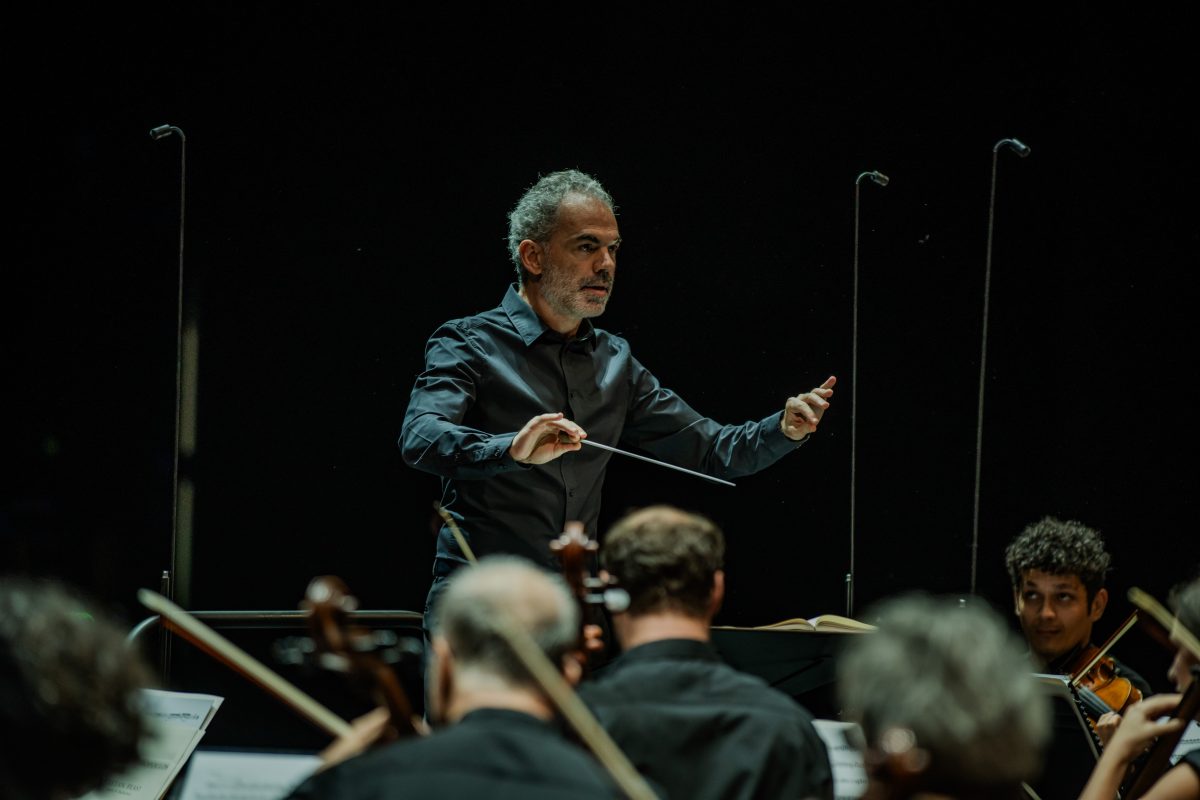
Maestro Vassilis Christopoulos with GNO Orchestra. Photo: A. Simopoulos
The three Cretan Dances, composed by Nikos Skalkottas (1904–1949), draw on Crete and Cretan music. Skalkottas, an outstanding figure in modern Greek music, wrote works that ranged from the Greek National School and neoclassicism to atonality and the twelve-tone technique (dodecaphony). His most emblematic composition, the 36 Greek Dances, is based on folk songs and traditional tunes from all over Greece, showcasing the distinctive musical characteristics and diversity of the Greek landscape.
Dimitri Mitropoulos (1896–1960), enchanted by Cretan culture, composed the piece Cretan Feast in 1919. This prominent Greek 20th-century conductor and friend of Nikos Kazantzakis made his international debut with the Berlin Philharmonic and later carved out a distinguished career in America, where he also served as both the musical and artistic director of the New York Philharmonic. Cretan Feast is one of his early notable piano works, later arranged for orchestra by Nikos Skalkottas.
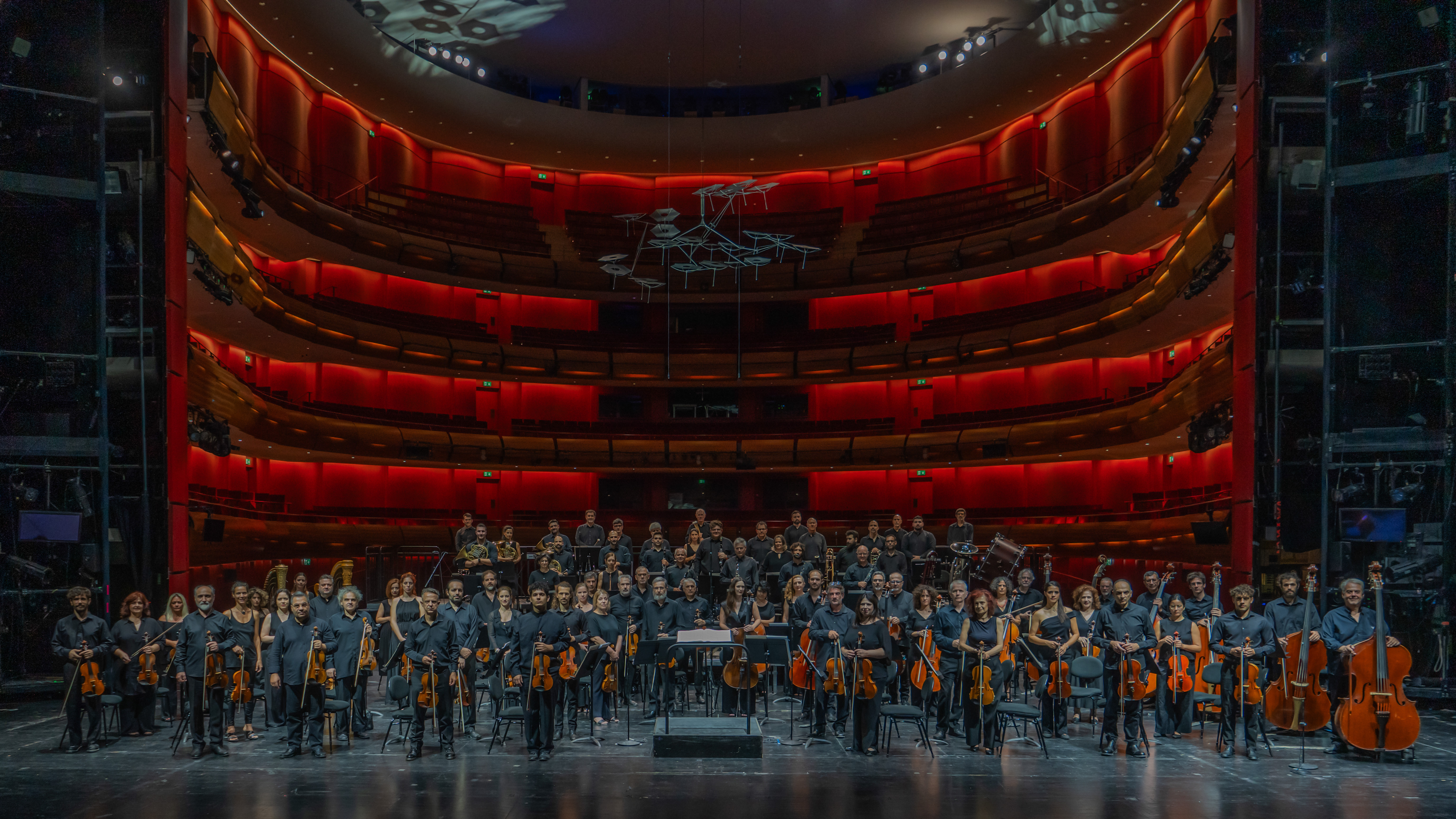
GNO Orchestra. Photo: A. Simopoulos
The concert at Carnegie Hall on 15 October 2026 forms part of the Greek National Opera’s international outreach strategy, building on its highly successful tours across Europe, Asia, Australia, and Africa. The concert is held under the auspices of the Consulate General of Greece to New York and the Greek Orthodox Archdiocese of America. The Official Corporate Partners of the Greek National Opera’s Carnegie Hall Debut are Capital Clean Energy Carriers and Evangelos Marinakis, who champions Nikos Kazantzakis’ work as the Grand Sponsor of the Kazantzakis Museum in Heraklion, Crete.