 Μake us preferred on Google
Lumina, an advanced computer simulation, is opening a new era in the study of cosmic history, allowing scientists to follow the evolution of the universe during the first two billion years of its existence in unprecedented detail.
The project, involving researchers from the Massachusetts Institute of Technology (MIT), Harvard University and other research institutions, aims to reveal how the first stars and galaxies formed and how the universe gradually emerged from the cosmic “dark ages.”
From Primordial Darkness to the Emergence of Light
After the Big Bang, the universe was an extremely hot and dense place, filled with particles and energy. As it began to expand and cool, the first neutral hydrogen atoms formed.
The hydrogen limited the spread of radiation, setting the stage for the long period of cosmic darkness that followed. About 380,000 years after the Big Bang, an era began in which the universe remained dark, without the bright structures we know today.
The decisive change came with the birth of the first stars and galaxies. Their intense radiation began to interact with hydrogen, stripping electrons from its atoms and allowing light to travel more freely. This process, known as the “reionization of hydrogen,” marked one of the most important transitional stages in the history of the universe.
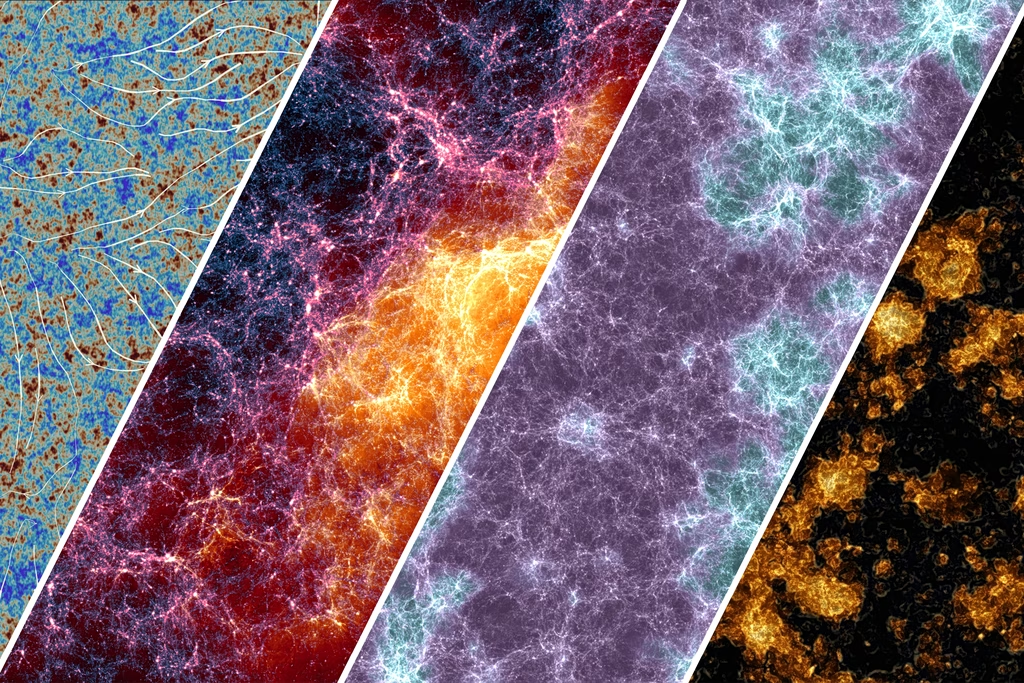
The large-scale Lumina simulation, presented in a study published in the journal Monthly Notices of the Royal Astronomical Society, focuses on this cosmic transition. By combining the evolution of dark matter, gas, stars and radiation, the researchers aim to recreate the complex processes that led the early universe from darkness to light.
The Next Step in Cosmology
One of the simulation’s most important features is that it captured the reionization of both hydrogen and helium. According to the results, hydrogen reionization was driven mainly by ultraviolet radiation from the first stars and galaxies. Helium reionization, which required much higher energies, was linked to intense radiation from supermassive black holes.
Lumina covers a region of space about 1.6 billion light-years across and includes roughly half a trillion computational elements, such as dark matter particles and gas atoms. Compared with previous leading simulations, its volume is about 100 times larger, while its resolution is about 30 times higher than that of IllustrisTNG, the model on which it was based. The calculations were run on Frontier, one of the world’s most powerful supercomputers.
The research team plans to make Lumina available to the scientific community so that its results can be compared with observations from current and future telescopes.
This comparison could provide new insights into the formation of the first galaxies, the distribution of dark matter and the evolution of large cosmic structures. As new telescopes reveal increasingly distant and ancient galaxies, such simulations may help scientists reconstruct the first pages of the universe’s history more accurately.
By the Numbers
The simulation required peak computing power of 100,000 CPU cores and about 15,000 GPUs.