 Μake us preferred on Google
What happens when discarded construction materials become art, an ordinary kitchen disappears beneath white lace, and the history of electricity is reimagined through photography, sculpture and sound? At a former power station in Neo Faliro, Athens, contemporary artists are finding unexpected answers.
The exhibition DEI Meets Art Vol. 2 has opened at the historic facilities of the Public Power Corporation (DEI), Greece’s main electricity provider, bringing together 55 works of contemporary art. The exhibition is the result of the company’s second open art competition, which attracted more than 1,000 submissions and offers five cash prizes worth a total of €20,000.
Curated by art historian and curator Christopher Marinos, the exhibition explores the history and evolution of DEI through a diverse range of artistic approaches, all connected in some way to light, electricity, energy and industrial heritage.
Its striking industrial setting, combined with the originality and inventiveness of the selected works, aims to establish the exhibition as a major event on Athens’ contemporary art calendar.
From an overturned skip to a work of art
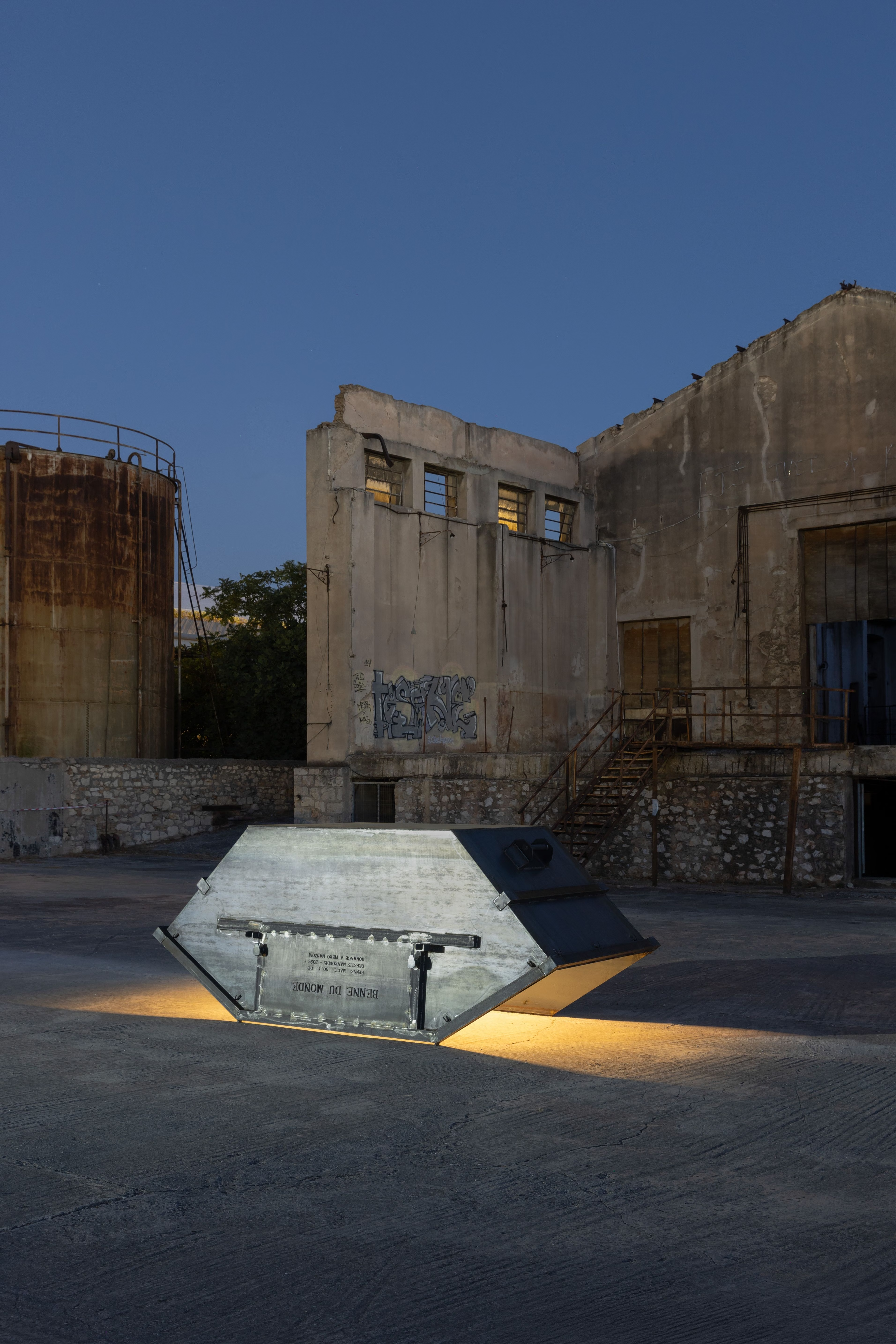
The first prize of €8,000 went to Orestis Mavroudis for Benne du Monde (The World’s Skip), a sculptural installation that directly engages with the work of Italian artist Piero Manzoni.
Mavroudis has taken an overturned construction waste container and transformed it into something unexpected: light spills from its interior, turning an object normally associated with rubble and discarded building materials into a source of poetic and symbolic meaning.
The work references Manzoni’s celebrated 1961 sculpture Socle du Monde (Base of the World). The Italian artist created an upside-down metal plinth bearing an inverted inscription, symbolically declaring the entire Earth a work of art.
With this deceptively simple but radical gesture, Manzoni overturned the traditional relationship between sculpture and its pedestal. Rather than supporting an artwork, the pedestal suggested that the whole world could itself be considered art.
Mavroudis takes this idea further by subverting the ordinary function of an everyday object. The light emerging from the overturned container shifts attention away from what is useless or discarded and towards the possibility of seeing materials in an entirely new way.
Five artists, five different interpretations of energy
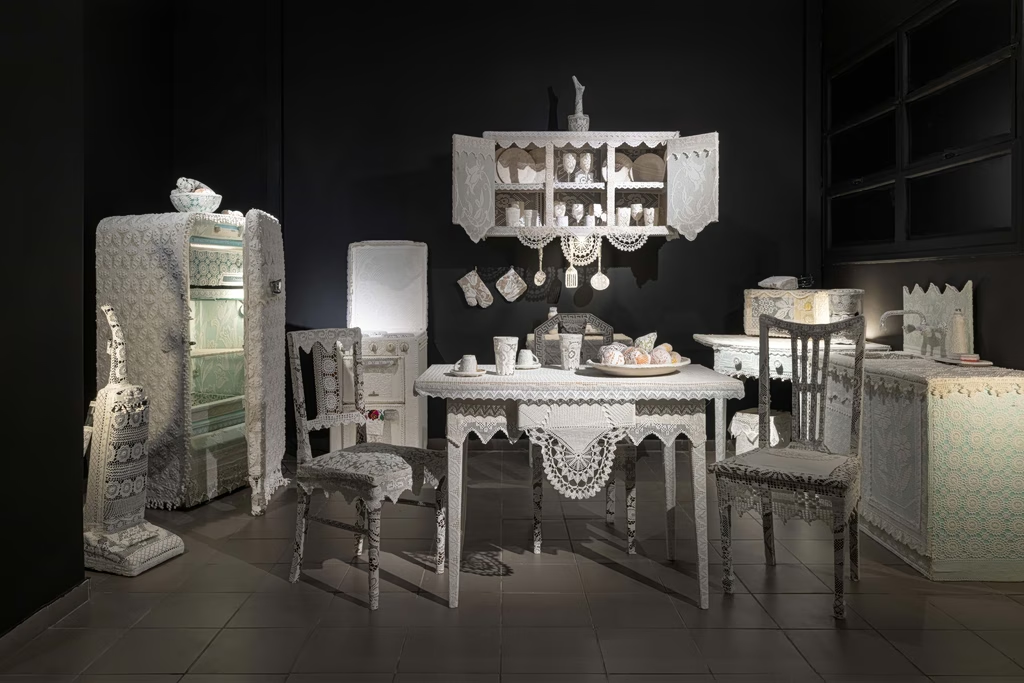
The second prize, worth €5,000, went to Dionysis Christofilogiannis for White Current (2026).
The installation features an entire kitchen, including its electrical appliances and household equipment, covered in white lace. The material evokes domestic labour, care and traditional gender roles, introducing a different perspective on the relationship between energy and everyday life.
The third prize of €3,000 was awarded to Sofia Dtona for Blocking Minority (2026), a luminous sign built around a play on the name of DEI.
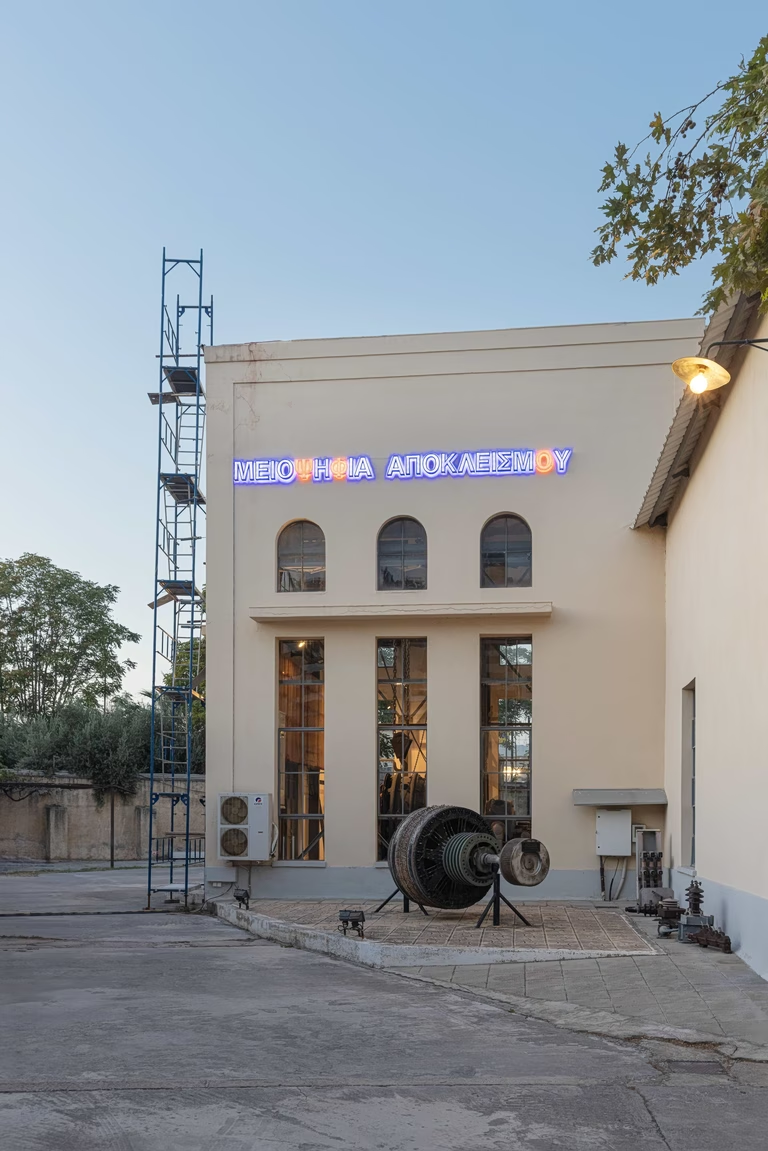
Third Prize: “Exclusion Minority” by Sofia Ntóna
The artist rearranged the letters of the company’s Greek name, Public Power Corporation S.A., adding three new letters to create the English term “blocking minority”. The expression describes a shareholding position that allows an investor to prevent critical decisions from being approved.
The fourth and fifth prizes, worth €2,000 each, went to the artistic duo VASKOS, comprising Vasilis Noula and Kostas Tzimoulis, and Virginia Mastrogiannaki, respectively.
In their photographic series Divine Currents (2026), VASKOS combine staged photographs with archival material from DEI advertisements dating back to the 1950s. Their work also draws on ancient Greek mythology, including depictions of Apollo and Hyacinthus as discus throwers.
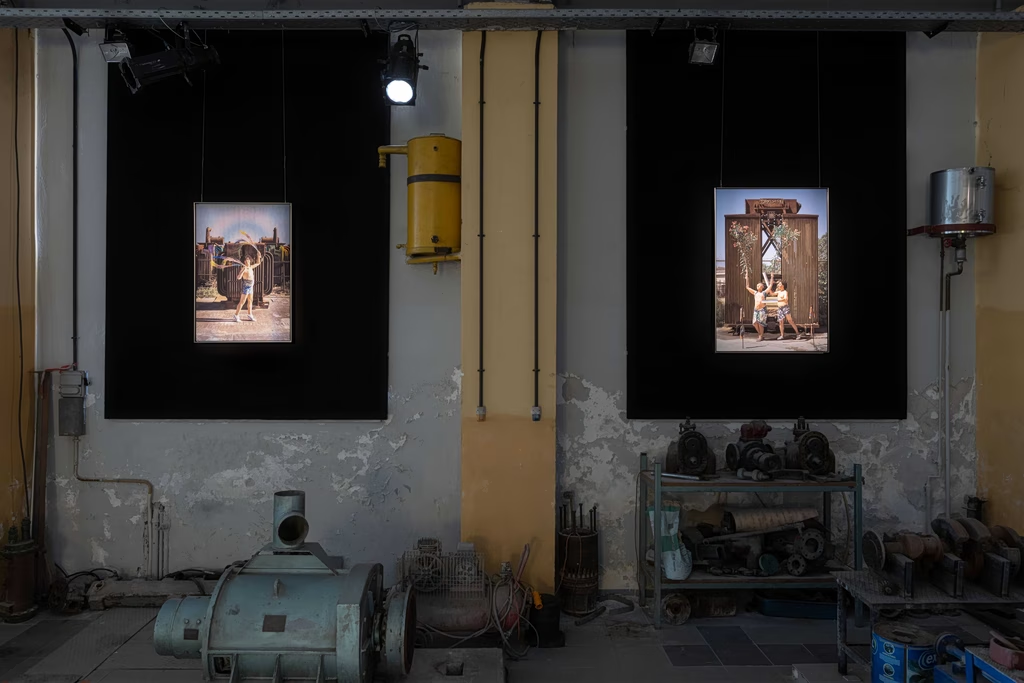
Fourth Prize: “Divine Currents” by VASKOS (Vasilis Noulas & Kostas Tzimoulis)
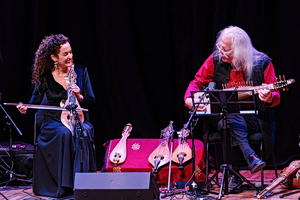
Mastrogiannaki, meanwhile, presents the video Auratus Sanguinarius (2026). Two musicians disguised as technicians engage in a musical dialogue using wind instruments that appear to have been constructed from materials found at DEI’s former industrial facilities in Keratsini, another area of greater Athens.
Here, industrial memory becomes a sonic and performative experience.
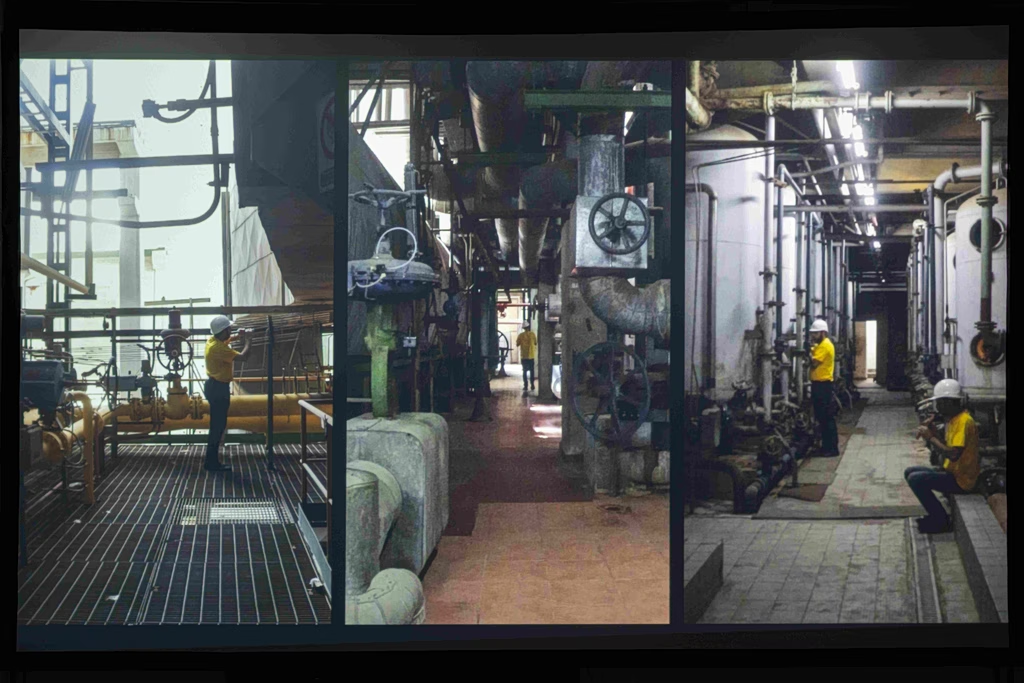
Fifth Prize: “Auratus Sanguinarius” by Virginia Mastrigiannaki
A seven-member jury and more than 1,000 submissions
The five winning works were selected by a seven-member jury. Alongside Marinos, its members were:
- Katerina Gregou, artistic director of the National Museum of Contemporary Art (EMST) in Athens.
- Giorgos Koumendakis, composer and artistic director of the Greek National Opera.
- Maria Mavroeidi, director of Corporate Heritage and the PPC Museum.
- Elena Mavromichali, cultural strategist and cultural management consultant.
- Thouli Misirlοglou, artistic director of MOMus – Museum of Contemporary Art.
- Giorgos Tzirtzilakis, professor at the Department of Architecture of the University of Thessaly.
With more than 1,000 works submitted under the competition’s thematic framework, the selection process presented a considerable challenge. We spoke to Marinos about the balance between the competition’s requirements and artistic freedom, the opportunities it creates for emerging artists and the decisions behind the final exhibition.
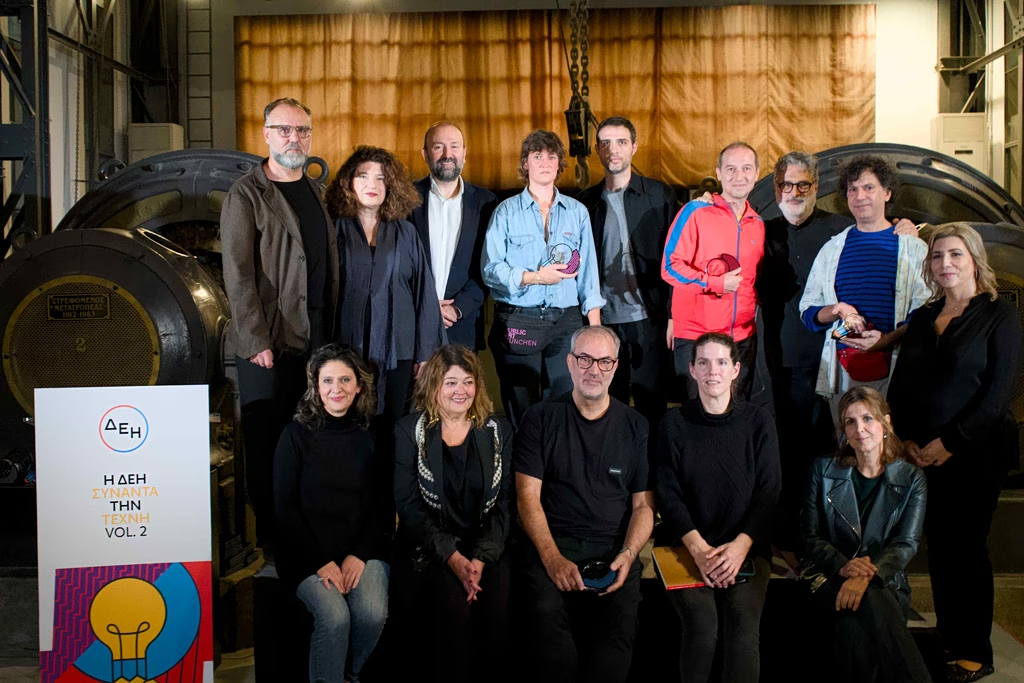
Bottom row, from right to left: Elena Mavromichali, Cultural Strategist and Cultural Management Consultant; Virginia Mastrigiannaki; Dionysis Christofilogiannis; Sofia Parissi, from DEI’s Commercial Placement Department; and Thouli Misirlόγlou, Artistic Director of MOMUS – Museum of Contemporary Art. Top row, from right to left: Sofia Dimtsa, General Director of Corporate Affairs and Communications at PPC Group; VASKOS (Vasilis Noulas & Kostas Tzimoulis); Giorgos Koumentakis, composer and Artistic Director of the Greek National Opera (GNO); Orestis Mavroudis; Sofia Ntóna; Giorgos Karakousis, Deputy CEO and Head of Commercial Activities at PPC Group; Sofia Mavroeidi, Head of the Corporate Heritage and DEI Museum Department; and Christoforos Marinos, art historian and curator of the exhibition.
How did you, as a jury, balance the terms of the open call with the artistic independence of the participants?
The open call’s thematic framework allowed considerable artistic freedom. Artists could even submit existing works that had not been created specifically for the exhibition, provided they had a direct connection to light and energy.
There was no prescribed aesthetic direction or specific requirement regarding how artists should approach the subject. On our part, we sought to encourage pluralism, both in terms of content and artistic expression, encompassing painting, sculpture, installations, video and works with interactive or participatory elements.
The response was indeed impressive. This made the jury’s task even more difficult, because evaluating 300 or 500 proposals is one thing; evaluating 1,000 is quite another.
We assessed every submission using the same criteria and with the same degree of respect, scoring them individually.
Interestingly, when we were subsequently asked to evaluate the 55 selected works again, this time installed in the historic facilities of the Faliro Steam Power Station, we noticed significant differences compared with our initial assessments.
And that is perfectly understandable. Looking at a work on a screen is one thing; experiencing it in person is quite another.
Can an open competition offer a more democratic way of bringing art to public attention, particularly for artists outside the established art world?
The works included in the exhibition confirm that initiatives of this kind can indeed help bring emerging artists into the spotlight.
One example is a painting by Nikos Georgakopoulos, who is still a student at the Athens School of Fine Arts. Marileni Vourtsi is also taking part in a group exhibition in Greece for the first time. Until now, her exhibition experience had been limited to Switzerland, where she studied.
We are giving these young artists a genuine boost by placing them alongside established names such as Alexandros Psychoulis and Eleni Zouni.
And we have not simply given artists greater visibility. We have also created an opportunity for people from other professional fields to participate in an art exhibition for the first time.
I am referring to Georgia Tzazi and Maria Danilatou, who come from architecture and lighting design, respectively.
Finally, it is worth remembering that 20 of the participating artists were born after 1990.
How 55 works emerged from more than 1,000 proposals
What were the main criteria behind your selection, and how did you shape the final exhibition?
The main criteria were the quality and originality of each work, as well as its relevance to the exhibition’s themes: electricity, energy and DEI’s industrial heritage.
After all the proposals had been assessed, I had to decide, as the exhibition’s curator, how many works I could actually include.
And I say “could” deliberately, because one essential prerequisite was to have a thorough understanding of the spatial possibilities of the Faliro Steam Power Station. How many works could the venue accommodate? I needed to answer that question beforehand.
Moreover, given the high standard of the submissions, it would have been unfair to include only 40 works, as I had initially planned.
But the difference is not simply a matter of numbers. The real challenge is to curate the works successfully and establish a balance between the artworks themselves and the space in which they are presented.
It was undoubtedly a major challenge for me.
Does being both a juror and curator create a conflict of interest?
Marinos occupied two roles in the project: he was both a member of the jury assessing the submissions and the curator responsible for selecting and arranging the final exhibition.
We asked him whether this dual responsibility influenced his approach and whether it created a potential conflict of interest.
How did these two roles affect your decisions? Was there any conflict between them?
I would argue the opposite. Not only is there no conflict, but I consider it essential that the person who will curate the exhibition also participates in evaluating the proposals and, ultimately, selecting the works to be displayed.
In any case, the jury members, who independently scored the submissions, collectively shaped the first stage of the curatorial process. By identifying and recommending the most compelling entries according to their own aesthetic criteria, they were already helping determine the exhibition’s direction.
I should also point out that it was my idea to include people with curatorial experience on the jury.
We should not forget that an exhibition bears the identity of the person who signs off on its curation. There is no doubt that this exhibition would have been entirely different if someone else had curated it, even if exactly the same artists had been included, regardless of whether that person had been a member of the jury.
I am pleased, on the one hand, that the evaluation process introduced me to the work of artists I had not previously been familiar with and, on the other, that it gave me the opportunity to collaborate with so many talented young people for the first time.
In fact, I had never worked with half of the participating artists before. For a curator who wants to keep developing, that is the greatest benefit of all.
An industrial landmark becomes a contemporary art space
By bringing together established artists, emerging talent and creators from disciplines beyond the traditional art world, DEI Meets Art Vol. 2 offers a fresh perspective on the relationship between art, technology and industrial heritage.
The exhibition also gives new life to the historic Faliro Steam Power Station, transforming a former industrial site into a space for artistic experimentation and dialogue.
Exhibition information
DEI Meets Art Vol. 2
Venue: Historic DEI Steam Power Station, 1 Solomou Street and Dimitriou Faleréos Street, Neo Faliro, Athens, Greece.
On view until: January 10, 2027.