
 Μake us preferred on Google
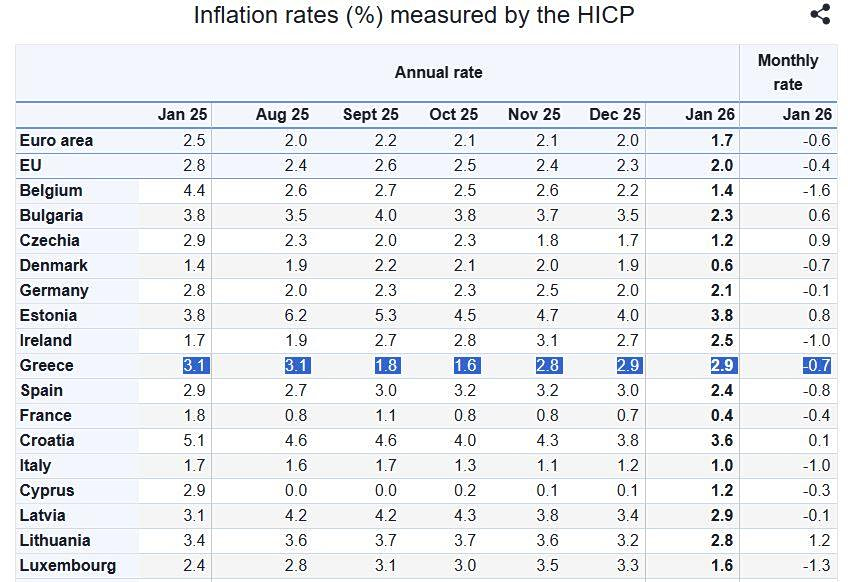
 Greece’s annual inflation rate was revised upward to 2.9% in January, according to final figures released by the European Union’s statistics agency, Eurostat.
The updated reading is slightly higher than the initial estimate of 2.8%. On a monthly basis, however, consumer prices in Greece declined by 0.7%, compared with a preliminary estimate of a 0.8% drop.
Eurozone inflation slows in January
Across the eurozone, annual inflation stood at 1.7% in January 2026, down from 2.0% in December. One year earlier, the rate was 2.5%.
In the wider European Union, annual inflation came in at 2.0% in January, compared with 2.3% the previous month. In January 2025, the rate was 2.8%.
Where inflation was lowest and highest in the EU
The lowest annual inflation rates in January were recorded in France (0.4%), Denmark (0.6%), and Finland and Italy (both 1.0%).
At the other end of the scale, Romania posted the highest annual rate at 8.5%, followed by Slovakia at 4.3% and Estonia at 3.8%.
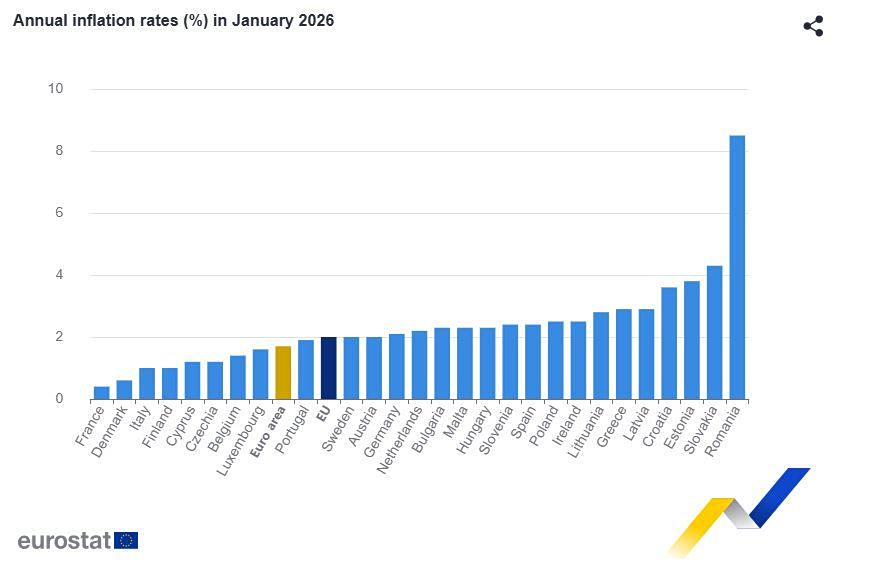
Compared with December 2025, annual inflation decreased in 23 EU member states, remained unchanged in one country and increased in three.
What is driving inflation in the euro area?
In January 2026, services made the largest contribution to annual inflation in the eurozone, adding 1.45 percentage points.
They were followed by food, alcohol and tobacco, which contributed 0.51 percentage points, and non-energy industrial goods, at 0.09 percentage points. Energy had a negative contribution of minus 0.39 percentage points, helping to offset overall price pressures.