 Μake us preferred on Google
 The system and the anti-system. Politics and anti-politics. The old and the new. Those in power and the protesters. The forces of reason and the populists. Secularists and believers, the religious and the religious zealots.
Another party, anyone? Democracy closes its doors to no one. Its doors are wide open, and it is spacious enough for everyone to find a place in the space once occupied by the so-called traditional forces — from imitation versions of social discontent to the most threatening formations, at least until they end up in prison.
All the good ones fit in — and sometimes the bad ones as well. Dozens of these parties will not even find their own vote among the ballots dropped into the box. They will end up in the sack placed behind the voting booth, destined to become paper pulp. So what? In a democracy, with a modest registration fee, a little more money for printing, and an application to the Prosecutor of the Supreme Civil and Criminal Court, anyone can have their moment. Freely, provided they wait their turn in line. “Next, please.”
What does all this hyperactivity reveal? First of all, one might conclude that politics is not as boring as people say. It offers spectacle, and with AI capable of creating pure white doves—or anything else that any political or apolitical mind can imagine—in a matter of seconds, it promises new thrills.
A second conclusion is that politics has soothing properties. It can be swallowed like a cure-all pill simply because it allows you to belong to a social subgroup and express your feelings, instead of wandering around alone with a placard hanging from your neck shouting at passersby that the homeland is being lost or that the Apocalypse is coming. For the lucky few who make it through the ballot box, it also offers a not insignificant social status. It is a vehicle for social mobility and public recognition, because it is one thing to speak on a television panel bathed in studio lights and quite another to make your case in the neighborhood café while dice rattle and backgammon pieces clatter on the table beside you.
The political environment, however, is not useful only for psychosocial observations. One notices, for example, that alongside the classic dividing line of the postwar world — “Left versus Right” — new fault lines have emerged. Either because, in a more macabre sense, the death of ideologies was proclaimed, or because, in a more Darwinian sense, ideologies evolved out of sync with the evolution of society.
In other words, the Left may have borrowed elements from the Right, and the Right from the Left, in order to broaden their appeal. Yet this broadening was also a convergence toward the Center. The Left became more economically liberal, while the Right became more socially social-democratic. Upon this shared inclination toward ideological moderation were built the rule of law and the welfare state.
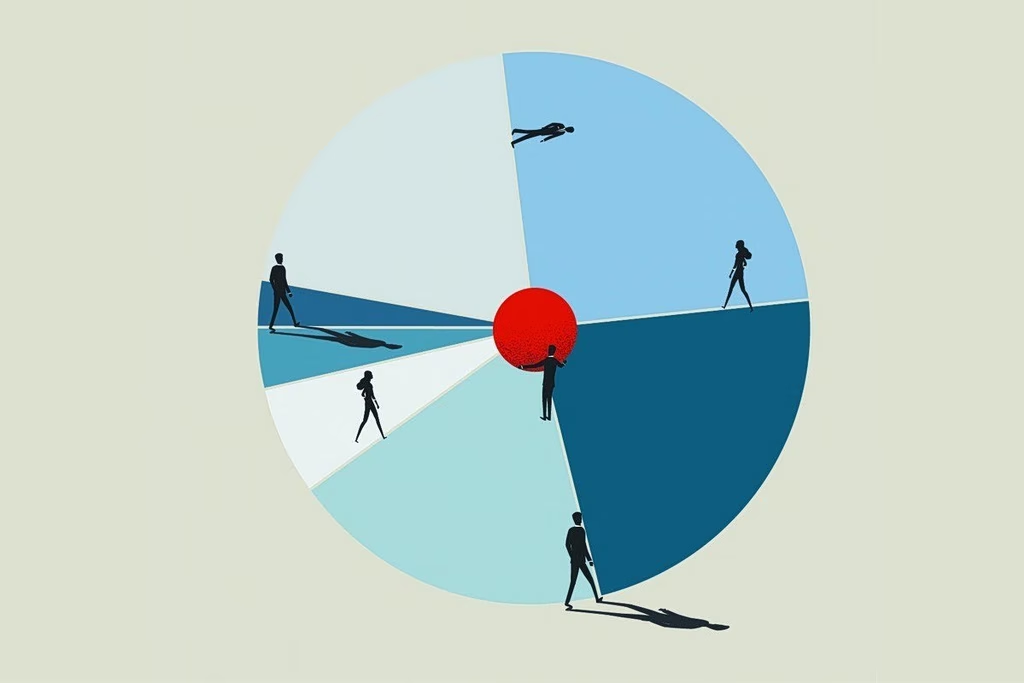
The problem is that, unlike democracy, which is inclusive even at the risk of undermining itself, the Center and its surrounding space cannot accommodate everyone. Large social groups have been left out—or feel excluded—economically or even ideologically, facing a common enemy defined as “the system.” The radical Left and the ultra-conservative Right, as anti-system forces, therefore function like communicating vessels. Their audience moves from one vessel to the other, and when it finds expression in a single figure, it can consolidate into a cohesive electoral force.
This is happening in Germany with the AfD and in France with the National Rally. It has not yet happened in Greece, where anti-system forces remain fragmented. But while all “the good ones who fit” provide spectacle with all its soothing qualities, the more traditional forces carry the burden of preserving a rule of law that is not à la carte and a welfare state capable of making room for more people.
Another one for the Center?