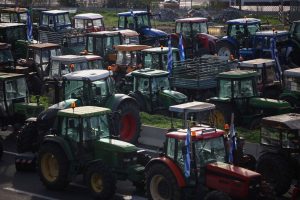
For weeks, Greek farmers have been blocking roads, surrounding public buildings, and forcing a conversation that Athens has long postponed. Their message is not complicated: the pressures weighing on Greece’s agricultural sector have become unsustainable. Rising production costs, volatile prices, climate shocks, and uneven competition within the EU are familiar problems. What feels new is the depth of frustration—and distrust—now shaping the relationship between rural Greece and the state.
The recent scandal involving OPEKEPE, the authority responsible for agricultural payments and oversight, has further eroded confidence. For many farmers, it reinforced a belief that the institutions meant to support them are either incapable of doing so or fundamentally disconnected from realities on the ground. The result is not just protest, but a growing sense that there is no credible long-term plan for agriculture’s future.
This matters because Greek agriculture, though shrinking and ageing, remains economically significant, socially foundational, and culturally central. Entire regions depend on it. Farmers are not simply asking for emergency relief; they are asking whether the state has a vision that extends beyond crisis management.
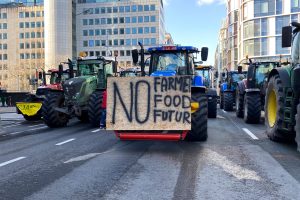
In this, Greece is not unique. Across Europe, agriculture is under strain. Farmers face global competition, tightening environmental rules, climate volatility, and rising input costs, often while being told to do more with less. Recent protests in France—where tractors once again filled the streets of Paris—highlight how fragile even heavily subsidized agricultural systems have become. Belgium and other EU countries have seen similar unrest. These demonstrations are not a rejection of reform as such; they are a response to reforms that feel unbalanced, top-down, and detached from lived experience.

French farmers block the A61 motorway with tractors and straw bales to protest against government measures, including the culling of entire cattle herds, aimed at containing an outbreak of lumpy skin disease among livestock in France, and the EU-Mercosur free trade agreement, in Villefranche-de-Lauragais, in the Haute-Garonne department, France, December 16, 2025. REUTERS/Benoit Tessier
At the same time, European governments are embracing the language of innovation. Artificial intelligence, digital transformation, and technological sovereignty now dominate national strategies and funding plans. AI is framed as a driver of productivity, competitiveness, and resilience. Yet agriculture—the sector arguably most exposed to climate risk and market volatility—often sits at the margins of these visions. Innovation is discussed around farmers, not with them.
This is precisely where AI could matter most.
The current standoff between Greek farmers and the state is often portrayed as a clash between tradition and modernity, or between rural communities and a technocratic center. But the deeper issue is strategic incoherence. Greece has yet to articulate how advanced technologies such as AI translate into resilience for the parts of the economy that need it most.

A farmer holds a Greek flag, while protesting at the entrance to the city’s port, over delays in payments of European Union subsidies, in Thessaloniki, Greece, December 12, 2025. REUTERS/Alexandros Avramidis
Across Europe, countries are moving quickly. France is investing in sovereign compute and large-scale AI infrastructure. Spain has built applied AI hubs linked to specific sectors, including agriculture. Estonia continues to automate public services at scale. Greece, by contrast, has pursued digitalization in fragments—important steps, but without a clear sense of how AI fits into a broader economic transformation.
Greece is not lacking in ambition. The Greece 2.0 recovery and resilience plan puts digital transformation at the heart of national renewal, emphasizing public administration reform, digital services, and infrastructure upgrades. These investments are important, but digitalization that ignores a country’s strengths and fails to support the sectors that need it most is ultimately ineffective. When it comes to governing, deploying, and embedding artificial intelligence into the real economy, Greece remains tentative and unclear. The government can—and should—do better.
Nowhere is this gap more evident than in agriculture.
AI is not a cure-all, nor a substitute for fair prices, predictable policy, or institutional trust. But it is a powerful set of tools—already being used elsewhere—to reduce costs, manage risk, and improve competitiveness. Precision agriculture, predictive analytics, AI-supported irrigation and fertilizations, disease detection, and yield forecasting are no longer experimental technologies. In many countries, they are becoming standard practice.
The risk for Greece is not technological failure, but strategic misalignment. Farmers increasingly see digital tools as burdens rather than enablers: new compliance obligations, new reporting requirements, new costs. Without trust—already weakened by governance failures—no technological transition will succeed.
Against this backdrop, protests are not simply about subsidies or compensation. They are a demand for direction. Greece has long lacked a coherent plan for rural modernization, leaving agriculture suspended between nostalgia and necessity—expected to preserve tradition while competing in a highly technologized market.
This is where AI, used properly, can make a difference.
Across Europe, artificial intelligence is already reshaping farming. Satellite imagery and machine-learning models guide irrigation and fertilizations. Predictive systems identify pest outbreaks and disease risks earlier. Automation and robotics help address labor shortages. Countries such as the Netherlands and Denmark have improved yields while reducing environmental impact. Spain has created dedicated AI-for-agriculture accelerators, and Italy is investing in digital traceability to support small producers.
Greece, by contrast, remains an early adopter. Farms are small and fragmented. Digital skills vary widely. Rural connectivity is uneven. Most importantly, there is no coordinated national effort to bring AI out of research centers and pilot projects and into everyday agricultural practice.
Yet the potential is significant. Greece’s diverse terrain, climate, and crop portfolio—from olive groves and vineyards to citrus orchards and livestock—are well suited to AI-supported optimization. Even relatively simple tools, such as soil diagnostics, water sensors, and yield forecasting, could reduce costs and increase resilience. In the context of climate change, better forecasting and resource management are not luxuries; they are essential.
Still, technology alone will not bridge the gap. The greatest risk is treating AI as another top-down mandate. That approach would guarantee resistance.
What is needed instead is collaboration. An effective AI strategy for agriculture must be built with farmers, not imposed on them. This means creating regional demonstration farms where tools can be tested in real conditions; subsidizing AI-enabled equipment just as previous generations subsidized machinery; supporting farmer-led data cooperatives that lower costs and preserve data sovereignty; investing in permanent rural innovation hubs rather than one-off training sessions; and ensuring tools are designed for Greece’s agricultural reality, not generic industrial models.
Farmers are pragmatic. They will adopt technologies that work, that save time and money, and that respect their knowledge. But they need support, clarity, and trust.
Greece has secured substantial funding through the EU Recovery and Resilience Facility. Much of it rightly targets public-sector efficiency and infrastructure. But a genuine AI strategy must go further. It must integrate artificial intelligence across the economy—and agriculture should be a priority, not an afterthought.
This would require clear programs, partnerships with universities and cooperatives, ethical national datasets tailored to Greek conditions, regulatory clarity under EU rules, and serious investment in rural connectivity. An AI strategy is not a policy document; it is an ecosystem.
The farmers protesting today represent a sector in crisis, but also one capable of renewal. Their demands point to a simple truth: people want fairness, stability, and a future they can believe in. AI, used carefully and inclusively, can contribute to that future.
Greece has a rare opportunity to align its digital ambitions with its traditional strengths. Walking the walk on AI means starting where the need is greatest—not in abstract strategy papers, but in the fields, groves, and farms that have sustained the country for generations.
Konstantinos Komaitis is PhD. Resident Senior fellow, Global Governance Lead, Democracy & Tech initiative, Atlantic Council Non-resident fellow, senior researcher, the Lisbon Council