 Μake us preferred on Google
 Italy announced on Friday that it is suspending the Schengen agreement with Spain, in response to the mass arrival of migrants at Spain’s Ceuta enclave from neighboring Morocco.
Italy shares no land border with Spain, but the measure will affect anyone traveling between the two countries by air or sea. Italian Interior Minister Matteo Piantedosi said the decision followed a review of the latest intelligence, discussed that morning at an emergency meeting of Italy’s Migration and Border Security Analysis Committee, which he chaired.
Piantedosi also spoke by phone with his French counterpart, Laurent Nuñez, and the two agreed it made sense to step up checks along the French-Italian land border, under existing police cooperation agreements between the two countries.
Death toll rises to 57 as thousands return to Morocco
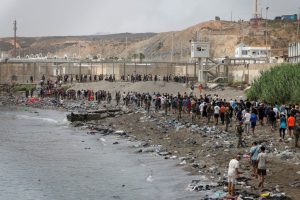
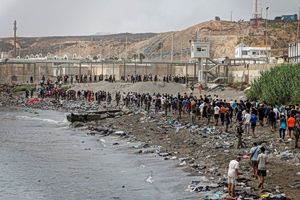
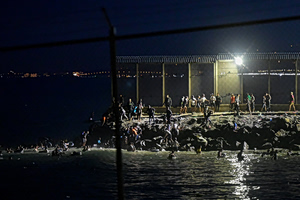
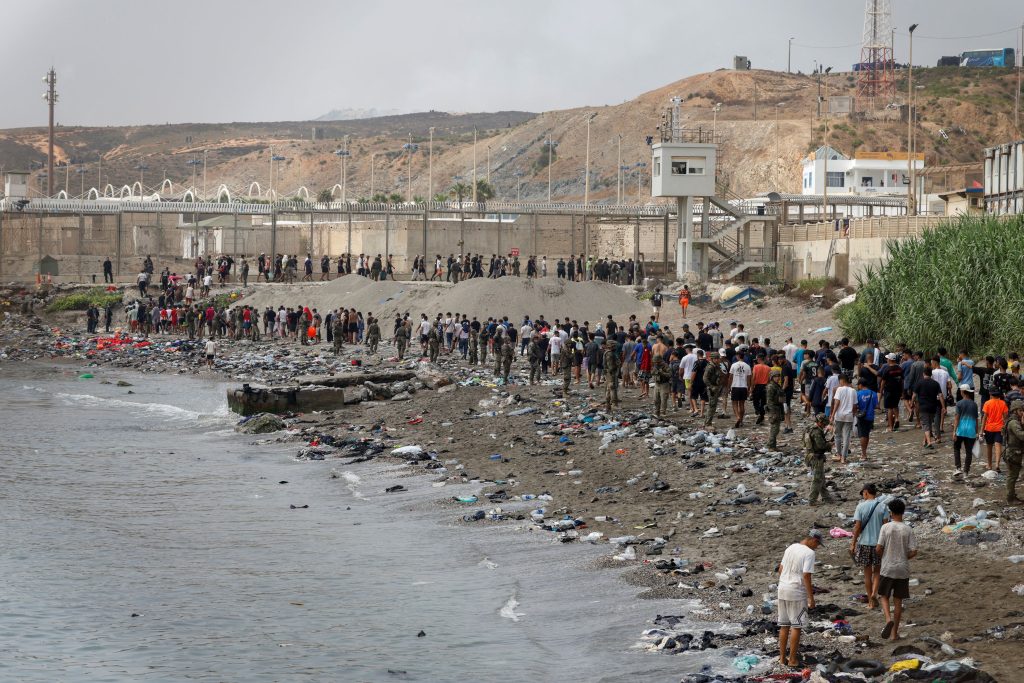
Fifty-seven people have died trying to reach Ceuta, a spokesperson for the Spanish government in the enclave announced. Spanish authorities have recovered 57 bodies so far, and more victims may still be found on the Moroccan side. Some of the dead drowned, while others were trampled trying to climb the breakwater that supports the border fence.
According to Reuters, Moroccan security forces pushed the crowd back from Ceuta’s gates using batons, tear gas, and water cannon. Reuters journalists said they saw a burned bus and seven vehicles damaged in clashes with the crowd.
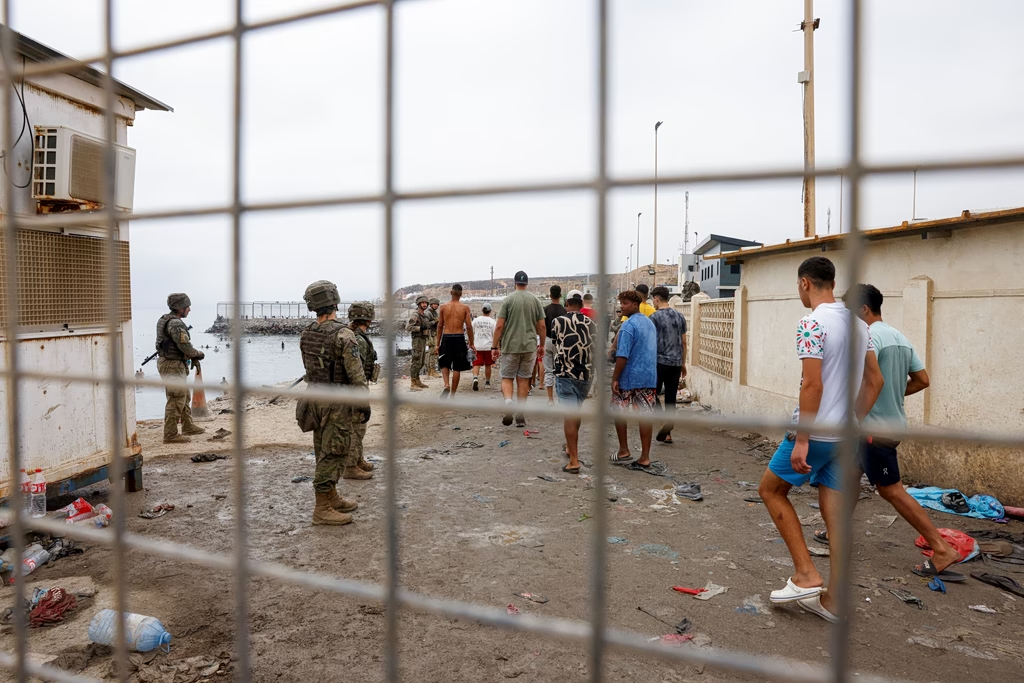
On the other side of the border, Spanish military vehicles were deployed along the frontier, while dozens of would-be migrants watched from a hillside, unable to cross into Ceuta. Several hundred people returned to Morocco, either through official border posts or through gaps in the fence, with some saying they could not find food or shelter in Ceuta. One young man who said he was from Tangier put it simply: he didn’t know why he had come, and now he was going back, and hadn’t eaten since the previous afternoon despite having money with him.
Spain responds and pushes back
Prime Minister Pedro Sánchez traveled to Ceuta on Friday and described the mass entry as an attack and a violation of Spain’s territorial integrity. He said that, working with Morocco, authorities are speeding up the return of those who crossed into the enclave illegally.
Responding to the wider criticism from Italy and other countries, Sánchez posted on X that solidarity and empathy are optional, but respect for European treaties and data is not, and that this was not the time for division. He cited Frontex figures on irregular entries into the EU between 2021 and 2026: 478,600 people through Italy, 340,600 through the Western Balkans, 259,800 through Greece, and 234,760 through Spain, a pointed reminder that Italy has taken in far more irregular arrivals over that period than Spain has.
In a post on X, the Spanish police union AUGC said that on Thursday only a small number of officers were guarding the fence, leaving them unable to stop the crowd. Spain’s Minister of Territorial Policy, Ángel Víctor Torres, said one factor behind the mass arrival may have been a ruling issued this month by Spain’s Supreme Court, which bars authorities from summarily turning away migrants intercepted at sea while trying to reach Ceuta or Melilla. Experts note, however, that the ruling does not prevent their eventual deportation.
Finland, Sweden, and Denmark back Italy
Finland’s Interior Minister, Mari Rantanen, publicly backed Italy’s push to exclude Spain from Schengen, writing on X that Spain had completely failed to protect the Schengen area’s external border and describing what happened as a “migration invasion.” She said any country failing to meet its border-protection obligations cannot remain a Schengen member, and later announced Finland was beginning its own process to reinstate internal border checks. Sweden and Denmark have also called for Spain’s exclusion from Schengen.
European Commissioner for Internal Affairs and Migration, Magnus Brunner, denied that anyone was moving from Ceuta into mainland Europe, while still calling the situation in the enclave “unacceptable.” He noted that the Schengen Borders Code sets special rules for Spain’s autonomous cities, requiring identity and passport checks for anyone in Ceuta or Melilla who wants to travel to mainland Spain or the rest of Europe.
On the Moroccan side, thousands of aspiring migrants gathered overnight in the town of Fnideq despite tightened security, with some searching the coastline for alternative ways around the fence. “I was late,” said 32-year-old Brahim from Tangier, who had hoped to cross into Ceuta but found the gate closed. Among those gathered were women and children, not only from Morocco but from countries across sub-Saharan Africa.