 Μake us preferred on Google
 The Eastern Mediterranean became impossible to ignore in early 2026. The coordinated U.S. and Israeli strikes against Iran, Tehran’s missile and drone retaliation, and the disruption of vital shipping routes all pointed to the same conclusion: this is no longer a secondary theater. It is a region where American military power, energy interests, global commerce, and competition with strategic rivals increasingly converge. Conflict is not inevitable, but leaving the eastern basin without resilient surveillance, air defense, and logistics would be a serious strategic gamble.
Washington’s attention remains fixed on Taiwan. Yet the waters between Crete and the Levant demand strategic attention in their own right. Russian warships, Chinese intelligence vessels, Western fleets, commercial shipping, and critical infrastructure operate in the same crowded maritime space every day. The danger is not that a clash here is inevitable, but that close proximity, uncertain intent, and short decision times leave little room for error.
The Eastern Mediterranean should therefore be treated as a strategic theater in its own right, not merely as the flank of another priority.
The 2026 crisis also tested what allied access means when pressure is real. Several NATO members limited the use of their facilities or adopted narrowly defensive positions. Greece did not step back. Athens kept its facilities available, moved naval and air assets forward, and supported regional security at a moment of acute uncertainty. Washington should recognize what that demonstrated: Greece can provide dependable, politically sustainable access when other options are elusive.
That reliability matters all the more because Greece’s value to the United States now extends well beyond defense.
American LNG entering through Greek terminals can move north through the Vertical Corridor toward Bulgaria, Romania, Moldova, Ukraine, and other markets historically dependent on Russian supply. For Washington, this is not simply a European energy-diversification project. It creates markets for American energy, reduces the leverage of a strategic competitor, and strengthens countries whose security is closely tied to U.S. interests. The U.S. Department of Commerce describes Greece as an increasingly critical entry point for American LNG and the Vertical Corridor as a commercially viable route into markets previously dependent on Russian pipeline gas.
The significance goes beyond LNG. Greece is becoming a place where American military access, energy exports, commercial interests, and regional influence intersect. As Greece grows more important to each, the security of the surrounding maritime space matters more to Washington as well.
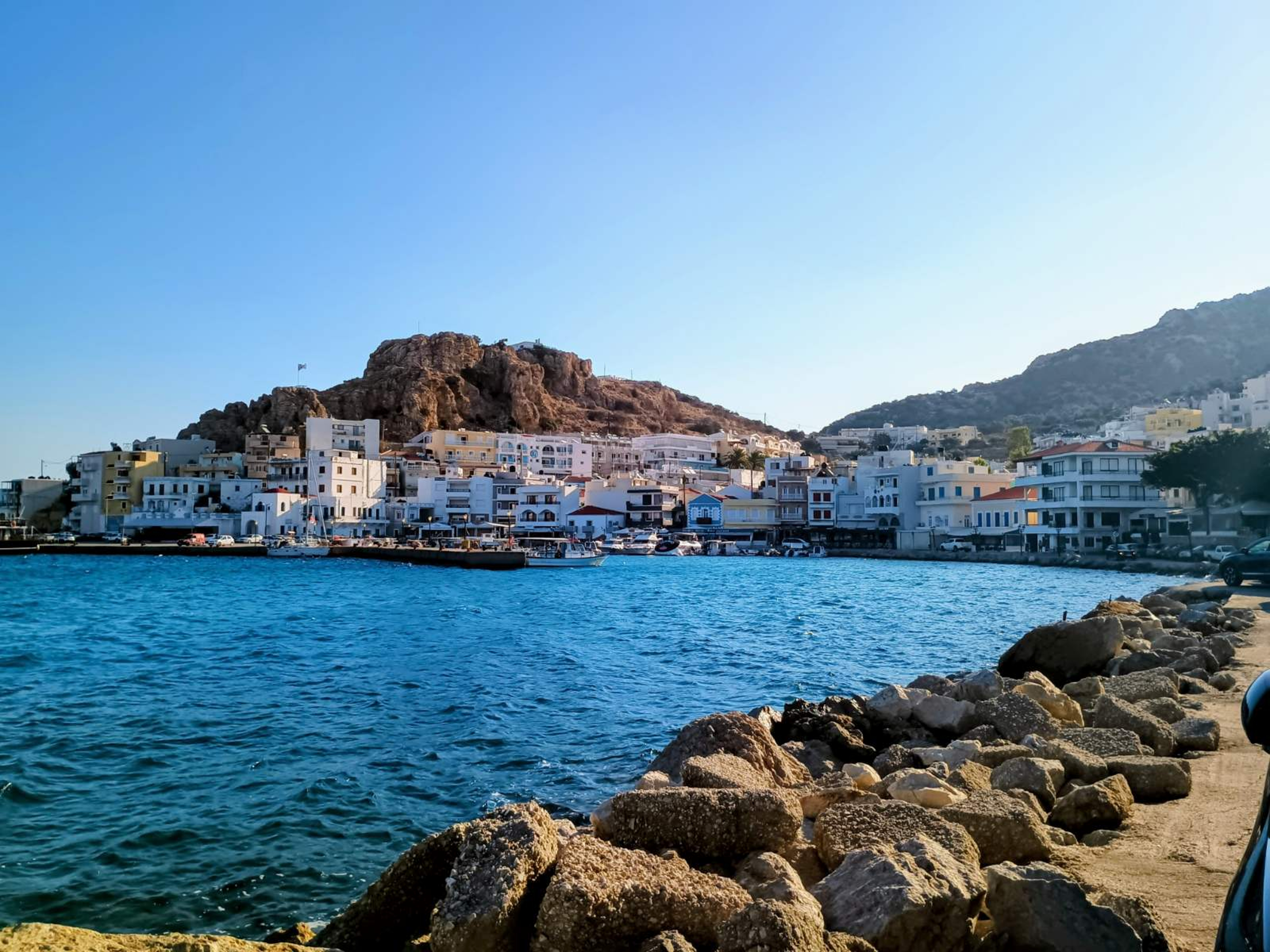
Karpathos lies at the heart of this geography.
Positioned between Crete and Rhodes, facing toward the Levant and close to the approaches to Suez, the island sits near sea lanes through which commerce, energy, and military power move. Karpathos does not need to sit physically on the Vertical Corridor to matter to the same strategic equation. It occupies the maritime space surrounding a Greece that is becoming steadily more important to American power and commerce.
Recent conflicts have meanwhile exposed the danger of concentrating forces, logistics, and command functions at a small number of major bases. In Ukraine, precision strikes have repeatedly targeted fixed logistics hubs. In the Red Sea, low-cost drones and anti-ship missiles have disrupted global commerce while forcing expensive defensive responses. The lesson is not that major bases have lost their value. It is that they should be complemented by a wider network of mutually supporting locations.
Karpathos should be one of them.
NATO’s 2025 Alliance Maritime Strategy calls for greater readiness and situational awareness, protection of vital sea lines and critical infrastructure, the integration of emerging technologies, and more resilient logistics. Karpathos offers a practical way to advance precisely those priorities in the eastern basin.
Its geography is unusually favorable. Aircraft and sensors operating from the island could improve awareness of activity stretching toward Cyprus, the Levant, Egypt, Libya, and southern Turkey. And because Karpathos lies within the territory of a reliable NATO ally, it offers strategic reach without another layer of dependence on third-country access.
Karpathos should be judged by four simple questions: Does it improve warning and maritime awareness? Does it reduce dependence on a handful of major bases? Can it be activated quickly without overwhelming civilian life? And is the strategic return worth the political and financial cost?
On all four counts, Karpathos makes the case for itself. Its geography is not theoretical, its infrastructure is not imaginary, and its strategic value should no longer be overlooked.
That infrastructure is more substantial than many outside the island may realize.
Karpathos Airport is already jointly used by civilian aviation and the Hellenic Air Force. In 2025, the Hellenic Civil Aviation Authority completed its EASA certification and specifically noted its cooperation with the Hellenic Air Force because of that joint use. The certification confirmed compliance with applicable European requirements governing infrastructure, operations, and organizational structure. Military use of the airfield, in other words, is not a hypothetical conversion of an ordinary civilian airport. It already exists.
An expanded allied role would require additional capacity and planning—fuel, aircraft dispersal, secure communications, maintenance, force protection, and accommodation of civilian traffic among them. But Washington and Athens would be building on an existing civil-military platform, not starting with an empty field.
The island also has supporting civilian infrastructure. The General Hospital of Karpathos provides emergency care, diagnostics, dialysis, and approximately 30 beds. It would not replace military medical support or aeromedical evacuation, but it strengthens the island’s ability to sustain a larger operational presence.
Then there is the human factor.
Karpathos has unusually deep ties to the United States through its large and active diaspora. Generations of Karpathians have built lives in America while maintaining close connections to the island. Those ties cannot substitute for consultation with the local community, but they provide something defense planners should not discount: an existing foundation of familiarity and goodwill.
The next step should be straightforward. Greece and the United States should jointly assess Karpathos and move quickly from study to practical testing through bilateral or NATO exercises. Maritime-awareness sensors, unmanned systems, ISR aircraft, air-defense capabilities, and secure communications could all be evaluated under real operating conditions.
The initial presence need not determine Karpathos’s ultimate role. Begin with exercises and rotational deployments; if the island proves its value, allow the relationship to grow with it. What matters now is not prescribing the endpoint but beginning the process.
There is already a natural framework for doing so.
The U.S.–Greece Mutual Defense Cooperation Agreement has underpinned bilateral defense cooperation for decades, allowing U.S. forces to train and operate on Greek territory and evolving as the strategic relationship has deepened. The State Department has described the MDCA as the “bedrock” of U.S.–Greek defense cooperation. The MDCA is precisely the kind of established framework through which Athens and Washington can study the island, conduct joint assessments and exercises, and determine what form of access or presence makes sense as the concept develops.
This combination is what makes Karpathos unique: an existing military-capable airfield on NATO territory, access to the eastern basin, proximity to major shipping and energy routes, supporting civilian infrastructure, and unusually deep ties to the United States. Few locations offer so many advantages at once.
Karpathos is not a substitute for Souda Bay. It fills a different gap—farther east, closer to the point where the Aegean, the Levant, Suez, regional energy infrastructure, global commerce, and American security interests meet.
The course from here does not need to be complicated.
Start.
Study the island seriously. Exercise there. Deploy useful capabilities. Test what works. Build what is needed. And if experience confirms what geography already suggests, expand accordingly.
Karpathos has sat between Crete and Rhodes while the strategic importance of the waters around it have steadily increased. It should no longer be viewed merely as an island between two better-known points on the map.
Karpathos may be the critical missing link in America’s Eastern Mediterranean strategy. Now is the time to turn that strategic promise into policy.
About the Author
Georgios F. Comninos, Esq. is an attorney, businessman, and philanthropist based in the Washington, D.C. area. He holds a degree in Political Science and History from McGill University and currently serves as counsel at the U.S. Department of Veterans Affairs. He began his legal career as a trial attorney and has since advised major nonprofit organizations and corporations on legal, governance, and institutional matters. He also maintains business interests in the private sector and supports a range of philanthropic causes. The views expressed are his own.