 Μake us preferred on Google
 Seventy-six years ago, on the 9th of May 1950, Robert Schuman stood before an audience in Paris and proposed something that, at the time, must have seemed almost naively optimistic: that the nations of Europe, still scarred by the most destructive war in human history, should bind their coal and steel production together under a common supranational authority. The logic was disarmingly simple; countries that share their industrial foundations cannot easily go to war with one another. From that speech, drafted in part by Jean Monnet and delivered in the ornate Salon de l’Horloge of the French Foreign Ministry, grew what we now call the European Union.
This Europe Day, as EU institutions mark the anniversary across all twenty-seven member-states, it is worth pausing not merely to celebrate that founding moment, but to interrogate what it continues to demand of us. Schuman’s declaration was not a commemorative gesture; it was a policy proposal embedded in a particular geopolitical emergency. The question we ought to be asking, seventy-six years on, is whether we understand our own moment with the same clarity.
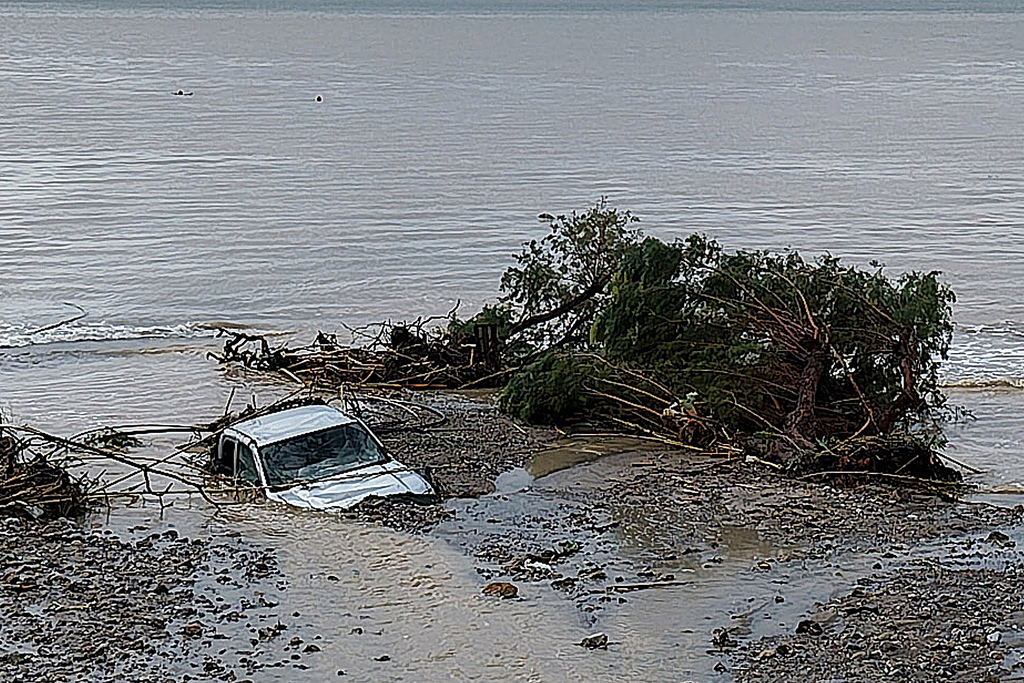
The words Schuman chose remain remarkably current: “World peace cannot be safeguarded without creative efforts proportionate to the dangers which threaten it.” The emphasis on proportionality is instructive. In recent years, the European Union has been called upon to respond to a sequence of overlapping crises: the COVID-19 pandemic, accelerating climate change, the regulatory challenges posed by artificial intelligence, the systematic spread of disinformation, the return of war to the European continent, and the energy security vulnerabilities exposed by Russia’s invasion of Ukraine. Each of these has tested the Union’s capacity for collective action, and each has revealed, in different ways, the tension between integration and fragmentation that has always defined the European project.
It is in this context that Europe Day must serve a purpose beyond ceremony. It cannot be reduced to a calendar occasion for institutional self-congratulation. For our generation, the first to have grown up entirely within the European Union, it needs to function as a moment of genuine political reflection.
Those of us who came of age in Greece have a particular vantage point on this. The European Union is not an abstraction for us. It is present in the roads we drive on, the universities we attended, the metro lines we use to get to work, the Erasmus+ programmes that sent many of us abroad for the first time and fundamentally altered the way we understand our own continent. EU structural funds have shaped the physical and institutional landscape of this country in ways that are often invisible precisely because they have become ordinary. That ordinariness is, in its own way, an achievement.
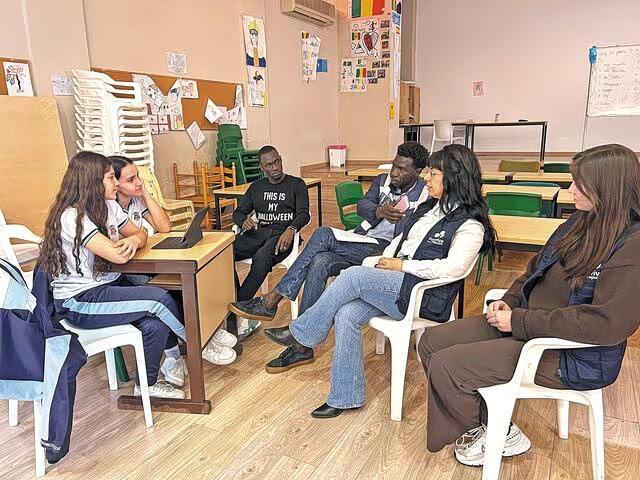
And yet, during school visits and public discussions I have participated in, a recurring sentiment surfaces with notable consistency: “Brussels is far away, and they don’t hear us.” It is a feeling worth taking seriously, not because it is accurate, but precisely because it persists despite being increasingly less so. The European Union has, in recent years, made a conscious and tangible effort to close that gap. The Youth Talks initiative, through which young people from different member-states meet directly with Commissioners to share their perspectives on EU policies and their hopes for the future, is one such step. The expanded mandate of Europe Direct centres, which now serve not only as information hubs but as direct channels for transmitting citizen feedback from every corner of the Union back to Brussels, is another. These are not cosmetic gestures. They reflect an institutional recognition that legitimacy must be continuously earned through proximity and dialogue, and that the Union is strongest when its citizens feel genuinely heard within it.
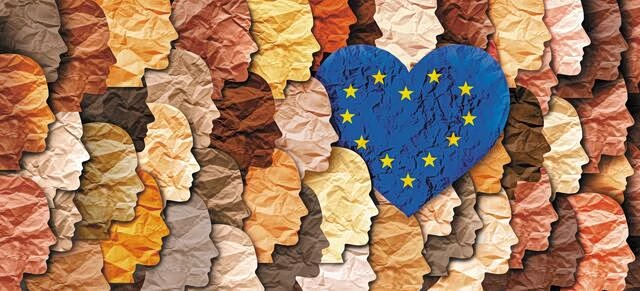
What Europe Day should remind us, above all, is that the values underpinning the Union are not self-sustaining. Article 2 of the Treaty on European Union enumerates them with quiet precision: respect for human dignity, freedom, democracy, equality, the rule of law, and human rights, including the rights of minorities, alongside pluralism, tolerance, non-discrimination, justice, solidarity, and equality between women and men. These principles are not merely aspirational language embedded in a founding document. They represent commitments that require active defence, particularly at a moment when democratic backsliding within the Union’s own borders has demonstrated that membership does not guarantee fidelity to shared values. This is not merely an abstract concern. It is being tested in real time. For years, Hungary served as the Union’s most visible cautionary tale, a member-state where a supermajority was used, methodically, to hollow out judicial independence, restrict minority rights, and realign the country’s foreign policy towards Moscow. But on the 12th of April, just weeks before this Europe Day, Hungarian voters delivered a result that stunned the continent. Péter Magyar’s pro-European Tisza party won in numbers that will definitively be classified as historically significant, fuelled largely by widespread outrage over entrenched government corruption. European Commission President Ursula von der Leyen captured the moment simply: “Hungary has chosen Europe.” It is a reminder that democratic backsliding is not irreversible, and that civil society, when it organises itself, retains the capacity to reclaim the institutions that represent it. That, too, is a European value worth marking on the 9th of May.
This is where the responsibility of our generation becomes concrete. We were not present at the founding of this project. We did not live through the wars that made Schuman’s proposal feel urgent and necessary. What we have inherited is both the achievement and the obligation; an integrated continent that we did not build, and that we are now charged with sustaining and improving. That means engaging with European institutions rather than retreating from them. It means voting in European Parliament elections, attending public consultations, and making use of the channels that now exist specifically to carry our voices to Brussels. It means understanding that the distance we sometimes feel is not a wall, it is a gap that closes every time we choose to show up.
Seventy-six years after Schuman spoke, the creative effort he called for is still required. The dangers have changed in form, but not in scale. We are closer to the European Union than we oftentimes think, it is present in our roads, our universities, our daily commutes. And increasingly, it is also listening. The question is whether we are willing to meet that openness with equal seriousness, or whether we will allow a perceived distance to become an excuse for disengagement.
Europe is not a given. It is a choice we have to keep making.
*Evelyn (Evangelia) Georgiou is Events and Communications Manager, Europe Direct ELIAMEP Attikis.