“I’m going to Methana. That’s it,” a good friend tells me shortly after giving me a detailed inventory of his suitcase ahead of his August vacation — 15 T-shirts, three pairs of Bermuda shorts, five tank tops. “Like hell I’m going to Italida,” he laughs sardonically. “Do you think I’m stupid?”
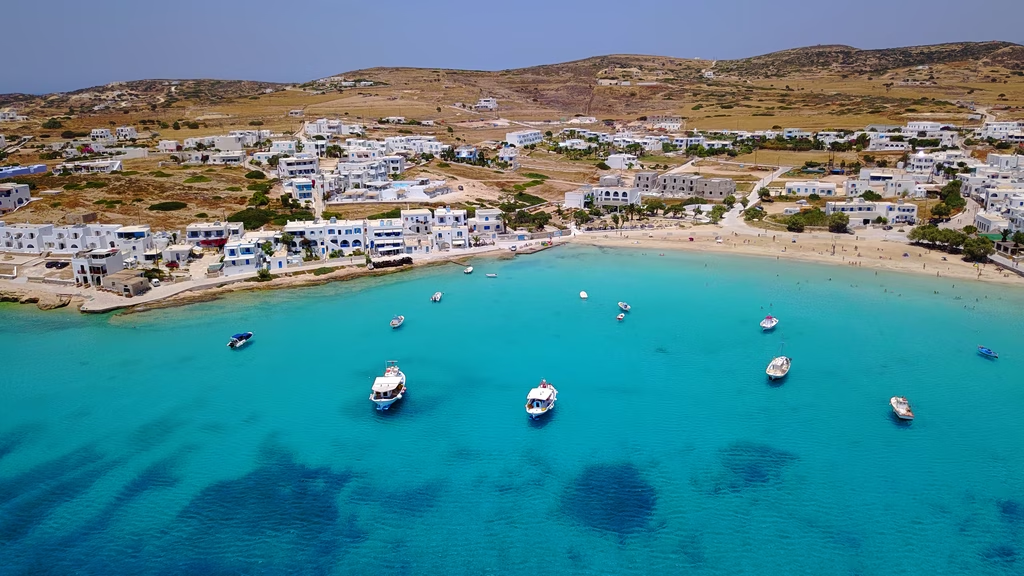
This year, Italida Beach on Koufonisia went viral for precisely the opposite reason that empty Athens once used to go viral around August 15, when Greeks traditionally leave the capital en masse for the summer holiday: a video showing beachgoers packed together like sardines prompted a flood of mocking comments along the lines of “Kypseli with sand” — a reference to one of Athens’ most densely populated neighborhoods — and “I left Athens only to end up in the Syntagma Square of the Small Cyclades,” among other absurdities.
Perhaps even some of the bathers captured in the footage joined in with sarcastic comments of their own.
The truth is, this sardine-packed image of Italida looks less like a beach and more like a failed social psychology experiment. Vacationers on towels, towels beneath vacationers, legs whose owners are impossible to identify, arms jutting out like those of Kali, the Hindu goddess of destruction, known for her association with human sacrifice. The sea in the background looks more like an emergency exit than the amniotic fluid of summer rebirth.
“I got tired just looking at it,” someone wrote. So did I.
I remember setting foot on the beautiful, flat expanse of Ano Koufonisi for the first time about 20 years ago and being overwhelmed by its beauty and complete lack of pretension.
The real name of Italida beach is Platia Pounta. Its nickname came from an Italian woman who once owned a business above the shore, prompting locals to say, “Let’s go to the Italian woman’s place.” (Italida in Greek) That is how myth works: It takes an event, strips away the story, leaves behind the label, turns it into a place name and then, eventually, into a hashtag.
“Ever since the legendary campground closed, Koufonisia has turned into Mykonos,” an irritated friend told me a few years ago, flicking her bohemian braid from side to side. Little could she have imagined that Koufonisia would one day become an extension of the capital itself.
I remember setting foot on the beautiful, flat expanse of Ano Koufonisi for the first time about 20 years ago, leaving my shoulders completely exposed to burn beneath the midday sun, and being overwhelmed by its beauty and complete lack of pretension. How I sank into the precious nothingness of it all.
A decade later, the only thing that had remained the same was the Dadaist Finikas, with its Cycladic rooms and reed-covered arches at the taverna. Today, I have no idea.
Overtourism has this particular quality: It doesn’t just destroy the landscape. It destroys our personal mythology.
Because we all want to believe we discovered something. These days, that may be the most expensive lie we tell ourselves about vacations. We don’t simply want to visit somewhere beautiful. We want to be the people who found it.
So that later, sitting in a bar in Athens, we can say: “Koufonisia has changed so much. I used to go years ago.” The “years ago” part matters.
At the same time, the paradox of modern tourism is that we search for authenticity by reading reviews. We want the “hidden” gem, as long as it has a 4.8-star rating. We look for the “unknown” beach, as long as someone with 800,000 followers has posted about it. We want to “get lost,” then follow Google Maps until it tells us exactly where we are supposed to lose ourselves.
There is something of The Terminator in a beach overrun by this many people, except Schwarzenegger isn’t arriving from the future to save humanity. Instead, along comes a guy carrying a latte, a phone, a power bank, a microfiber towel and a bucket hat, convinced that “he’ll find somewhere to squeeze in.”
Because that is our national sleight of hand: turning a lack of space into a social skill.
“Can you fit?”
“I can fit.”
“Where?”
“Well, we’ll see.”
“We’ll see” may be the most versatile phrase in Greek culture after ela more — the ubiquitous expression roughly meaning “come on, it’ll be fine.”
The idea that we can have a little piece of paradise all to ourselves is now about as outdated as the belief that Facebook would remain an innocent platform for reconnecting with old classmates.
And it isn’t just Italida. It is the entire modern economy of ready-made desire. First, we want something because it is beautiful. Then because it is rare. Then because everyone wants it. And finally because we can prove that we wanted it, too.
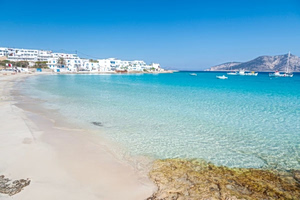
Italida was made to become famous. Golden sand, turquoise waters and the complete absence of those minor cultural infections of the modern vacation: sunbeds, DJs, reservations, QR codes, some guy explaining that the cocktail has “notes of bergamot.”
It was, in other words, a place without content.
And today, that is exactly the kind of content that sells.
Moral: Albert Camus might write The Stranger like this today: “The beach died today. Or maybe yesterday, I don’t know. They told me it had the day off.”