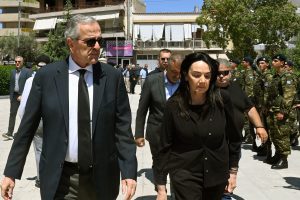
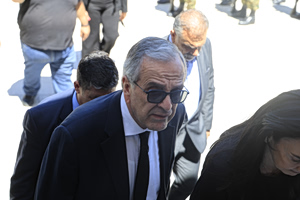
When a banker hosted a book launch in Athens recently, the seating chart became a talking point inside the ruling party. The organizers placed Antonis Samaras and Kostas Karamanlis, two former prime ministers, at a distance from each other, and government officials spent the following days parsing the arrangement for clues. That small detail fed a wave of speculation inside the ruling camp, which is wrestling with two intertwined anxieties: whether Samaras, who was expelled from New Democracy, will launch a new party, and whether it will be supported by Karamanlis as well.
Samaras, a former premier from the southern region of Messinia, has been careful not to reveal his plans. He has limited himself to occasional statements on social issues, including recently the legislationon on no-performing loans, and on foreign policy and Greece’s approach to Turkey. That restraint, rather than reassuring the prime minister’s office and party headquarters, has only deepened the unease. As a response both the government and party apparatus have set up a task force to monitor closely everything said or written about the two former leaders, whether by the men themselves, their associates, or third parties, including former New Democracy figures, who are trying to open channels of communication with the rumored new party. For now, with officials describing Samaras’s signaling as deliberately vague, the strategy hinges on treating the two former premiers very differently.
Warm Words for Karamanlis
Government spokesman Pavlos Marinakis left the door open to a reconciliation between Mitsotakis and Karamanlis, praising the latter as one of the party’s most emblematic figures, whom, he said, everyone respects and wants at the front line.
That is also the line New Democracy officials carry onto television panels: Samaras is one thing, Karamanlis another. Some within the party caution that similar hopes have been raised before and dashed. In February, they note, the two former premiers were both in Kalamata, and Karamanlis remarked that he, too, felt like he had been expelled from the party. Furthermore ahead of the recent party congress, despite various efforts at mediation, including by senior lawmaker Dora Bakoyannis, Karamanlis declined to attend. That came shortly after the prime minister had dismantled the foreign policy the two former PMs had shaped, accusing them implicitly of “inertia.” Karamanlis did not respond directly. But days after the congress he turned on the government, accusing it of interfering with state institutions and the judiciary in particular, in a clear reference to the wiretapping scandal.
The 4% Question
The government remains cautious toward Samaras as well, with some clinging on to the hope that he will ultimately won’t form a new party rather in order to safeguard his legacy. A government source familiar with private polling told To Vima that support for a possible “Samaras party” hovers around 4%. Another source said that even as Hope for Democracy, the party led by Maria Karystianou, loses ground, none of its support appears to be drifting toward the party Samaras is rumored to be preparing.
The Samaras camp scoffs at all of this. His associates told To Vima that the government’s claims, on both Karamanlis’s stance and Samaras’s electoral chances, were “a midsummer night’s dream.” The people dreaming it, they said, are close to the prime minister and have no idea of the bleak reality Greeks are living through, or of the anger they feel watching national interests put at risk by the Mitsotakis government’s actions and failures. People close to Samaras say he is holding a stream of meetings himself, all of them under the radar. They will not confirm who he is seeing, and they dismiss much of what circulates online as false. The secrecy, they say, is deliberate, and it serves them two ways. It keeps some from posing as Samaras confidants. And it protects those suspected of leaning his way, who they say face heavy pressure from the Mitsotakis camp.
Taking the Fight to his Home Turf
The New Democracy apparatus has drawn up a program of summer tours by party officials across the regions, aimed chiefly at areas where Samaras retains support, such as the Peloponnese and specifically Messinia, his home base. Konstantinos Kyranakis, secretary general of New Democracy’s political committee, and Labor Minister Niki Kerameus are expected there, two figures who rose during Samaras’s time as party leader and are seen as better able to speak persuasively to right-wing voters disillusioned with the government’s record.
“We underestimate no one,” the prime minister’s circle tells officials heading out on tour or onto the airwaves. The next election, the government argues, will be mainly about two things: what the party delivered in the years it governed, and how convincing a plan it can offer for the next four. It will be judged on that, officials insist, and not on whether Samaras launches a party of his own. They add that that of course they hope that the former PM will not form a new party as it would be a bitter pill for New Democracy to swallow, watching a man it once made its leader walk away and build his own party again.