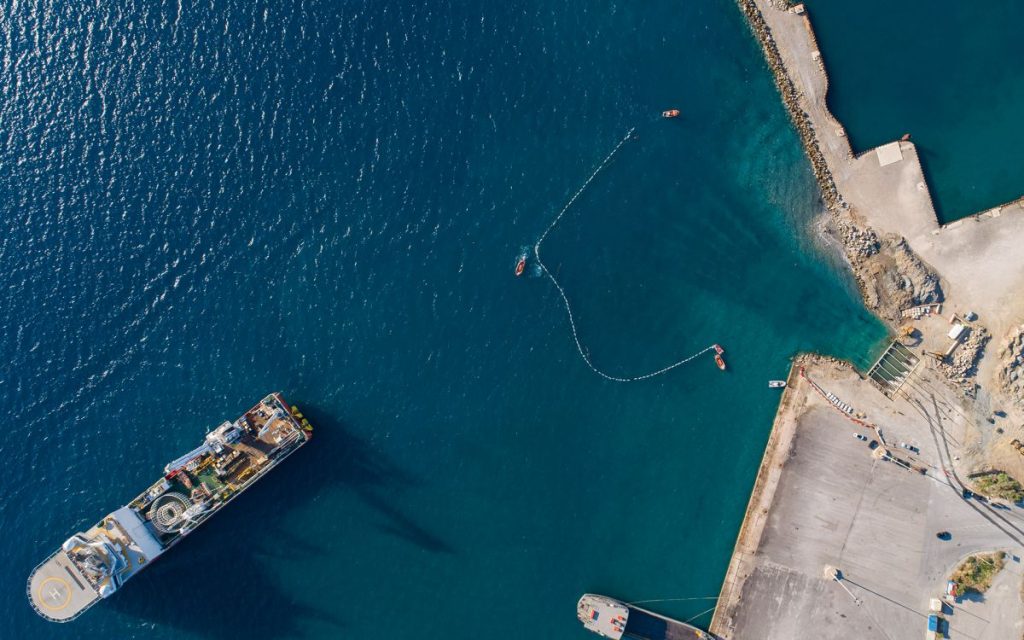
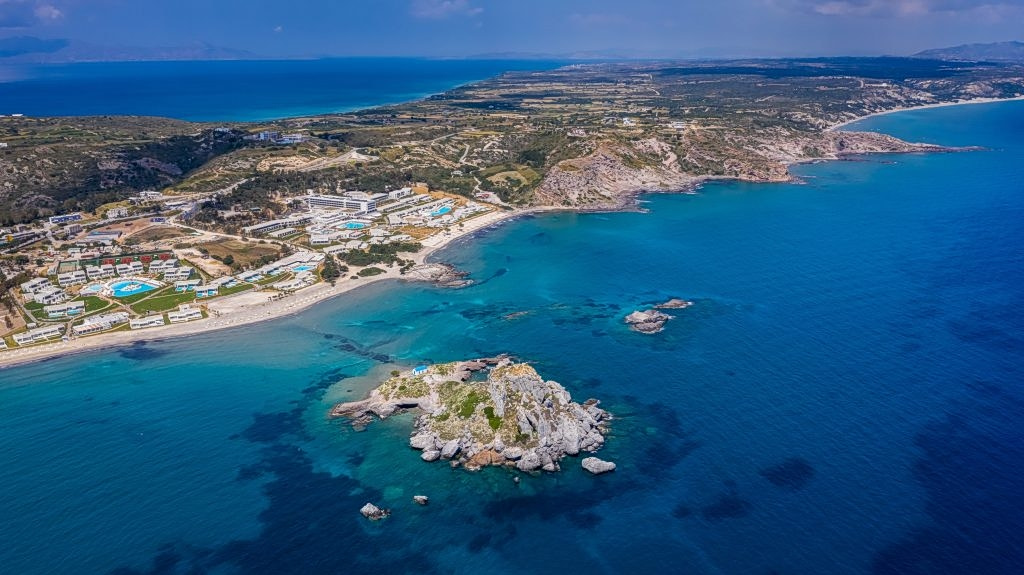
Greek media reports on Thursday cited “sources” at the foreign ministry Ankara as again expressing annoyance with a latest seaborne operation to lay a fiber optic cable between a handful of Greek islands in the central and southeast Aegean.
Official Turkey continues to cling to its revisionist and “idiosyncratic” notion that islands in the Aegean have no continent shelf or impact on delimitating any future exclusive economic zone (EEZ). Another revisionist-cum belligerent view held by Ankara over the past decades is that Greece does not have the right to extent its territorial waters in the Aegean beyond six nautical miles – an opinion that is not in line with the UN Convention on the Law of the Sea (UNCLOS).
Official Turkey’s position appears to be that the Aegean Sea, east of the 25th meridian and sans the areas where Greek islands enjoy six nautical miles of territorial waters, belongs to Turkey or comprises a future Turkish continental shelf/EEZ.
Last Saturday, in fact, a Turkish frigate, identified as the “Gediz”, reportedly hailed the vessel laying the cable, the Panamanian-flagged “Ocean Link”, calling on it to stop activities in areas of Turkish “jurisdiction”, which in this case was a location between the islands of Amorgos and Astypalea. The distance between the two Greek isles in the central-south central Aegean is roughly 28.5 nautical miles, but dozens of nautical miles from the nearest Turkish territory – i.e. the west Asia Minor coast.
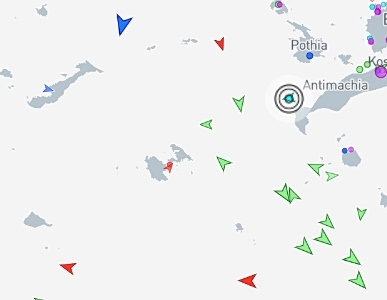
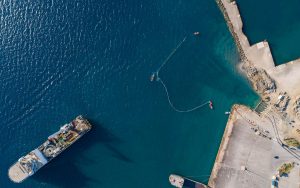
The Ocean Link appeared docked just off the eastern Aegean island of Kos on Thursday, Jan. 8, 2026.
The reports on Thursday, however, have the Turkish sources denying that any harassment targeted the vessel.
At the same time such activity, according to the press reports, had the sources referring to “unilateral activities” by the Greek side in the Aegean, “ignoring the rights and interests of our country (Turkey), which emanate from the maritime regions under its jurisdiction”.
“However, these efforts are rendered ineffective by the framework of international law and our country’s initiatives,” the sources added, while continuing to refer to “international law” but not which treaty, provision or case law is involved.
“In this context, the activities of the Panama-flagged cable-laying vessel ‘Ocean Link’, for which Greece has issued maritime instructions (NAVTEX) regarding the laying of optical cables, are being closely monitored…Contrary to the claims in the Greek press, there has been no harassment of the ship by Turkey,” the sources concluded.
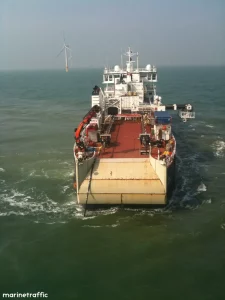
The Hellenic Navy’s hydrological service has issued a NAVTEX for the wider maritime region that extends to Jan. 26, 2026, in order to allow the Ocean Link to continue its activities, which to date have not been impeded in any way.
The vessel had reportedly finished laying cable between Astypalea and Kos when it anchored off the latter.