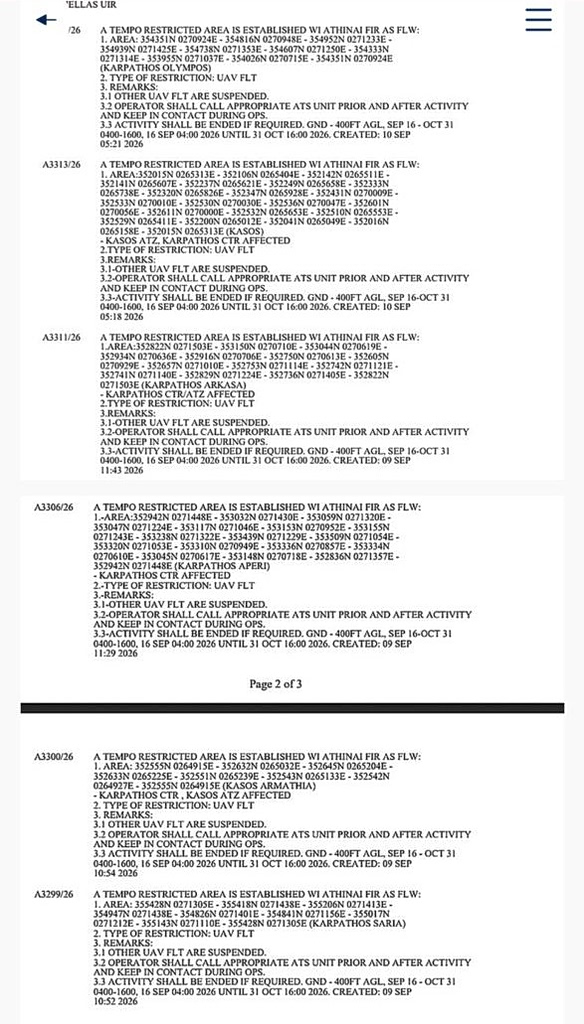
Athens is imposing a comprehensive airspace ban on most unmanned aerial vehicles (UAVs), better known as drones, across the southeastern Aegean, according to six Greek aviation notices (NOTAMs) issued over the past few days.
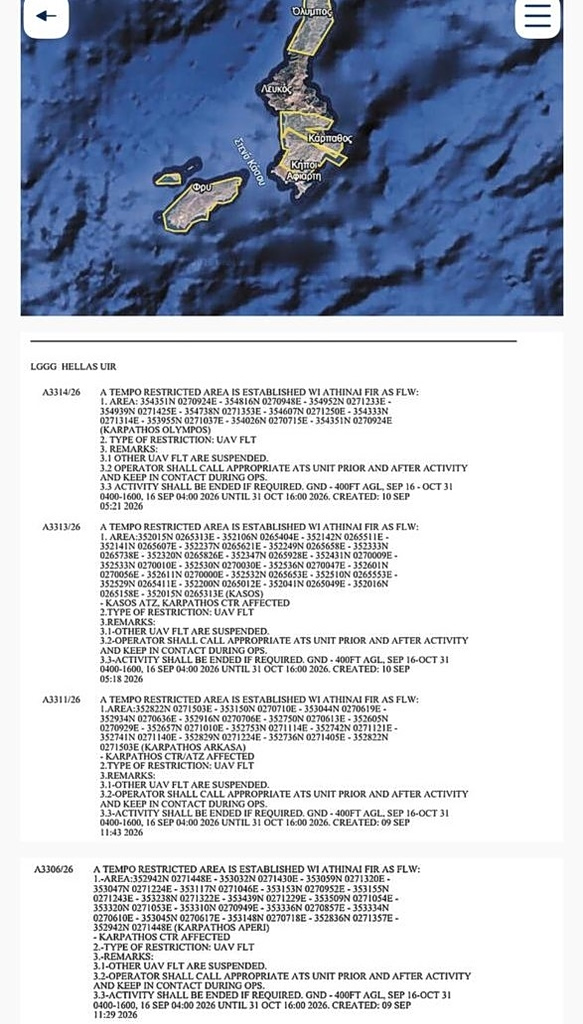
The measures establish an extensive network of “temporary restricted areas” within the Athens Flight Information Region (FIR), centered on the extreme southern-most islands of Karpathos and Kasos and the nearby islets of Saria and Armathia.
The blanket restrictions will take effect on Wednesday, Sept. 16, and remain in force through Oct. 31, 2026, applying daily from 7 a.m. to 7 p.m. The restricted zones cover strategic locations including the peaks of Olympos, Aperi and Arkasa on Karpathos, the entire island of Kasos and airspace around the two islands’ airports.
The ban covers altitudes from ground level to 400 feet, or about 120 meters, which is also the maximum legal altitude for ordinary recreational drones. According to the notices, all other UAV flights in the area will be fully suspended.
Although the official notices do not identify the agency responsible, the duration of the restrictions, their strict nature and the islands’ location point to national military exercises or special border-surveillance operations by the armed forces and security services. During the period, the authorized state operator will remain in constant communication with Athens’ air traffic control, while flights will be suspended immediately if required for safety reasons.
Local airport authorities have urged professional and recreational drone operators to comply fully with the restrictions. Enforcement is expected to be particularly strict, as violations of restricted airspace during special operations carry severe penalties and administrative fines.
The NOTAMs were issued on the day of Greek Prime Minister Kyriakos Mitsotakis’ meeting with French President Emmanuel Macron in Paris and the following day. The two leaders discussed a planned electricity interconnection cable linking Greece with Cyprus and Israel.
According to information cited in the report, work to resume laying the cable is expected to restart from the point where it was halted after the appearance of Turkish warships off Kasos on July 22-23, 2024, namely east of the island.
At the same time, Turkey has been making extensive use of drones in an effort to test Greek air-defense response times and procedures while putting pressure on the country’s air-defense system. Recently, Turkish drones reportedly reached the terminal area of Alexandroupolis airport, while another flew shortly before midnight over the heart of the Aegean, reaching an area north of Ikaria where its flight path formed an offensive shape.
The question raised with Greek officials is how long Athens will continue its policy of “strategic restraint” rather than shooting down such aircraft, as has occurred in Eastern Europe involving Russian drones. A first indirect answer has been a reference to the 35-month period after which the “Achilles Shield” air-defense system is expected to become operationally ready.
‘If and When We Decide’
Military sources stress, however, that any decision to shoot down a drone ultimately rests with the political leadership. Greece’s air defense operates under clearly defined and strict Rules of Engagement (ROE), despite its policy of strategic restraint.
The transition from simple identification to kinetic neutralization of a Turkish drone, for instance, during peacetime is not automatic. It requires political authorization and would be triggered by hostile action, clear hostile intent, prolonged overflight of Greek territory or an immediate threat to civil aviation.
According to senior military circles, the technology used by these systems is neither cutting-edge nor exclusively domestic. At present, they are described as relatively large and slow-moving and therefore vulnerable to interception from considerable distances.
“If and when we decide, we can bring them down in large numbers, either kinetically or non-kinetically,” military sources said.
The Greek defense doctrine views the operational role of such drones during peacetime as primarily one of psychological and hybrid influence rather than military effectiveness. Their significance could change in the event of a crisis or the start of hostilities, when different rules would apply to the airspace.
Athens is, therefore, seeking to avoid what it regards as the trap of premature kinetic action that could give Ankara a pretext for further escalation. This restraint, military sources stress, should not be interpreted as weakness.
“Without underestimating them, we have weighed them, assessed them and are trying to persuade our allies and neighbors to respect flight-safety rules and International Civil Aviation Organization (ICAO) provisions within the Athens FIR,” sources said.


