 Μake us preferred on Google
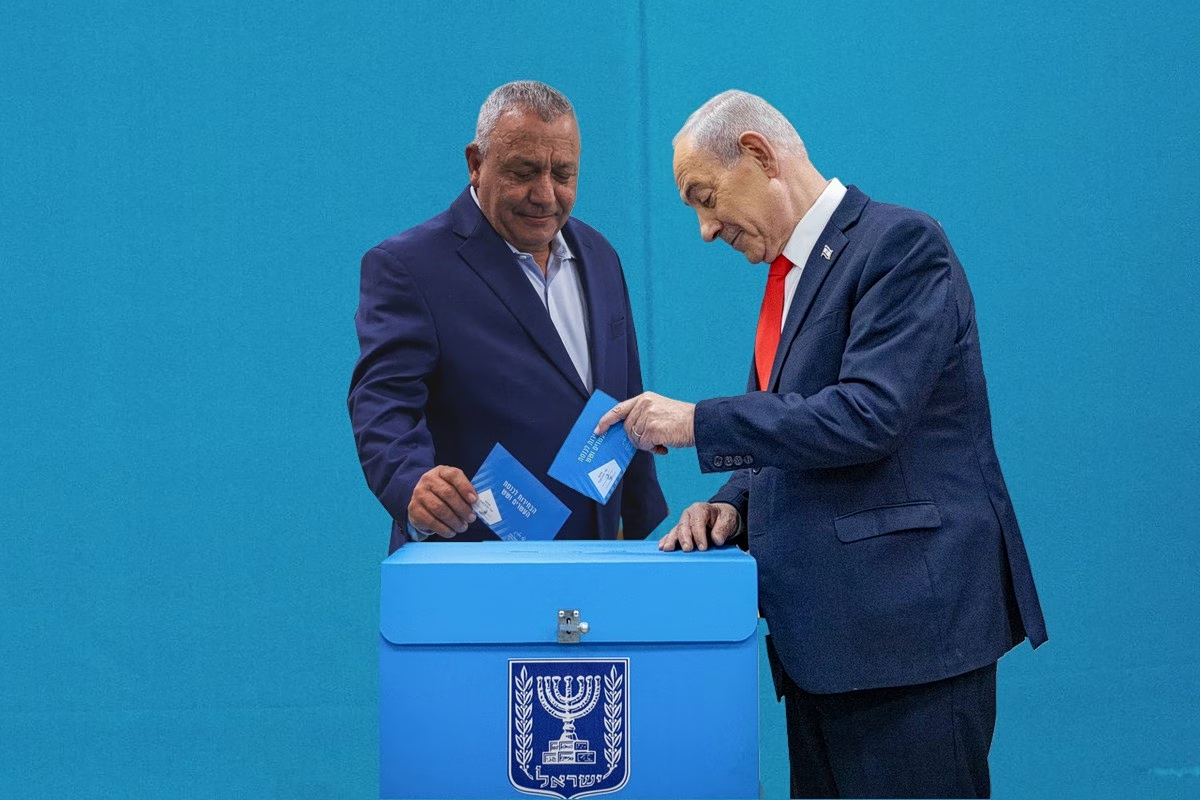
The main Israeli broadcast exit polls indicate that challenger Gadi Eisenkot’s bloc has emerged as the largest group in Israel’s election, the first since the October 7 Hamas attacks, just ahead of the ruling coalition but well short of a majority.
Prime Minister Netanyahu’s Likud is set to be the biggest single party in the Israeli Parliament, the Knesset.
According to Israel’s Channel 12, the opposition bloc is projected to win 52 seats, while the Netanyahu bloc would win 50 seats. Arab parties are projected to collectively win 18 seats.
Voter turnout in Israel’s general election reached 74.3% by 8 p.m. on Tuesday, according to the Central Elections Committee.
Some smaller communities recorded far higher rates, led by the central coastal community of Bat Hen, where 97.9% of eligible voters cast ballots.
Among larger cities, Rosh HaAyin posted turnout of 79%, the Bedouin city of Rahat 79.8% and Modi’in Illit 77.3%.
Turnout was lower in the main urban centres, at 63.6% in Tel Aviv, 62% in Jerusalem and 59.8% in Haifa.
Shortly before polls closed, Prime Minister Benjamin Netanyahu stepped up calls for supporters to vote, using AI-generated videos. One showed a keychain bearing a map of Israel and the Palestinian territories being handed to Mansour Abbas, leader of the Islamist Ra’am party, with the message: “Don’t give them the keys to the country.”
Even if Netanyahu’s party loses seats and his rivals make significant gains, he is not necessarily on his way out. He remains prime minister until a new government is formed, a process that, given Israel’s notoriously complex coalition politics, could take weeks or even months.
with information from BBC and Al Jazeera