 Μake us preferred on Google
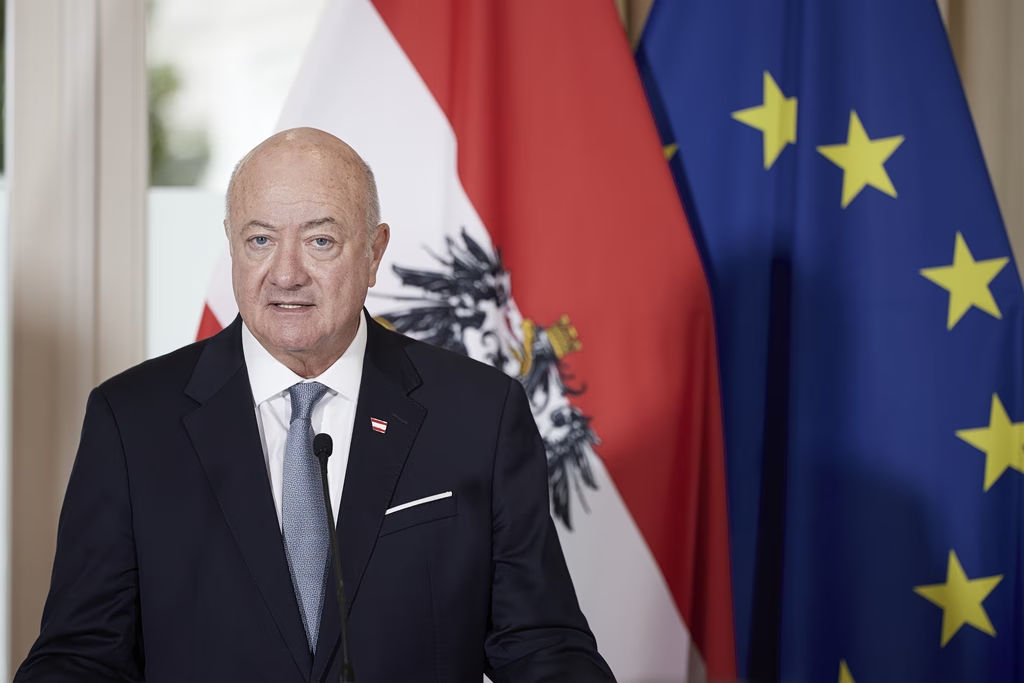
 Austrian Chancellor Christian Stocker praised Greece’s economic progress in recent years, describing the country as an example of successful reform policies following his meeting with Greek Prime Minister Kyriakos Mitsotakis in Salzburg.
Stocker highlighted Greece’s “impressive economic progress” and said the country had become one of Europe’s more resilient economies through steady growth and a consistent reduction in public debt.
“Greece has now become an important example of successful reform policy, which we need throughout Europe and in Austria as well,” Stocker said, congratulating Mitsotakis for his contribution to the country’s transformation.
The Austrian leader said that strengthening Europe’s ability to act effectively requires support for industry, greater investment in technology and innovation, and deeper integration of the European single market.
Energy Costs and Competitiveness
Stocker said Greece and Austria share concerns over high energy prices, which he described as a major challenge for both economies.
He said reforms to the European energy market design should be considered to reduce costs, adding that lower production costs from renewable energy sources should translate into lower prices for consumers and businesses.
At the same time, he stressed that European climate policy should not prevent European industries from remaining competitive.
“The prime minister and I agree that competitiveness is the key condition for Europe to remain strong and effective,” Stocker said.
Tourism Cooperation Between Greece and Austria
Speaking from Salzburg, one of Austria’s most popular tourist destinations, Stocker described tourism as a “stable bridge” connecting the two countries.
He noted that more than 900,000 Austrians visit Greece each year, while the number of Greek visitors to Austria is also increasing. The two countries share the goal of extending the tourism season and creating attractive opportunities for both visitors and local communities.
Stocker pointed to Salzburg as an example of tourism’s economic impact, highlighting the Salzburg Festival as a major cultural event that generates almost €250 million in added value for Austria’s economy each year, including nearly €200 million for the Salzburg region, while supporting around 3,000 jobs.
He said Greece and Austria, as two strong tourism countries, want to further deepen cooperation and exchange expertise.
Tourism Minister Olga Kefalogianni and Austrian Deputy Tourism Minister Elisabeth Zehetner also participated in discussions focused on tourism cooperation, workforce training, shortages of specialized personnel, the European labor market, sustainable tourism development and improving the competitiveness of both countries’ destinations.
Migration and EU Border Protection
Migration was another key issue discussed by the two leaders, with Stocker emphasizing cooperation between Greece and Austria in addressing irregular migration.
He said the two countries had made a “decisive contribution” to a change in the European Union’s migration policy and described the protection of the EU’s external borders as a shared European responsibility rather than a national issue.
Stocker thanked Greece for its role in protecting Europe’s external borders and said Austria supports the country.
He added that 15 Austrian Frontex officers are currently serving in Greek border areas as part of Austria’s contribution.
The Austrian chancellor also supported the creation of “Return Hubs,” facilities where rejected asylum seekers would be accommodated until their return to their countries of origin. Austria and Greece, together with other European partners, aim for the first such centers to begin operating in 2027 during Greece’s EU presidency.
Western Balkans Enlargement
The leaders also discussed the European Union’s enlargement prospects in the Western Balkans.
Stocker highlighted Montenegro’s progress, describing it as an “exemplary candidate country,” and expressed optimism that accession negotiations would advance further so that membership could become a reality in the near future.
He also stressed that the EU should maintain an open perspective for other Western Balkan countries, including Serbia, and said further steps in the enlargement process should continue.