 Μake us preferred on Google
 Since March 4, when PASOK leader Nikos Androulakis formally requested a pre-agenda debate in the plenary of the Greek Parliament, much has changed. Although the time span may seem short, politically it has been marked by rapid and multifaceted developments.
Case files from the European Public Prosecutor’s Office concerning the agricultural payments body OPEKEPE—implicating 11 plus two lawmakers from the ruling New Democracy party, as well as two former ministers—have increased pressure on the government and its parliamentary group.
At the same time, another flashpoint emerged with a heated clash between Makarios Lazaridis and opposition parties over his academic credentials. Meanwhile, a particularly sensitive issue for the government—accused so far of failing to provide clear answers—remains the wiretapping scandal. This is also the trigger for today’s debate, which begins at 11 a.m. in Parliament. A recent judicial ruling has introduced new dynamics, while fresh investigations are reopening the case.
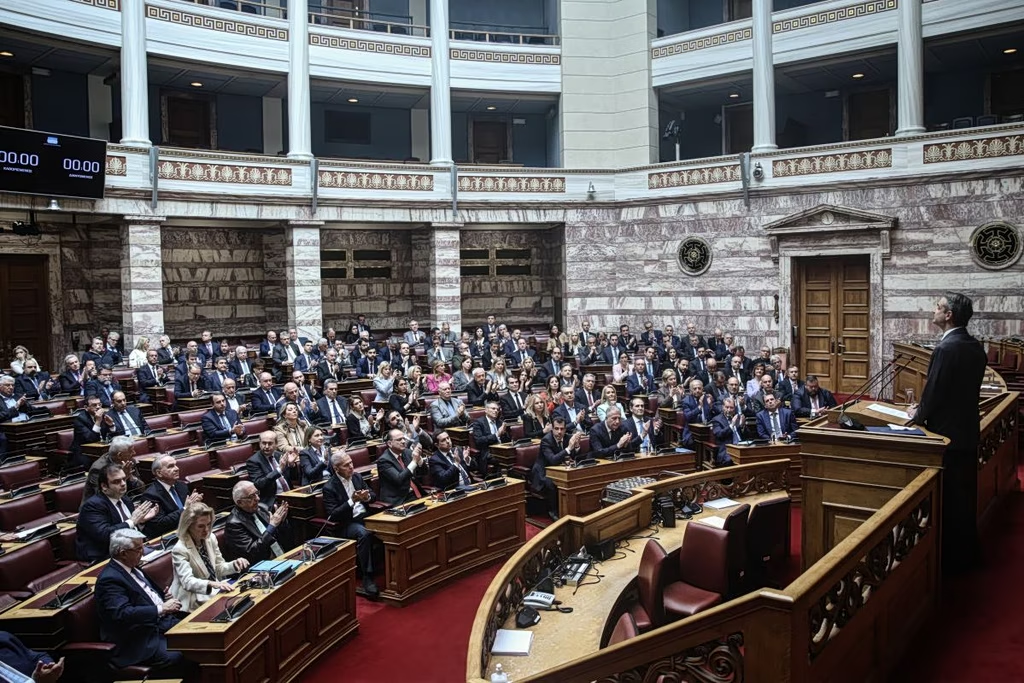
As provided by parliamentary rules (Article 143), the debate will be opened by Prime Minister Kyriakos Mitsotakis. The timing is difficult, as one of his closest aides, Giorgos Mylonakis, is currently hospitalized in “serious but stable condition,” according to a medical statement, at Evangelismos Hospital in Athens.
According to government sources, the prime minister is expected to use the debate—focused on “the state of the rule of law, institutions, and the functioning of Parliament in Greece”—to announce “institutional reforms aimed at restoring the functioning of the political system.” The government hopes this will mark a “forward-looking” shift.
Sources at the Maximos Mansion (the prime minister’s office) say Mitsotakis intends to respond in this way to what they describe as the opposition’s attempt to trap the government in a “closed, toxic debate” centered on recent scandals.
Government officials argue that the initiative is substantive, stressing that the country’s long-standing dysfunctions stem from a state unwilling to adapt to modern needs, clinging to outdated political practices and clientelist networks. According to these same sources, the prime minister is expected to argue that such issues can only be addressed by reducing human mediation through digital modernization of the state and by implementing deep institutional reforms, including constitutional changes.
In this context, Mitsotakis is also expected to offer a preview of proposals submitted by New Democracy lawmakers regarding constitutional revision.
On the opposition side, Androulakis is set to reiterate PASOK’s demand for early elections. He is expected to accuse the government of manipulating institutions, exploiting the state and public funds, and undermining transparency and sound lawmaking. He will also make extensive reference to what PASOK officials describe as a “blackmailed prime minister,” while outlining the wiretapping scandal, before concluding that resignation and elections are the only way forward.
Other party leaders will also take the floor. Sokratis Famellos is expected to insist on his call for a vote of no confidence against the government, urging opposition parties to unite behind a joint motion—a move that requires the signatures of at least 50 MPs. However, PASOK does not appear aligned with SYRIZA’s position, while the Communist Party (KKE) traditionally avoids such initiatives.
The session will also mark the debut of Peti Perka as head of the parliamentary group of New Left, following the resignation of Alexis Charitsis. According to sources, the MP from Florina will deliver broad criticism, focusing on rule of law issues and the wiretapping case, personally accusing Mitsotakis of institutional overreach and holding him accountable for the country’s overall situation. She is also expected to touch on the war in the Middle East, migration, and reporting by BBC on the latter.
All leaders will have the right to respond, meaning the prime minister is expected to reply to opposition leaders, followed by a second round of statements. Mitsotakis will also retain the right to a final closing intervention—setting the stage for a prolonged and politically charged parliamentary confrontation.