 Μake us preferred on Google
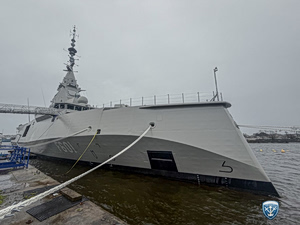
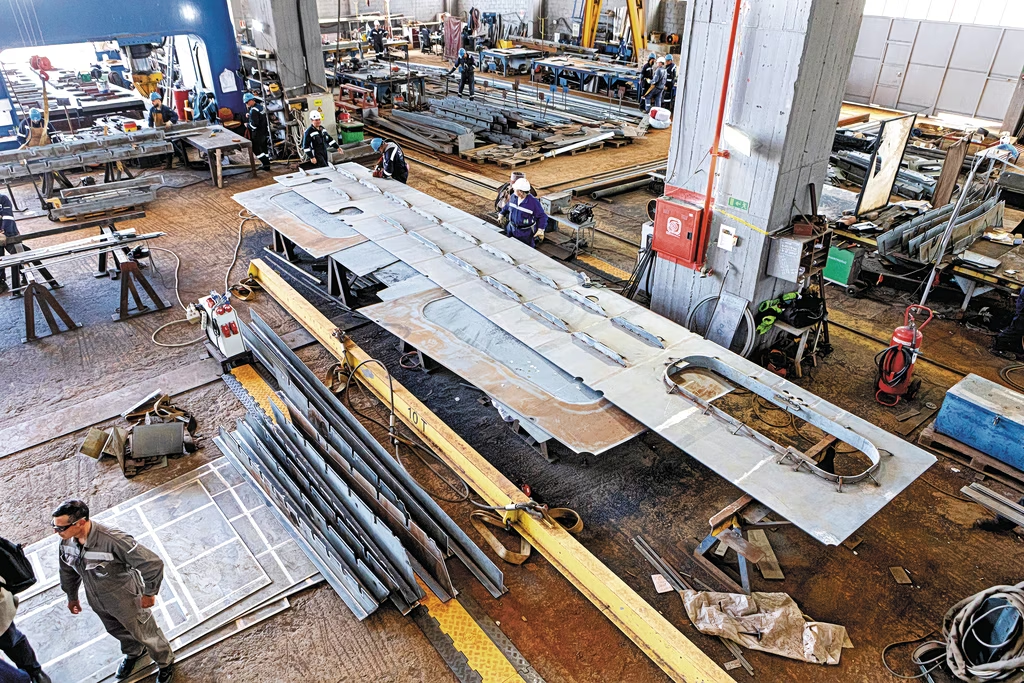
 At Salamis Shipyards, machines run non-stop in the sections dedicated to Belharra components. Specialized technicians process large metal structures intended to support the gun system at the bow of the frigates. So far, 15 pre-equipped sections (blocks) have been sent to the shipyards in Lorient in France, while another five are currently under construction.
Last Thursday, April 30, To Vima visited Salamis Shipyards for a guided tour by Chairman and CEO Dr. George Koros through the sheds where blocks are being built for both Greek and French Belharra frigates.
Anyone walking among the industrial machinery and the staff operating it is left wondering how such a volume of work is produced in such a limited space.
The level of pre-outfitting achieved by Salamis Shipyards has reached 80.4%, one of the highest rates recorded in frigate construction. This may be due to the evident “family-like” atmosphere in the workplace, despite the demanding pace.
NEWSLETTER TABLE TALK
Never miss a story.
Subscribe now.
The most important news & topics every week in your inbox.
“Panoptis”
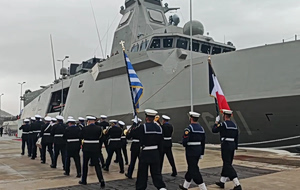
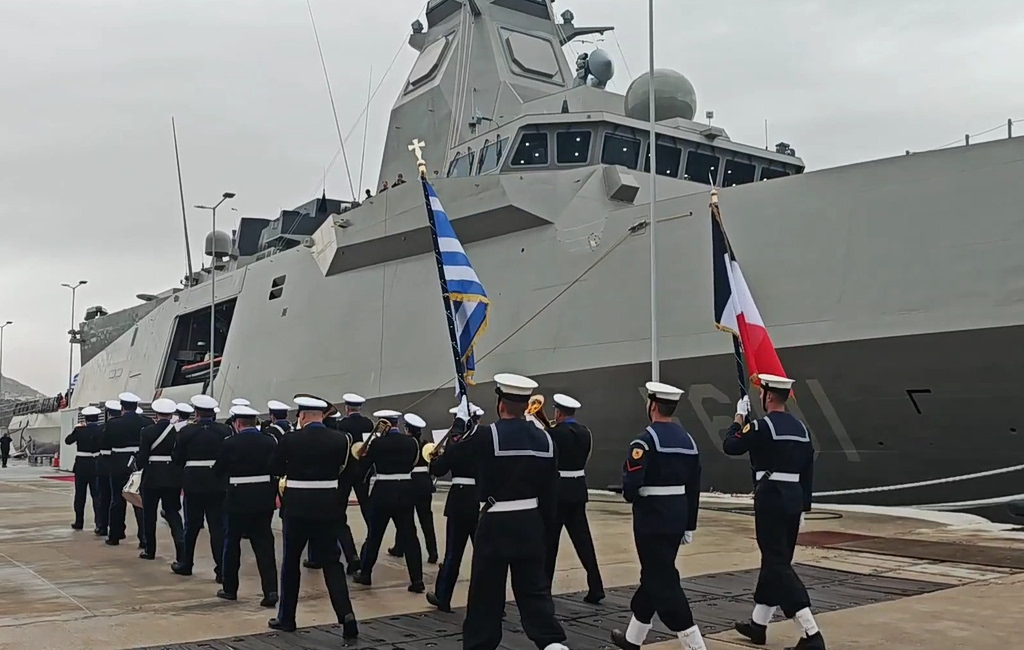
The visit coincided with the naming ceremony of an unmanned maritime surveillance floating platform USSPS (Unmanned Semi-fixed Sea Platform for Maritime Surveillance) by ETME, named “Panoptis.”
“Panoptis” is being developed under the USSPS program within the framework of the European Defence Industrial Development Programme, under the supervision of the General Directorate for Defence Investments and Armaments of the Ministry of National Defence and in cooperation with the Republic of Cyprus. The French Naval Group and other companies are also participating in the project.
The platform is being built at Salamis Shipyards, highlighting the contribution of the Greek shipbuilding and industrial base to the development of advanced technological solutions. According to information, the medium-term goal is to construct two additional platforms.
Salamis Shipyards are now a “permanent part of the Naval Group supply chain,” Koros explains, meaning that blocks for Belharra frigates will continue to be produced “for any country in the world where the French export, and in this way we will have embedded Greek DNA in them.” “It is the first time,” he adds, “that Greece exports a shipbuilding defense product, and we deliver under highly demanding timelines and strict technical specifications.”
Around 90 people are currently working on the frigate program, representing 50% of the workforce at Salamis Shipyards.
“At the moment, we are producing blocks for the seventh Belharra,” Koros notes, walking past the technicians, who continue their work without distraction. The chairman and CEO is not particularly revealing about future defense programs, but he says that “Salamis Shipyards will lead developments in shipbuilding in the country and beyond, not only in shipbuilding programs.” For example, on April 29 they undertook a major ship conversion project, for which they will hire an additional 70 employees.
Long-term plans
As the crisis in the Gulf continues and energy is increasingly linked to defense, the long-term plans of Salamis Shipyards also include the construction of dry cargo and LNG vessels. “At last, Greece will produce significant ships, specialized ships, ships for specialized markets,” Koros observes. Beyond the Belharra program, the shipyards are moving forward “with defense research and technology programs, as well as projects outside the maritime sector,” he says.
The timing of the visit to the inner workings of Salamis Shipyards—where Greek expertise plays a leading role in building some of Europe’s most advanced warships on behalf of one of the world’s most important shipyards, that of Lorient—combined with the ceremony for the “Panoptis” surveillance platform, shows that the country is moving to a new level and advancing dynamically.
“Panoptis” combines technological elements from offshore hydrocarbon extraction, offshore wind farms, unmanned systems, and artificial intelligence, aiming to integrate and process field data through advanced algorithms, according to the relevant announcement.
In addition, the Ministry of National Defence is preparing the next armament package, with the French “Swordfish Barracuda” submarines by Naval Group included on the list to be drawn up by the Hellenic Navy General Staff for evaluation.
The importance is also highlighted of acquiring, through a memorandum of understanding with Italy, 2+2 Bergamini frigates (two immediately after final signatures, with two more to follow once they are replaced by other vessels).
It is no coincidence that among those attending the inauguration of the floating platform were, among others, Athanasios Dokos, National Security Advisor; Ioannis Bouras, Director General of the General Directorate for Defence Investments and Armaments; Pantelis Tzortzakis, President of ELKAK; Patrick Mauffrey, USSPS Program Director for Naval Group; Dimitrios Terzis, and others.
Combined with the announcement by U.S. President Donald Trump on cooperation in shipbuilding and the repair and conversion of both military and commercial vessels between the United States, Greece, and South Korea (Hanwha), one could speak of the strengthening of the Greek Navy in the strategic region of the Southeastern Mediterranean, and of course in the Aegean.