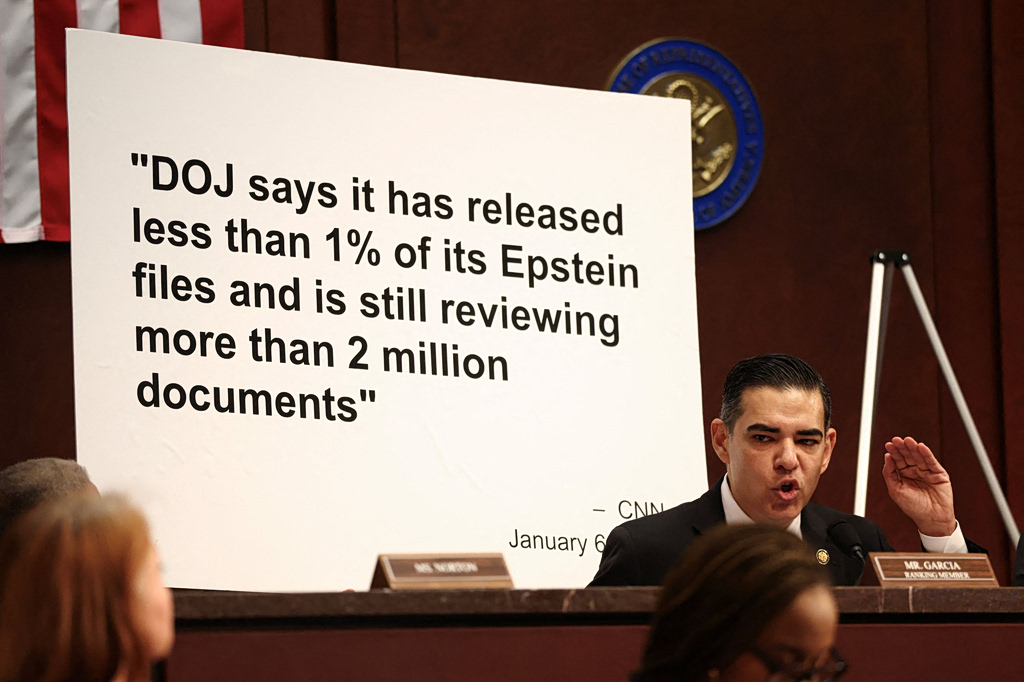
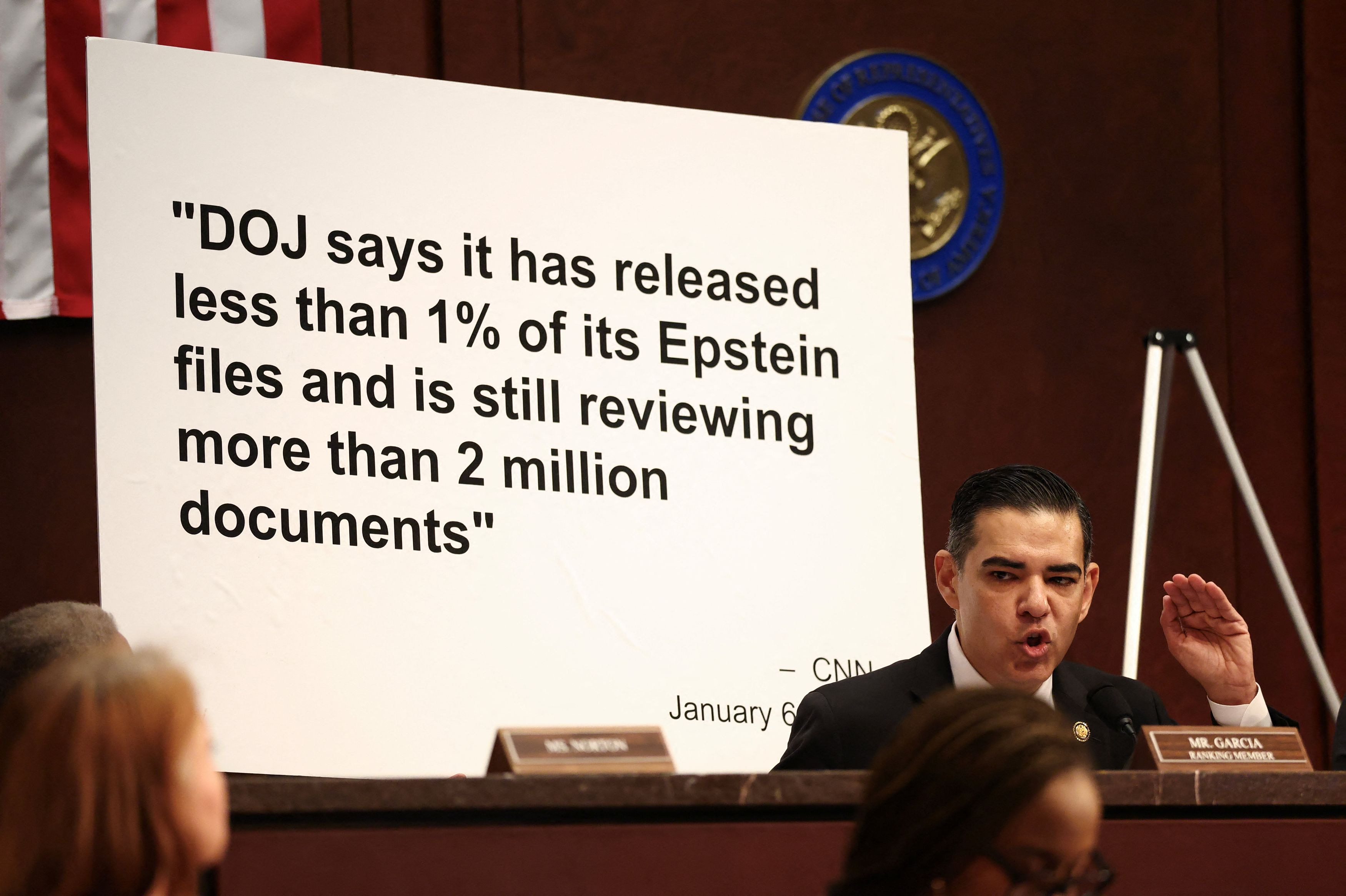
Emails released by the U.S. Department of Justice as part of the Jeffrey Epstein document disclosures show a series of business-oriented exchanges between Epstein and George Mantzavinatos, a well-known Greek real-estate executive who died in 2023, when Greece was amidst its third consecutive bailout by institutional creditors.
The correspondence, spanning 2015 to 2018, appears in multiple DOJ exhibits and consists primarily of discussions about macroeconomic conditions, banking sector stress, and potential investments related to Greece and other regions, including Ukraine, Iran and Argentina.
The emails reviewed for this article do not introduce or cite any allegations related to sexual abuse or trafficking. Instead, they consist of business-related correspondence about economic conditions, investment ideas and introductions, sometimes involving third parties and mentioning Greek companies.
Considering this, the records offer a narrow but verifiable snapshot of how Epstein- who had already been convicted in Florida in 2008 and was registered as a sex offender- continued to exchange emails about business and geopolitical issues in the years before his federal arrest in 2019. They also highlight how Epstein was interested in Greece as an investment opportunity, as evidenced by the fact that the country was mentioned more than 1,500 times in the recently released files, including in numerous market, economic reports, and analyses on the then-debt embroiled country.
Greece during the bailout
Several of the DOJ-released emails date from 2015–2016, when Greece was navigating another most acute phase of its decade-long debt and economic crisis, while operating under what became the country’s third economic adjustment program, agreed to and ratified by Greece’s Parliament in August 2015 and completed in August 2018.
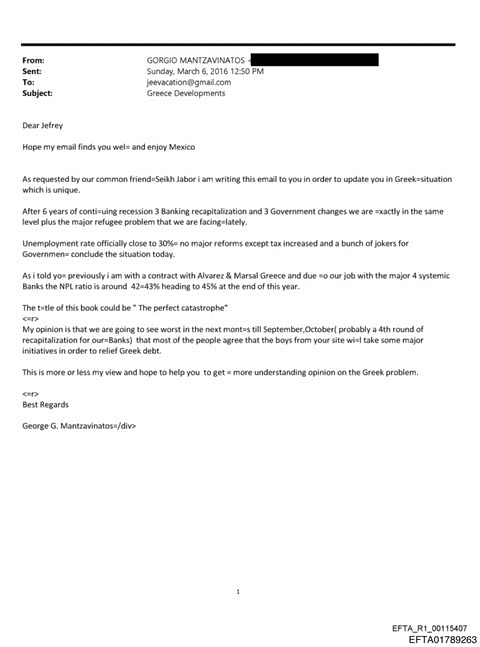
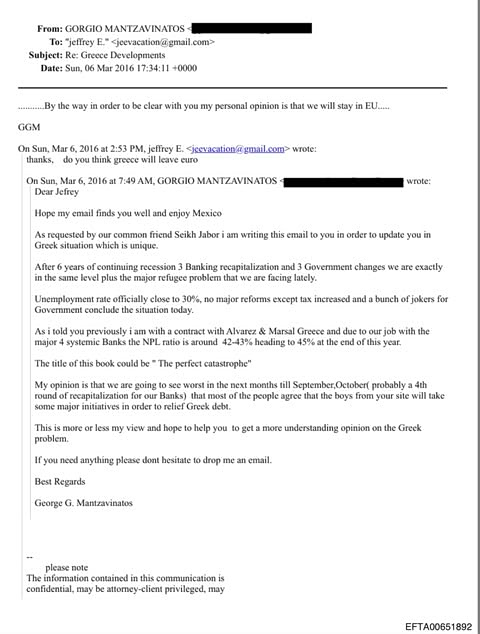
In an email dated March 6, 2016, Mantzavinatos presented himself as under contract with the Greek subsidiary of the Alvarez & Marsal global professional services firm, writing to Epstein under the subject line “Greece Developments.” He described a prolonged recession, repeated government changes and stress in the banking sector. “After 6 years of continuing recession,” he wrote, referring to “3 Banking recapitalization and 3 Government changes,” and estimating that the non-performing loan ratio was “around 42–43%.” (EFTA01789263)
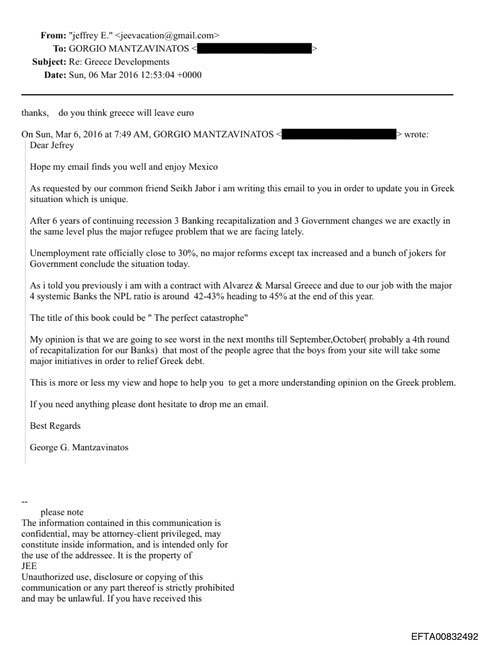
Epstein replied in the same thread with a direct question: “do you think greece will leave euro” (EFTA00832492)—a concern widely debated at the time amid negotiations with Greece’s international creditors.
Mantzavinatos responded with a scenario-based assessment, referencing domestic political uncertainty and potential leadership changes, what he calls a story of “the perfect catastrophe” before adding his own view: “my personal opinion is that we will stay in EU.” (EFTA00651892)
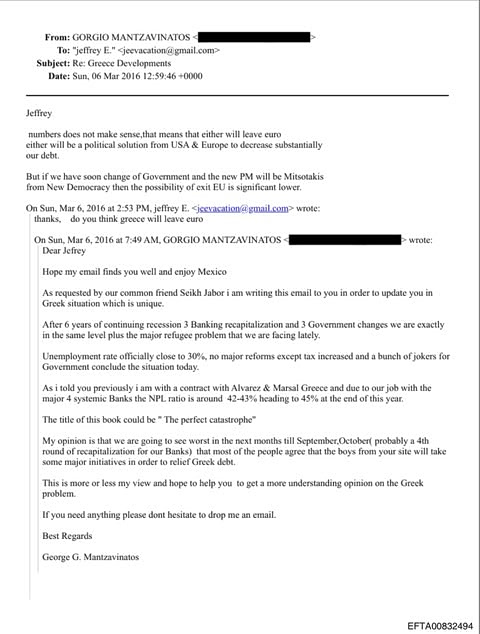
Mantzavinatos reiterated his view in a follow-up email, noting that a government led by Kyriakos Mitsotakis would significantly reduce the likelihood of Greece leaving the European Union (EFTA00832494). Mitsotakis’ center-right New Democracy (ND) party subsequently won the general election in July 2019 in a landslide over leftist SYRIZA.
The exchange mirrors public debates taking place in Greece and across Europe during that period, as the country sought to stabilize its economy, recapitalize banks and remain within the euro area under creditor supervision.
Business proposals and international focus
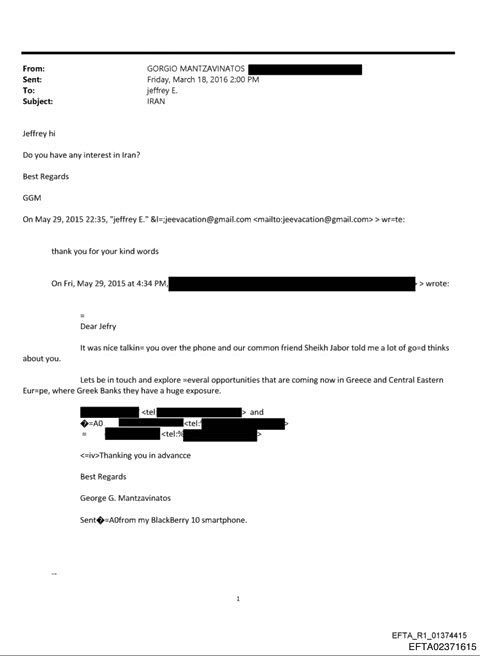
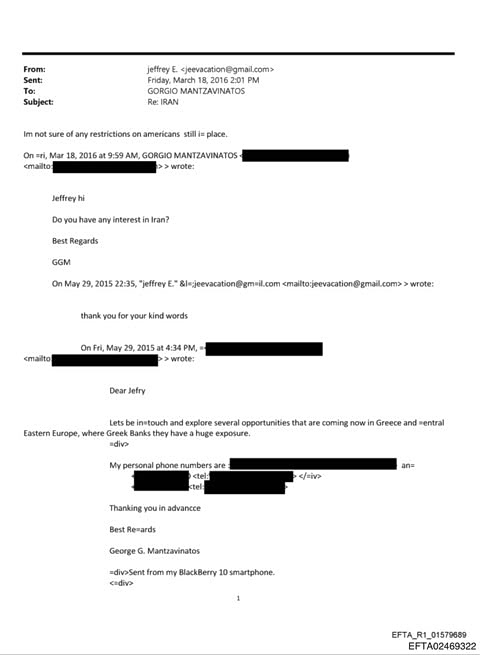
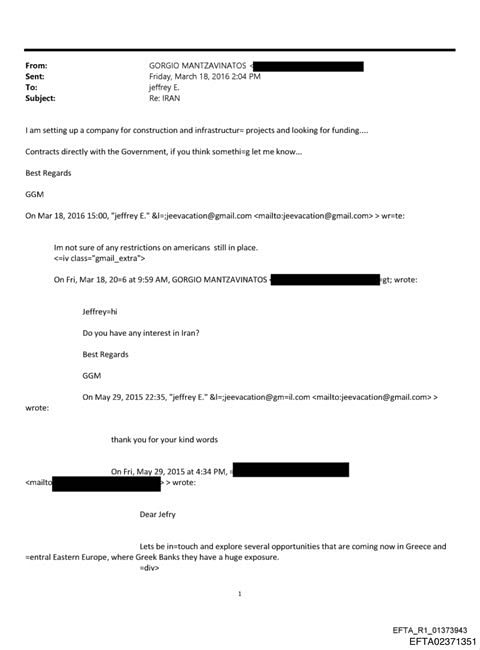
Other emails show Mantzavinatos raising possible business opportunities outside Greece. In a message dated March 18, 2016, he asked Epstein directly: “Do you have any interest in Iran?” (EFTA02371615). To which Jeffrey Epstein replied, “Im not sure of any restrictions on americans still i= place.” (EFTA02469322)
A follow-up email in the same day said he was “setting up a company for construction and infrastructure projects and looking for funding.”(EFTA02371351)
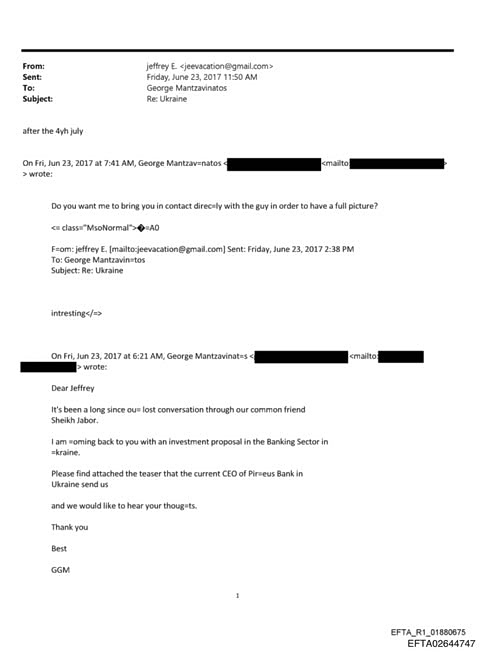
In June 2017, a separate email thread titled “Ukraine” referred to what Mantzavinatos described as an “investment proposal in the Banking Sector in Ukraine,” which he claims originated from the active CEO of Piraeus Bank in Ukraine. (EFTA02644747)
Epstein replied briefly—“intresting”—before suggesting a later follow-up.
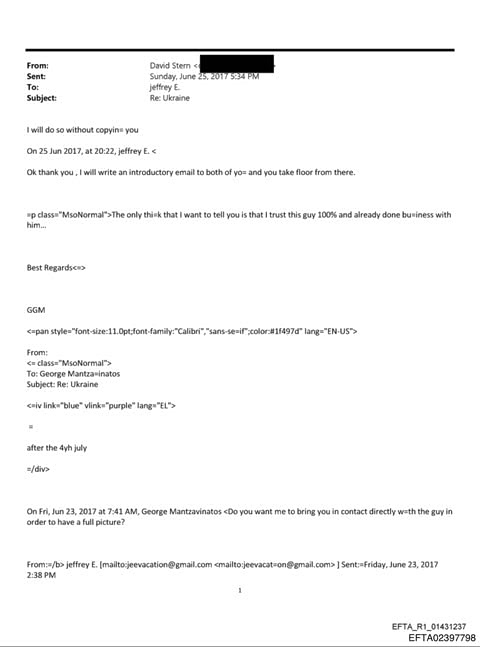
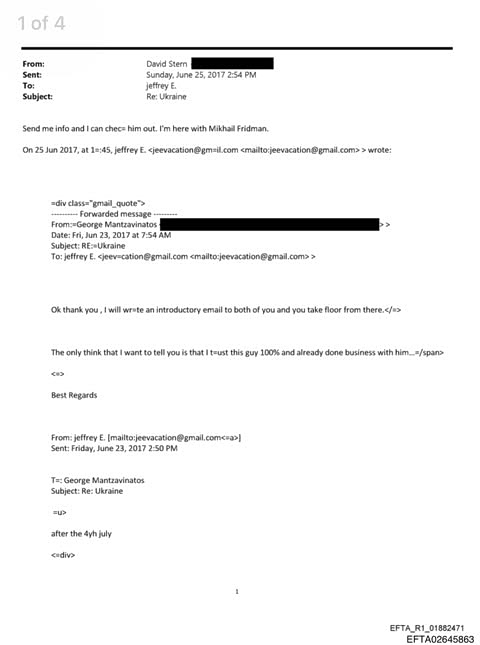
The documents also include emails involving third parties, including David Stern, in the context of introductions. The records do not establish Stern’s identity beyond his participation in the email chain (EFTA02397798), but Stern says that he was with Mikhail Fridman at the time (EFTA02645863).
In a follow up email from May 29 (EFTA02339792), it is mentioned that Greece would soon reach an agreement with the EU and IMF to secure short-term financial stability until September, after which additional funding would be required. It also notes that this period was being flagged as a potential moment to consider an “enter strategy” in the Greek market (EFTA02498054).
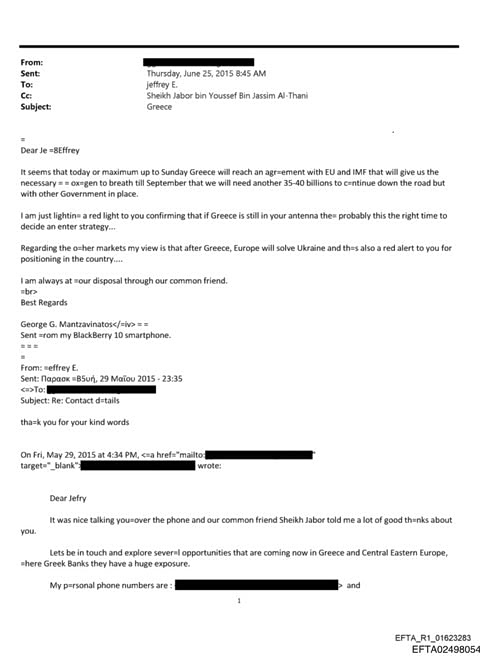
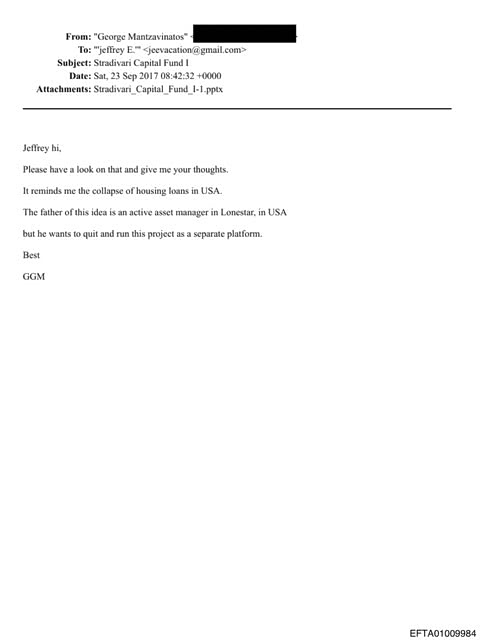
In September 2017, Mantzavinatos sent Epstein a message titled “Stradivari Capital Fund I,” asking him to review materials and “give me your thoughts,” while referencing distressed-asset dynamics following the collapse of housing loans in the United States. (EFTA01009984)
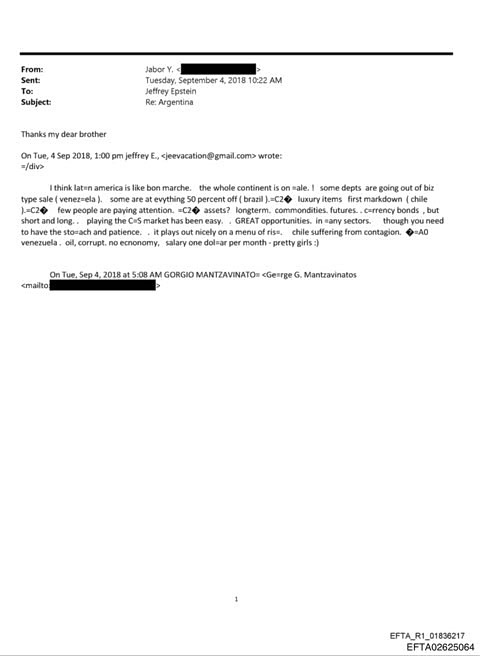
A final exchange from Sept. 4, 2018, shows Mantzavinatos as part of an email chain about Argentina. In that chain, Epstein wrote: “I think latin america is like bon marche. the whole continent is on sale.” (EFTA02625064)
Who was George Mantzavinatos
Publicly available biographies describe George G. Mantzavinatos as a senior real-estate executive with international experience. Speaker biographies and corporate disclosures list him as having served for roughly a decade as chief executive of Doha Properties, and later in senior roles linked to Greek real-estate investment entities, including Grivalia/Prodea, as well as other advisory and management positions.
Greek business media reported that Mantzavinatos died suddenly in May 2023, citing heart-related causes.
Epstein’s legal status during the correspondence
At the time of the emails—from 2015 through 2018—Epstein had already pleaded guilty in Florida in 2008 to state charges related to solicitation of a minor and was required to register as a sex offender. That status is documented in a U.S. Department of Justice Office of Professional Responsibility report reviewing the handling of the original investigation.
Epstein was not arrested on new federal charges until July 2019, when prosecutors in the Southern District of New York charged him with sex trafficking of minors.
Methodology and sourcing
This article is based on PDFs released by the U.S. Department of Justice as part of the Epstein disclosures, identified by EFTA document numbers, as well as publicly available biographical and historical sources. All quotations from emails are reproduced verbatim from the DOJ records. Context about Greece’s bailout period and Epstein’s legal history is drawn from official EU and U.S. government sources and widely cited reporting.