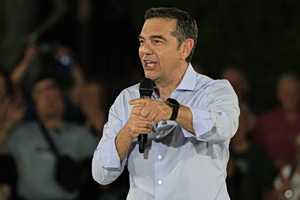
A new RealPolls poll conducted for Protagon shows Tsipras’ ELAS (Greek Left Alliance) narrowing the gap with New Democracy (ND) to just 6.9 percentage points, the first time the margin has fallen below 7 points since Kyriakos Mitsotakis took the helm of ND in 2016. ELAS records 21.4% against ND’s 28.3%, more than double the score of PASOK (9.9%), which drops to fourth place behind Maria Karystianou’s “Elpida” (Hope for Democracy) party at 11.9%.
Voting Intention
In voting intention, ND records a significant decline, falling nearly 2 points to 25.8% from 27.5% in May. ELAS consolidates second place with a rise to 18.2% (up from 14.1% in May), while Hope for Democracy comes third at 9.4%, having shed 2 points from the previous measurement (11.4%). PASOK stands at 8.9%, with a marginal increase from last month (8.6%), but remains fourth.
Notably, Zoe Konstantopoulou’s Plefsi Eleftherias (Course of Freedom) appears to be bleeding voters to both Tsipras and Karystianou, sitting below the parliamentary threshold at 2.8% in voting intention, though it just barely clears the threshold at 3.1% in the electoral projection. Also outside parliament in voting intention are the KKE (Communist Party) at 5.4%, Hellenic Solution at 4.5%, Voice of Reason at 3.3%, MeRA25 at 2%, SYRIZA at 1%, and Niki at 0.9%.
The poll notes that in May, the three contenders for second place were bunched closely together: ELAS at 16.1%, Hope for Democracy at 13.1%, and PASOK at 9.6%. By June, however, the picture has clarified significantly, with ELAS leading the third-place party by 9.5 points and PASOK by 11.5 points.
Citizens Want Political Change
The majority of citizens continue to want political change in how the country is governed, describing it as the defining issue of the next election for them. Specifically, 46.8% call for political change, 31.8% want stability and continuity, and 16.6% want a break with the political system altogether.
“Mitsotakis or Chaos” Isn’t Convincing Anyone
A majority of respondents (45.6%) consider the idea that only a strong government can guarantee stability to be a coercive dilemma, while 20.6% say it leaves them indifferent, and only 31% say stability takes priority.
ELAS Has the Second Largest Voter Pool
A key finding of the poll is that ELAS is solidifying its position as the second political force and steadily widening its lead over the third and fourth parties, forming a two-party dynamic that squeezes the rest.
The 46.8% majority calling for political change appears to be fueling Tsipras’ party, as the voter flow data shows ELAS attracting the majority of those who voted for SYRIZA in 2023, while also drawing voters from Plefsi Eleftherias, MeRA25, and the pool of abstainers.
By contrast, PASOK remains stuck in fourth place, behind Karystianou’s party. While it is not hemorrhaging voters on a broad scale, it is failing to capitalize on the realignments triggered by ELAS and Elpida, and in fact records the highest absolute rejection rate of any party at 70.5%.
Among undecided voters specifically, ELAS records the highest “very likely” score at 5.2%, indicating the strongest inclination to attract swing voters, followed by Karystianou’s party at 4% and ND at 3.2%. PASOK scores zero among undecided voters and a 69.9% “not at all likely” rating.
ELAS Leads Strongly in Perceived Second-Place Outcome
In an informal “victory parade” for second place, Tsipras’ party holds a commanding lead, with 31.9% of respondents believing ELAS will finish second in the next election and 18.8% predicting PASOK in that slot. Only 6.3% give Karystianou’s party a chance of finishing second, reflecting a widespread expectation that Elpida will continue to deflate.
What Voters Are Looking For
When asked what matters most when judging a party, 41.8% cite the ability to solve problems, closely followed by honesty at 39.4%, while ideological identity (12.6%) and the party leader’s persona (3.5%) trail far behind.
On the question of what they would most want from an ideal prime minister, the top answers are almost equally split between justice, meritocracy, equal opportunity, and the rule of law (22.5%), and tackling the cost of living through tax cuts and income increases (22%). These are followed by economic development and improved living standards (16.9%) and the prime minister’s integrity, meaning governing for the people and being honest (14.7%).
On economic policy, citizens are not convinced by communications tools or benefit handouts. When asked how to address the cost-of-living crisis, only 15.4% trust “transparency and price comparison tools” such as the government’s recent Posokanei platform, while 39.9% prefer controls and fines on cartels, and 38.7% favor tax cuts.
Despite dissatisfaction and growing distance from politics, voting remains an act of hope for 51.4% of respondents and of conviction for 30.8%. Only 7.6% describe their vote as an act of anger, and 69.8% say they will vote for what they believe in regardless of forecasts.
There is also a strong undercurrent of distrust toward the political system as a whole. Specifically, 43% agree that “none of the current party leaders represents them,” while 47.3% view the “no cooperation with anyone” line pushed by some parties as a matter of political circumstances, and 34.4% see it as “immaturity and a political dead end.”