 Μake us preferred on Google
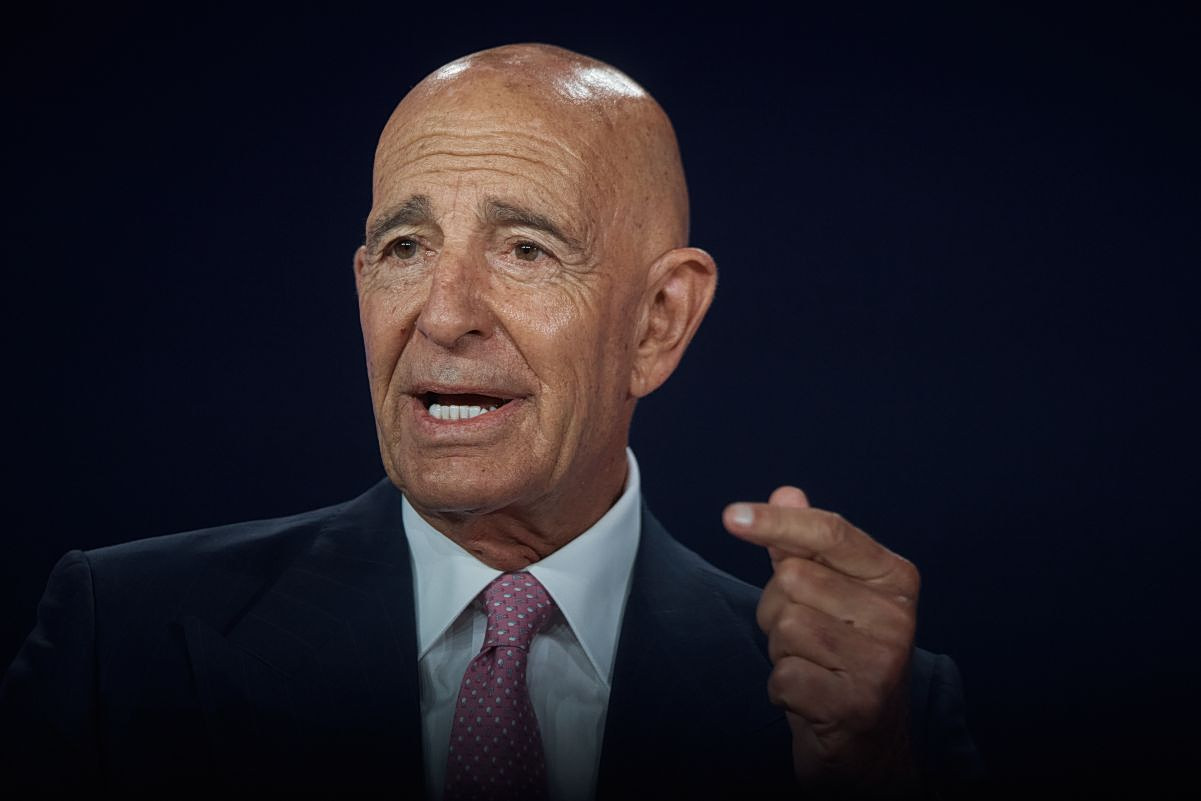
Two influential voices in conservative American media have called for greater scrutiny of Tom Barrack, President Trump’s ambassador to Turkey, following allegations that he encouraged the Iraqi government to take action against the country’s autonomous Kurdish region.
Matthew Boyle, the Washington bureau chief of Breitbart News, and Mark Levin, the Fox News host and conservative radio personality, took aim at Barrack on Friday, less than two months after a Reuters investigation raised questions about potential conflicts of interest between his diplomatic activities and his business relationships.
The criticism came from two longtime Trump supporters with considerable access to his administration. Neither claimed to be speaking for the president.
In a subsequent post, Boyle escalated his accusations, alleging that Barrack was seeking to make billions of dollars from pipeline projects in the Middle East.
“It’s going to be a major scandal and every day the president sticks with him it will get worse,” Boyle wrote.
The political concerns extend beyond Trump’s presidency. As some figures within the MAGA movement in Washington begin to look toward 2028, they worry that Barrack could become a political liability for Vice President JD Vance, leaving him to contend with the fallout from decisions he was not responsible for making.
Reuters, in its October investigation into a proposed oil pipeline from Iraq to Syria, found no evidence that Barrack stood to profit from the project. His office declined to comment at the time, while the State Department denied that he had any affiliation, role or financial interest in the project.
To Vima has learned that a major American newspaper is preparing an additional investigative report on Barrack. It is unclear whether or when the article will be published.
Criticism From Conservative Media
On Tuesday evening, after the Iraqi government had announced measures to assume control of border crossings administered by the Kurdish authorities and several oil fields, Diyar Kurda, the Washington bureau chief of the Kurdish news organization Rudaw, cited an Iraqi official in a post on X as saying that Barrack had encouraged Baghdad to take action against the Kurdistan Regional Government.
Boyle revived the allegation on Friday, after Trump publicly endorsed the Iraqi prime minister’s efforts to assert state authority across the country.
“Barrack is almost certainly cashing in on all of this somehow,” Boyle wrote on X, alleging corruption and calling for investigations by the news media and Congress.
“Barrack is worthy of major investigation by both the news media and bipartisan congressional committees. He should be testifying every day next year,” he wrote.
Breitbart has been a vocal supporter of Trump since his first presidential campaign. Boyle has interviewed the president on multiple occasions and developed extensive contacts within his administration. A March 2025 profile of Breitbart by Semafor highlighted Boyle’s unusually broad access to members of Trump’s cabinet.
In October, The Wall Street Journal reported that Kimberly Guilfoyle had sought Boyle’s help in appealing to administration officials during her final days as the American ambassador to Greece.
Earlier this month, Boyle traveled to Iraqi Kurdistan, where he moderated a public discussion with Qubad Talabani, the deputy prime minister of the Kurdistan Regional Government, at a forum in Sulaymaniyah. Boyle did not specify whether his allegations against Barrack were based on information he had obtained through his reporting.
Hours later, Levin shared Boyle’s post and called for Barrack’s removal.
“And he continues to operate openly when his ass should’ve been fired long ago. I agree, he needs the closest of scrutiny,” Levin wrote.
A former Reagan administration official and longtime Trump supporter, Levin reaches millions of listeners through a radio show carried by more than 300 stations, according to Fox News. In April 2025, Trump announced his selection to serve on the Homeland Security Advisory Council.
In June 2025, as Trump weighed his options over Iran’s nuclear program, Levin met with him at the White House and argued that Iran was close to developing a nuclear weapon, according to The Washington Post.
Levin had previously criticized Barrack in October over the ambassador’s remarks about Iran.
Trump Weighs In on the Kurdish Dispute
The government in Baghdad is seeking greater control over the Kurdish region’s borders and economic resources less than two months after the United States completed its military withdrawal from Iraq. The last American troops departed from Erbil Air Base in Iraqi Kurdistan on Sept. 30.
On Tuesday, Prime Minister Ali al-Zaidi ordered that international border crossings administered by the Kurdish authorities be brought under federal control. His government also ordered federal authorities to assume management of oil fields under Kurdish security control in disputed areas of four Iraqi provinces.
Baghdad says the measures are intended to combat oil smuggling. Kurdish leaders see them as an attempt to erode the autonomy guaranteed to their region under Iraq’s 2005 Constitution.
Thousands of Kurds demonstrated in Erbil, the regional capital, on Thursday, as Baghdad closed two border crossings with Iran and Syria.
Trump intervened publicly the following day, endorsing Zaidi’s efforts to combat corruption and oil smuggling, strengthen state authority and bring all weapons under the exclusive control of the Iraqi government.
The president’s statement, posted on Truth Social, made no mention of Iraq’s federal system or the constitutional status of the Kurdistan Region.
Hours later, Kurda published a response from a State Department spokesperson reaffirming American support for a “sovereign, united, and federal Iraq” and a “stable and prosperous Iraqi Kurdistan Region” within it.
The spokesperson added that Washington supported resolving outstanding disputes between Baghdad and Erbil through dialogue and in accordance with the Iraqi Constitution.
On Saturday, senior delegations from the Kurdistan Region’s two dominant political parties, the Kurdistan Democratic Party and the Patriotic Union of Kurdistan, met in Sulaymaniyah and agreed to present a united position at Tuesday’s talks in Baghdad, according to a joint statement.
Boyle portrayed the rapprochement as an unintended consequence of Barrack’s actions.
“The Kurds are quickly unifying after Tom Barrack’s actions,” he wrote on X.
“Doubt this was Barrack’s intent by pushing to back Iraqi federal government takeover of oil (which he intends to make billions off on the back on pipeline deals), but amazing to see the Kurds coming together seemingly very quickly after Barrack’s actions represented a split from longstanding U.S. policy.”
The Syrian Precedent
Barrack was a principal advocate of integrating Kurdish forces into Syria’s central government and has publicly opposed federalism as a model for governing that country.
In Iraq, however, Kurdish autonomy is enshrined in the Constitution.
Renad Mansour, director of the Iraq Initiative at Chatham House, the British foreign policy institute, told The New York Times this week that the approach taken by the Trump administration, particularly Barrack, had encouraged political figures in Baghdad seeking to consolidate power in the central government.
Barrack has also reportedly sought to defuse the confrontation. On Wednesday, Rudaw reported that he had offered to mediate between Baghdad and Erbil during a telephone conversation with Masrour Barzani, the Kurdish regional prime minister, and had urged Zaidi to rule out military action.
Trump’s intervention drew criticism from Victoria Taylor, a former deputy assistant secretary of state for Iraq and Iran who now directs the Iraq Initiative and Syria Project at the Atlantic Council.
In a post on X, Taylor described the president’s statement as “like dropping a grenade” into the dispute, coming just days before a scheduled Dec. 1 meeting between Iraqi and Kurdish leaders.
By siding so heavily with the prime minister, she argued, Trump had made a negotiated settlement more difficult and undermined Washington’s credibility as a mediator.
American support for a strong Kurdistan within a federal Iraq, Taylor noted, had long enjoyed bipartisan backing in Washington.
She also warned against conflating oil sales by the Kurdish regional government with those of Kataib Hezbollah, a militia backed by Iran and designated by the United States as a terrorist organization.
Baghdad had legitimate questions about the volume of Kurdish oil sales and the destination of the proceeds, Taylor said, but those issues should be resolved through negotiations. She argued that illicit oil networks in southern Iraq were more directly connected to one of Washington’s principal objectives in the country: disarming militias.
Business Ties and a $15 Billion Pipeline
On Oct. 9, Reuters published an investigation examining Barrack’s involvement in plans to restore an oil pipeline connecting Kirkuk in Iraq with the Syrian Mediterranean port of Baniyas.
The proposed $15 billion project would provide Iraq with an alternative export route that bypasses the Strait of Hormuz.
Citing three sources, Reuters reported that Barrack had promoted the involvement of TI Capital, an investment firm with which he had longstanding business ties. Barrack also had a longstanding business relationship with the firm’s founder, Ziad Ghandour.
In a financial disclosure filed in March 2025, before assuming his diplomatic duties, Barrack reported a financial interest in a real estate venture near San Francisco managed by TI Capital. His disclosure included a carried interest arrangement entitling him to 20 percent of profits above a 15 percent hurdle rate.
Former government ethics officials interviewed by Reuters raised questions about whether his diplomatic activities complied with federal ethics rules. They noted that impartiality requirements could apply to matters involving a business associate even when an official stood to gain nothing financially from a particular project.
Reuters also reported that, according to records it had requested from the Office of Government Ethics, Barrack had not filed a conflict of interest waiver concerning his ties to TI Capital in connection with the pipeline project.
At the time, a State Department spokesperson said Barrack’s public remarks about the pipeline reflected longstanding American policy in support of regional energy integration and that he was complying with applicable ethics requirements.
Implications for Athens and Nicosia
In public remarks, Barrack has advocated closer ties between Greece and Turkey and discussed the Cyprus issue as part of a broader regional settlement.
In April, following comments by Barrack at the Antalya Diplomacy Forum, the Greek Foreign Ministry reiterated that the existing framework for structured dialogue between Athens and Ankara fully covered discussions between the two countries.
There is no public indication that the criticism of Barrack has shaken Trump’s confidence in him, and the calls for scrutiny have yet to produce an announced congressional inquiry.
With Democrats set to take control of both chambers of Congress in January, the prospect of congressional scrutiny comes at a politically sensitive moment for Barrack. But the concerns being voiced within Trump’s own movement suggest that questions about the ambassador’s conduct may also become an issue for Republicans as they begin to look toward 2028.