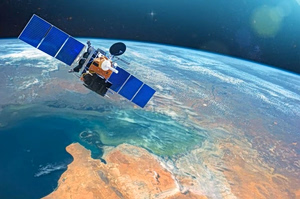
Crete is gaining new infrastructure for Greece’s space program, as the Ministry of Digital Governance and Artificial Intelligence installs a ground satellite station at the Foundation for Research and Technology (FORTH), which will serve as the operational communication hub for Greece’s fleet of microsatellites.
The station will provide telemetry, remote control, and data transfer services, making it one of the key ground-based components of the “National Microsatellite Program.” A lease agreement for installing the station and related equipment has been signed between FORTH and the General Secretariat of Telecommunications and Post, with a start date of November 1, 2025.
A €200 Million Program for Greek Microsatellites
The project falls under the “National Microsatellite Program,” with a total budget of €200 million, carried out in partnership with the Hellenic Space Center and the European Space Agency (ESA), funded through Greece’s Recovery and Resilience Fund.
FORTH was chosen to host the ground station because of its research work in space-related technologies, including satellite remote sensing, astrophysics, advanced telecommunications, quantum communications, and space surveillance. FORTH also runs the Skinakas Observatory jointly with the University of Crete, which is being developed to support space surveillance technologies and secure ground-to-space laser communication.
Who Built It
The consortium that built the ground station was led by Open Cosmos Aegean, while installation was completed by the Greek Libre Space Foundation, which specializes in space technology development.
Digital Governance and AI Minister Dimitris Papastergiou said the program is building infrastructure that will let Greece put satellite data to use in critical areas such as civil protection, climate change response, environmental protection, precision agriculture, maritime surveillance, and spatial planning.
Another €35 Million for Space Technology in Crete
The station’s installation coincides with another major investment in Crete’s space sector. FORTH secured €35 million in funding from the HORIZON-WIDERA-2025 program to establish the Crete Centre of Excellence in Emerging Space Technologies (CCEST) through the SPACE-Crete project.
The goal is for Crete to develop into an international hub for research and innovation in space technology. SPACE-Crete’s scientific lead, Panagiotis Tsakalidis, noted that the data collected by the new station can be used to develop new services.