 Μake us preferred on Google
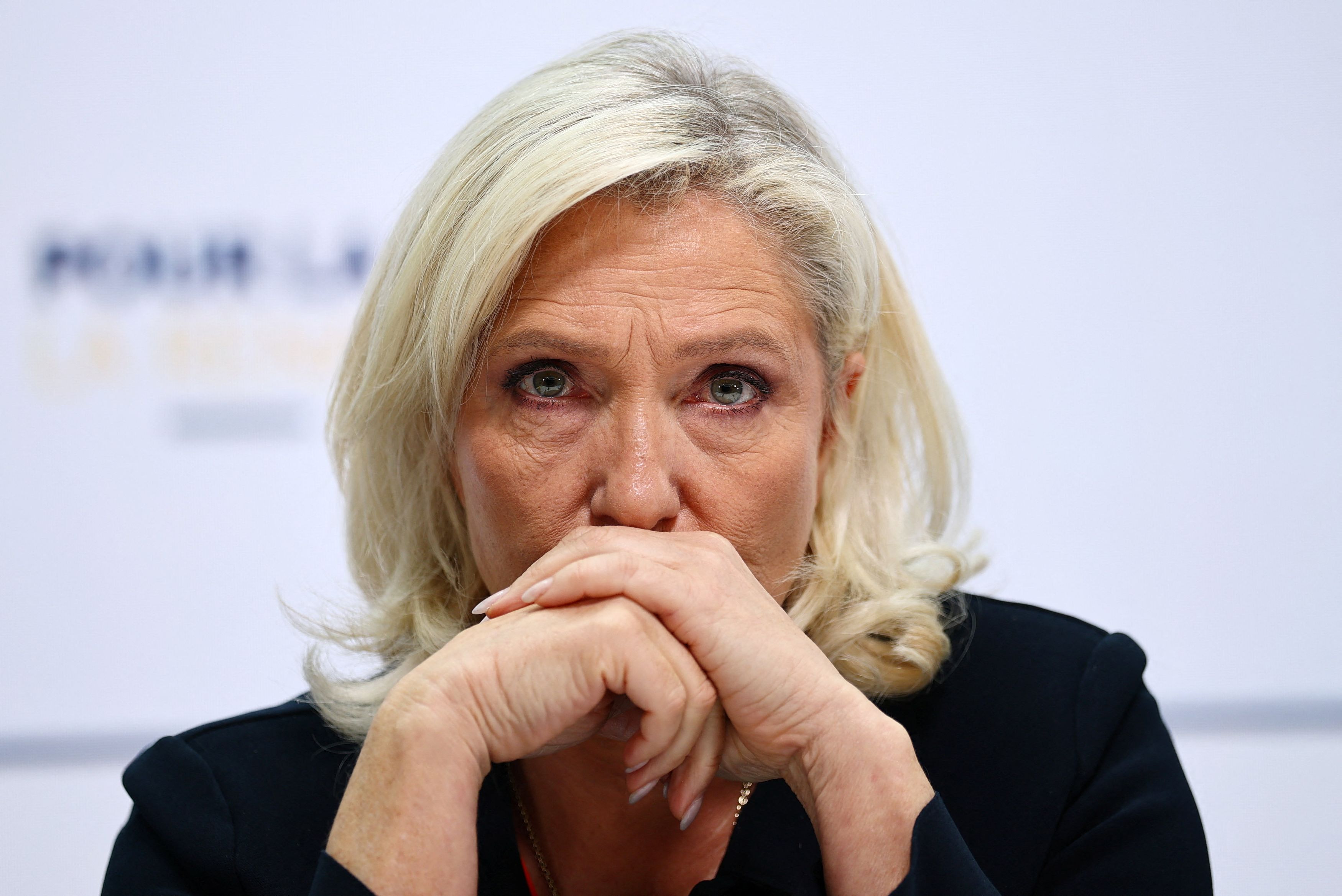
 France’s far-right leader Marine Le Pen is gearing up for a fight with the EU if elected president next year, promising a “trial of strength” over the bloc’s budget and powers while questioning whether the top leadership should remain.
In an interview with the FT, the frontrunner in the April contest showed that her ambitions to transform the EU from within are undimmed even as she tries to reassure voters about her pragmatism on other issues, such as tackling France’s degraded public finances.
She recognised that her biggest “outside constraint” was the “gigantic, enormous debt . . . that could become uncontrollable”, but said she was determined to enact her policies both domestically and in Europe.
“Politics is in reality a question of conviction confronted by constraints,” she told the FT in her Paris office. “I have no intention of losing my convictions.”
Le Pen sees her potential victory in next year’s contest, together with possible gains for her nationalist counterparts in elections in Spain, Italy and Poland, as ushering in radical change in the EU, including a weaker European Commission.
“You have to take into account that there is an extraordinary event in 2027,” she said, referring to the supercycle of elections over the next 12 months.
She questioned whether Ursula von der Leyen could remain as Commission president through to the end of her mandate in 2029 since “she no longer has the confidence of many governments in the EU”.
Le Pen, 58, is fighting her fourth presidential contest with greater confidence and as the wide frontrunner in polls, with her mainstream rivals divided and a restless population more prepared for a rupture with the past.
Yet she is running against a backdrop of a brewing debt crisis. Bond investors have pushed up French borrowing costs over concerns about the sustainability of its debt at 119 per cent of GDP, a challenge to all presidential candidates.
Le Pen last week unveiled a €140bn plan to tackle France’s deficit if she were elected, which includes deep public spending cuts as well as tax reductions for consumers and protections for pensioners. The five-year plan also includes savings of €11bn from cutting France’s 2027 contribution to the EU budget and tens of billions more in subsequent years, which would provoke a stand-off with Brussels and other European capitals, especially Berlin.
The EU is racing to agree a seven-year budget before the French presidential elections and Le Pen is travelling to Brussels on Wednesday to warn against what she described as a “deeply objectionable” attempt to seal a deal. “In fact, I think it reveals the contempt the Commission has for democratic processes in Europe,” she said.
She recognised that her mission to slash France’s EU budget contribution would not come easily. “We know there will be a tough debate, even a trial of strength,” she said. “But we have the will and the conviction that we will be able to do it.”
A country cannot unilaterally cut its contribution to the EU budget because that contravenes the bloc’s treaty and would require the agreement of 26 other member states.
Her comments underline that even though she dropped her push for France to leave the EU and the euro nearly a decade ago, she remains profoundly Eurosceptic. She wants power in the EU to shift back to member states, reversing what she sees as the Commission’s attempts to “take competencies” on diplomacy and defence.
Asked whether her planned clash with the EU would not itself unnerve markets, she retorted that the bloc’s heavy debt was a bigger concern and that there must be a benefit to France being in the Eurozone.
Le Pen said she wanted the European Central Bank to finance large-scale borrowing for priorities such as the energy transition and defence, arguing that the ECB was not a “fossilised dinosaur”. The EU’s treaties prohibit monetary financing but Le Pen insisted they were a “little malleable”.
Many economists and financial analysts have criticised her five-year deficit-reduction plan as unrealistic, difficult to enact and based on overly optimistic economic assumptions.
Le Pen disputed the criticism that the proposal would cause recession, pointing out that it included tax cuts on companies and a broad deregulatory push that would liberate business. “We will do both massive state spending cuts, while also kick-starting the economy,” she said.
Business leaders are sceptical that such a line can be walked and some remain mistrustful of what they see as her Rassemblement National’s big-spending, statist view of the economy. Analysts at ING estimated that the hit to growth of cutting public spending so quickly could be “several percentage points of GDP”.
She brushed off criticism from experts who she said shared responsibility for “the economic policies implemented in France over the past 30 years”.
“There are many economists in France, in particular, who advised those who drove us into the wall.”
Link To FT.com: https://www.ft.com/content/60d09841-052a-44f3-a8ae-52c38fdbb5ab
Copyright The Financial Times Limited 2026
© 2026 The Financial Times Ltd. All rights reserved. Please do not copy and paste FT articles and redistribute by email or post to the web.