
 Μake us preferred on Google
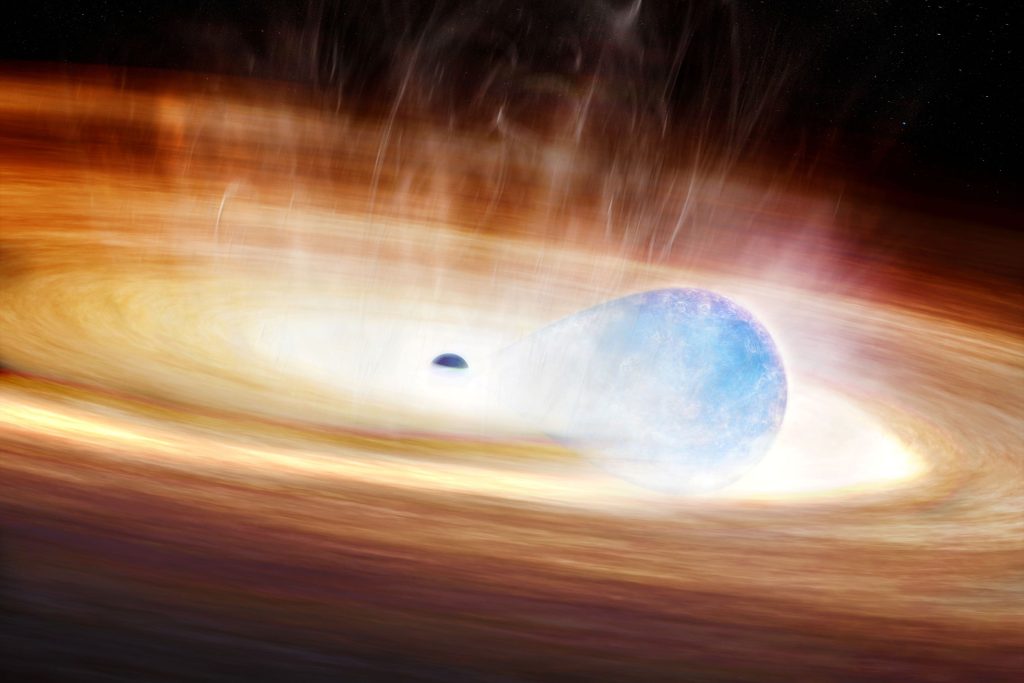
 Astrophysicists using the James Webb Space Telescope have identified a supermassive black hole with a mass 50 million times that of the Sun.
The discovery challenges established theories about how black holes form and evolve in the early universe.
The black hole is known as Abell2744-QSO1, a so-called “Little Red Dot,” a term used to describe very compact, reddish light sources observed at great cosmic distances. The object existed just 700 million years after the Big Bang and, despite its small size of roughly 1,300 light-years in diameter, could be observed in detail thanks to the gravitational lensing effect produced by the galaxy cluster Abell 2744, also known as the Pandora Cluster.
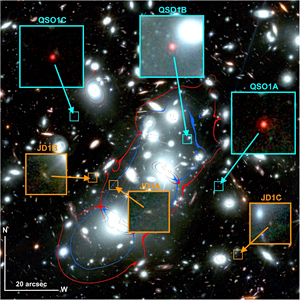
Deep field James Webb Space Telescope image of Abell 2744-QSO1 (teal)
The findings are presented in two new scientific studies from the Institute of Cosmology at the University of Cambridge, published in the journals Nature and Monthly Notices of the Royal Astronomical Society.
Overturning Established Models
Until now, the prevailing scenario held that supermassive black holes form gradually. A stellar-mass black hole is born from the collapse of a massive star and then grows by absorbing matter or merging with other black holes. Galaxy mergers eventually lead to the formation of colossal black holes with masses in the billions of solar masses.
The new finding, however, suggests that in some cases black holes may have grown much faster and through more unconventional mechanisms than previously calculated.
What James Webb Measured
Earlier observations had suggested that QSO1 might be a gas cloud hosting a black hole of around 40 million solar masses. Those estimates, however, were indirect and based on data from the nearby universe, which may not apply to the early, distant universe.
The researchers used James Webb’s NIRSpec instrument to directly measure the gravitational influence of the black hole on the surrounding gas and map the chemical composition of the region. They calculated the black hole’s mass at 50 million solar masses, ten million more than previous estimates.
New Questions About Cosmic Evolution
Even more striking is the fact that the black hole accounts for a very large share of its host galaxy’s total mass, something not observed in galaxies of the nearby universe. According to the scientists, the system is chemically barely evolved, yet already hosts an exceptionally large black hole, a phenomenon difficult to explain with existing cosmological models.
The finding compels researchers to revisit classical scenarios of black hole formation and growth. While the new measurement does not fully overturn the picture James Webb has offered of massive black holes in the early universe, it provides strong evidence that their evolution did not always follow the gradual, hierarchical path considered most likely.