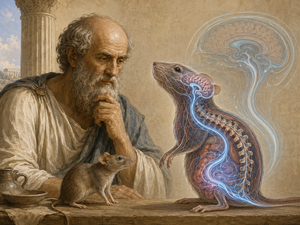
What if you could retrieve bits of information from your memory as easily as clicking and opening a folder in your computer, or what if you could recall information in a way that is so natural, it almost feels “embedded” in your mind?
Would you need a deep passion about something to achieve such a feat? Or spend endless hours reciting mind-numbing bits of information again and again, and again? Not necessarily.
The Power of Visualization
Since ancient times, the power of visualization has been considered essential for remembering things from “holy grail” texts, like the Iliad and Odyssey, to shopping lists for the local market.
A poet in ancient Greece, Simonides of Ceos, born approximately in 556 BC was the inventor of the so called “memory palace”, a mnemonic device that many who have watched the BBC’s Sherlock, might find familiar. The technique was born after Simonides had attended a banquet in which the roof collapsed on the guests. Having narrowly escaped, he was able to identify the bodies based on where they were sitting.
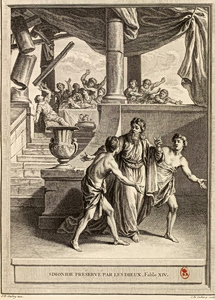
Engraving by Charles-Nicolas Cochin (II) after a drawing by Jean-Baptiste Oudry, depicting the fable “Simonides Preserved by the Gods” by Jean de La Fontaine (Book I, Fable 14). Source: Picryl
This technique transforms the minds into a giant house with many rooms which can be visited to retrieve specific heavily visualized parts of information. This is also known as the “Method of Loci”, the word Loci being the plural of the Latin word Locus meaning “place”.
The technique is based on the premise of pairing abstract information with familiar physical spaces. The more surreal the visualization, the better the association as it becomes more emotionally charged.
The technique was quickly adopted by learned circles in antiquity. Roman orators used it extensively as a practical tool to organize their thoughts in sequence, allowing them to speak for hours without notes.
Cicero, in his work De Oratore (On the Orator, 55 BCE), described how a speaker could mentally walk through a building, placing each part of a speech in a different room, then retrieve the entire argument in order simply by revisiting those rooms in his mind.
Medieval monks also extensively used this method to memorize entire chunks of the Bible and the Gospels by mapping out various routes across their monastery and creating bizarre associations.
Its effectiveness is so established that modern-day companies like Loci Languages have built an app based on this ancient method, allowing users to memorize new vocabulary by linking words to vivid pictures of places.
The Power of Simplification
Another exceptionally well-received method of retaining information was inspired by the working approaches developed by renowned physicist Richard Feynman.
Feynman himself never sat down to write a “technique”. Its creation was more so inspired by Feynman’s lifelong habit of insisting that to understand an idea, it has to be explained simply.
Biographers describe him keeping a notebook titled “Notebook of Things I Don’t Know About“, a running map of his knowledge gaps, which he’d then work to close through active reconstruction rather than passive review.
In his own retellings of tackling difficult research, he describes going back through supporting material piece by piece until every part of a hard idea made sense to him.
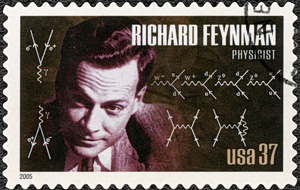
A stamp printed in USA shows portrait of Richard Phillips Feynman (1918-1982), physicist. National Postal Museum Collection, 2005. Source: Shutterstock
Based on this approach, writer Scott Young constructed in 2011 what he called the “Feynman technique”.
It asks one to first choose a concept, then to explain it in one’s own words simply but clearly as if talking to a child or someone entirely unfamiliar with that concept. Then, reflecting on your thought process, identify the gaps in reasoning, and returning to the source of information review specific parts. Finally, explain it again but in a simplified manner, adding analogies, comparisons and concrete examples.
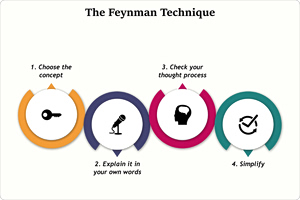
A simplified diagram of the Feynman Technique. Source: Shutterstock
The idea is to engage deeply with the information by forcing the detection of difficult-to-understand information and digging into the reasons behind the lack of understanding. Simplifying the concept afterwards in one’s own words makes it all the more deeply embedded into one’s mind.
As an approach this is quite time-consuming however, and its effectiveness remains anecdotal without many peer-reviewed studies backing it.
The Power of Repetition
In the 19th century, German psychologist Hermann Ebbinghaus showed that memory decays over time and that repeatedly reviewing material after delay rather than all at once improves retention. The crucial detail here is after delay.
He went on further to explain that to learn, you need to keep ahead of the forgetting curve, a model that posits that memory doesn’t just naturally decay over time, but that in fact people can lose 50% of new knowledge just within the first 24 hours.
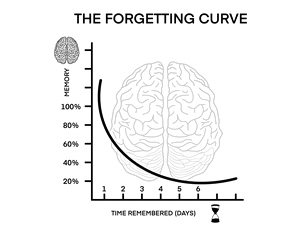
A simplified diagram of the forgetting curve. Source: Shutterstock
With this discovery came the birth of the memorization technique of spaced repetition. Ebbinghaus realized that by revisiting and reviewing material at gradually increasing intervals, it would combat the forgetting curve by forcing the brain to actively recall information that would otherwise have slowly faded from memory.
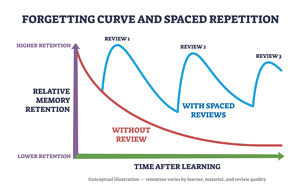
The Forgetting Curve and Spaced Repetition. Source: Shutterstock
The first to create an application of this technique was Piotr Wozniak, who invented the first computer algorithms by developing SuperMemo in 1985, turning the spacing effect into a concrete schedule that adapted to how well each item was remembered, allowing the method to shift from a psychological finding to a usable study method.
Since then there has been considerable scholarship on the effectiveness of spaced repetition particularly in the field of medicine.
Today, with the help of technology, memorization of crucial information can be done in a way that blends scientific rigour and the fast pace of modern life. Applications such as Anki, RemNote, or FlashRecall, amongst many others allow for mobile-friendly quick notes that can blend sound, image and text, creating memorable combinations. The most cutting edge modern approaches incorporate AI-assisted personalization to adjust flashcard number and difficulty level.
A Look Through Time
What all these approaches have in common is that they all force the brain to do more work than passive reading or listening, whether it’s building a vivid scene, rebuilding and simplifying an idea from scratch or straining to recall something before it fades.
Of the three, only spaced repetition has the weight of controlled research behind it, with the memory palace and the Feynman technique leaning more on centuries of practice and anecdote than on lab results. That of course doesn’t make them any less worth trying.
What’s clear across all three is that memory rewards effort spent up front. By building the palace, teaching yourself and reviewing before you forget, you’d be surprised how well you hold on to new discoveries.