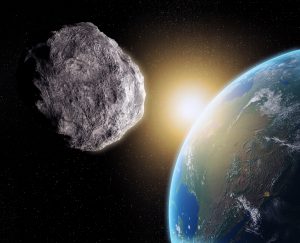
A Japanese spacecraft made history this month by passing just 400 meters from an asteroid, according to the Japan Aerospace Exploration Agency (JAXA), the closest distance ever achieved in this type of mission.
Hayabusa2, roughly the size of a refrigerator, made the closest flyby in the history of such missions on July 5. The flyby demonstrated the ability to help deflect a potentially hazardous space rock that could threaten Earth.
Traveling at more than 18,000 kilometers per hour, the spacecraft came within 400 meters of the asteroid’s surface and 744 meters of its center, a performance that beat JAXA’s own projections, which had estimated a minimum distance of about 800 meters from the center of the asteroid, known as Toutatis.
JAXA scientist Yuya Mimasu told reporters that compared with every spacecraft that has ever flown past an asteroid, this one came closer than any before it.
The previous record was held by a Chinese spacecraft that came within 770 meters of an asteroid, according to the business newspaper Nikkei.
After the flyby, JAXA released rare images showing the asteroid has a shape resembling a snowman.
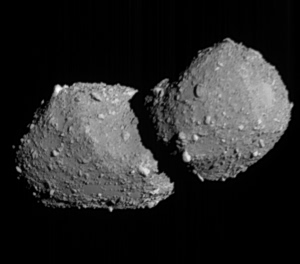
The black-and-white photos, taken with a telephoto camera, show two spheres fused together. While the asteroid’s elongated shape was already known, the details had remained unclear until now.
The mission builds on NASA’s successful 2022 test, when the US space agency altered the orbit of the asteroid Dimorphos by crashing a spacecraft into its surface.
JAXA and the European Space Agency are also working together on a new “planetary defense” mission to explore the asteroid Apophis, which is expected to pass close to Earth in April 2029.
Hayabusa2, launched in 2014, had already impressed the scientific community by landing on the asteroid Ryugu and collecting samples about 300 million kilometers from Earth. Six years later, those samples returned to Earth, offering important clues about the birth of the solar system roughly 4.6 billion years ago.
After its encounter with Toutatis, Hayabusa2 is scheduled for a 2031 rendezvous with the asteroid 1998 KY26, with a possible landing to gather further data.