About 600 years ago, members of the pre-Inca Chimú civilization buried more than three dozen people in a mausoleum near what is now Trujillo, Peru. The dead were laid to rest with an extensive collection of grave goods, metal weapons, copper and gold objects, elaborate jewelry, and colorful textiles, evidence pointing to high social status, possibly even royalty.
The tomb stayed largely undisturbed until this year, when excavation work uncovered its entrance buried under layers of sand, soil, and stone at Chan Chan, a UNESCO World Heritage Site and the former Chimú capital. It likely dates to right around the time of the Inca conquest of the region in the mid-15th century, making its survival through both colonial-era and modern looting all the more remarkable.
Lead archaeologist Jorge Meneses told BBC News that this is essentially the first time Peruvian archaeologists have encountered an almost fully intact funerary platform built for an elite individual, one whose main chamber stayed sealed for nearly six centuries. He explained to El País that, until now, most knowledge of elite Chimú burials came from looted sites, private collections, and museum holdings, with no real scientific data tying individuals to their belongings and burial context.
The Chimú civilization flourished across what’s now northern Peru between roughly 900 and 1470 CE. Hydraulic engineer Charles Ortloff has described it as the first genuine engineering society in the Americas, noting the Chimú built extensive irrigation canal networks that let their population thrive in an otherwise arid desert valley. Chimú kings lived in walled palace compounds, and tradition held that each new ruler built their own royal complex upon taking power. Many of the surviving palaces at Chan Chan include funerary platforms where rulers were buried alongside members of their court.
At its peak, Chan Chan was the largest city in the Americas, with a population that may have reached 60,000.
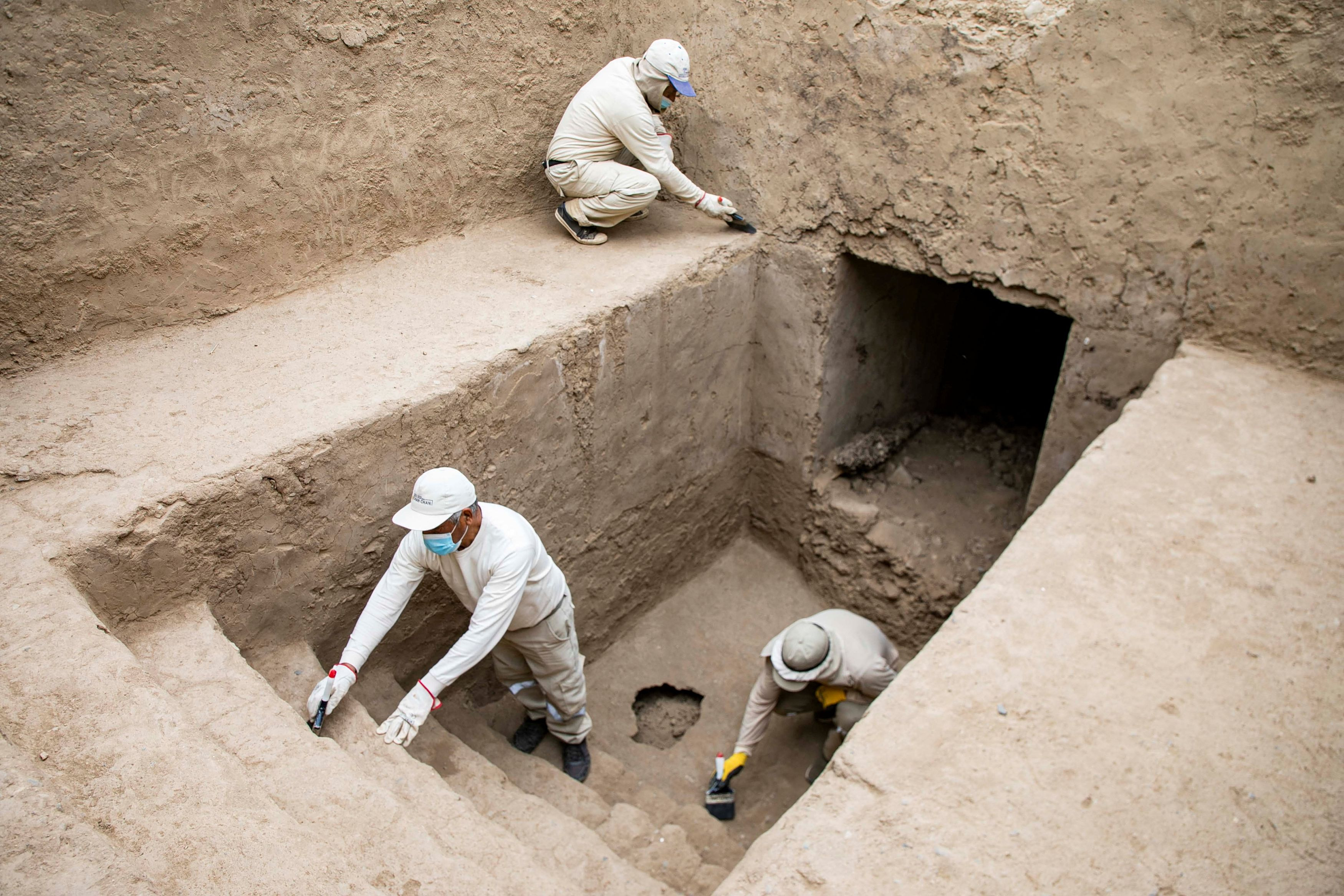
Peruvian archaeologists work at an almost intact pre-Incan funerary platform containing remains of 38 individuals, including an elite member of the Chimu civilization that flourished on Peru’s northern coast between 900 and 1470 AD, in Trujillo, Peru, in this handout image distributed on September 8, 2026. Peruvian Culture Ministry/Handout via REUTERS
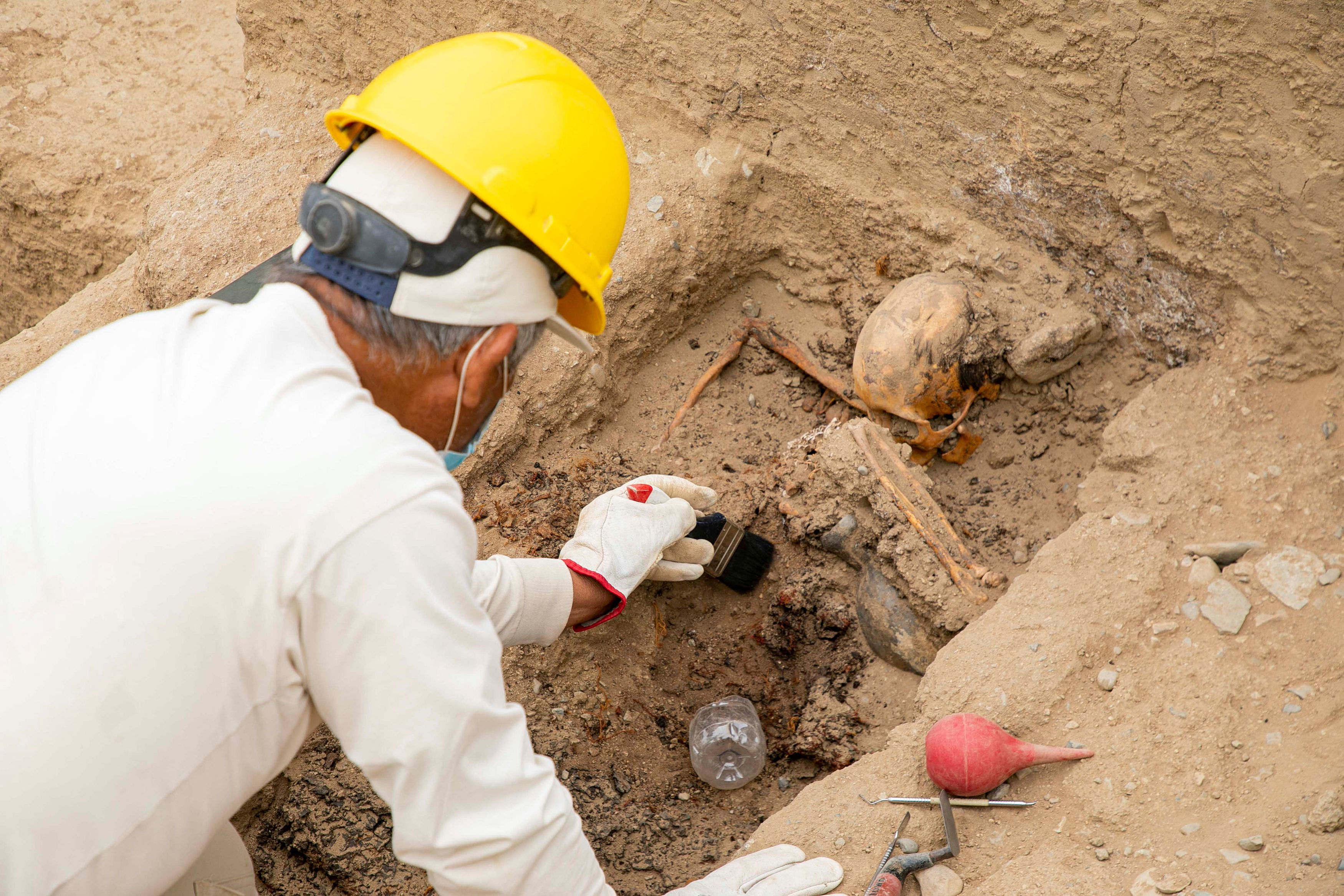
A Peruvian archaeologist cleans remains at an almost intact pre-Incan funerary platform containing remains of 38 individuals, including an elite member of the Chimu civilization that flourished on Peru’s northern coast between 900 and 1470 AD, in Trujillo, Peru, in this handout image distributed on September 8, 2026. Peruvian Culture Ministry/Handout via REUTERS
Inside the tomb
The newly found mausoleum sits within Chan Chan’s Utzh An complex. A staircase leads down into a central chamber roughly 4 feet wide and 16 feet deep, according to Peru’s state news agency, Andina. Inside, researchers found the remains of one individual whose skull showed traces of a red pigment, possibly cinnabar, a mercury-based mineral. Some bones from the skeleton were missing, suggesting the remains may have been moved or reburied at some point, a practice that was fairly common in Andean societies, where communities often continued interacting with, and even venerating, the remains of deceased loved ones and leaders.
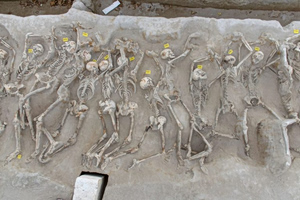
Two smaller rooms flank the central chamber. One was largely empty, while the other contained around 20 sets of human remains along with various artifacts. Archaeologists uncovered another 17 skeletons elsewhere on the funerary platform, bringing the total number of people buried at the site to at least 38.
Much remains unknown about who these individuals were, including their ages, genders, and how they died. A Peruvian Ministry of Culture official, Henry Luis Gayoso, told the New York Times that what’s clear so far is that the people buried there were either part of the elite or closely connected to it.
University of Florida anthropologist Gabriel Prieto, who wasn’t involved in the excavation, called it the discovery of the decade in the sense that it’s the first time archaeologists have been able to directly examine an elite Chimú burial. Researchers hope studying the untouched tomb will offer new insight into Chimú funerary customs and social structure during a turbulent period for the civilization.
The find also highlights how much of the ancient capital remains unexcavated. Meneses noted that archaeologists have so far uncovered no more than 7 percent of Chan Chan’s total area, meaning the site likely still has a great deal more to reveal.
Source: Smithsonian magazine