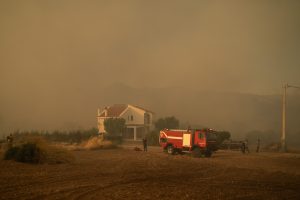
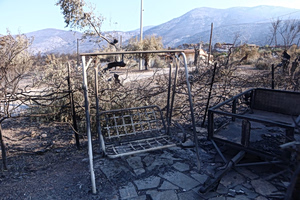
It will take more than a century for the forest destroyed in the recent wildfire on Mount Trapezitsa, near Konitsa, to be reborn. The fire entered its ninth consecutive day on Sept. 8, cutting through one of northern Greece’s most remote and ecologically sensitive forests. The fire had burned about 8,000 stremmata (roughly 2,000 acres) as of Sept. 8, according to data from FireHUB, a monitoring service run by the BEYOND Centre of Excellence at the National Observatory of Athens.
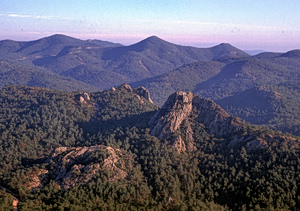
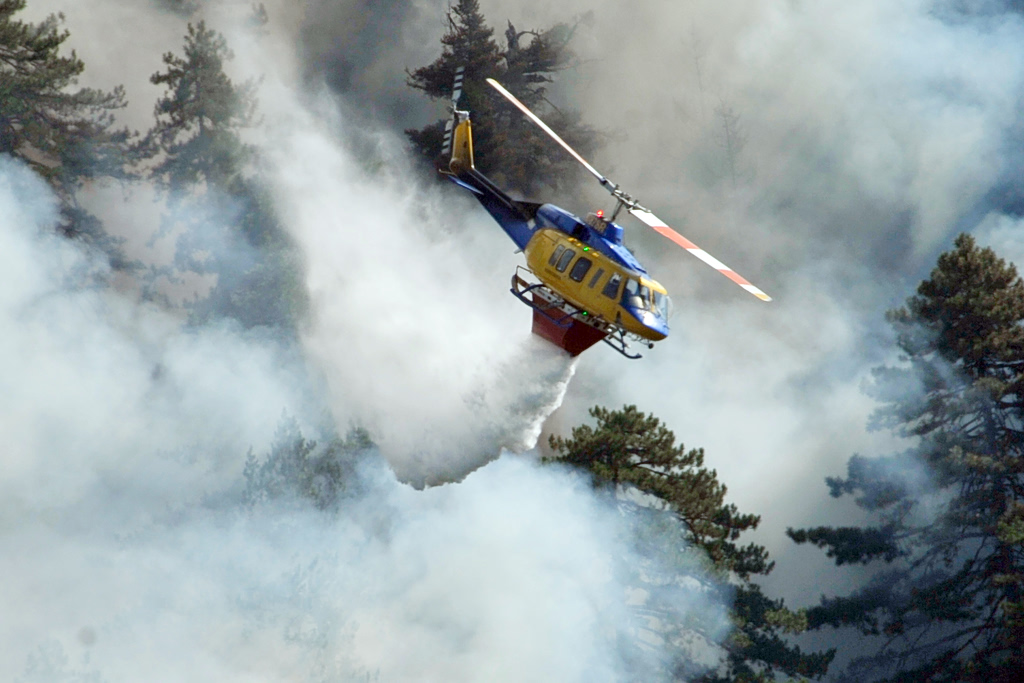
Much of the burned area lies inside Zone II of Northern Pindos National Park, a section of the European Union’s Natura 2000 conservation network that carries enhanced protection status. The terrain is steep and heavily forested, with little road access, forcing crews to rely heavily on aircraft. Helicopters spent Sept. 8 ferrying portable water tanks to forest fire commando units working on the mountain, since ground vehicles could not reach large parts of the fire front.
A slow recovery, if any
Elias Tziritis, an actions coordinator for forest fires at WWF Greece, said the mountain’s terrain and dense tree cover make the Trapezitsa fire especially difficult to assess and to fight.
“We are talking about a very mountainous and steep area, with very dense forests,” Tziritis said. He said officials still need to determine which sections burned only at ground level and which lost their tree canopy entirely, since canopy loss carries a far heavier ecological toll.
For the high altitude species that dominate northern Greece’s mountains, Tziritis said natural regrowth can be extremely slow. In the most severely damaged sections, he said, natural recolonization from surrounding, unburned areas could take more than a century. Fir and black pine, the two species that make up much of the burned forest, lack the strong regenerative mechanisms found in typical Mediterranean ecosystems, he said, meaning recovery in those areas depends almost entirely on trees reseeding in from elsewhere, a process that unfolds over generations rather than years.
A pattern at high altitude
The Trapezitsa fire has sharpened concerns about a shift already underway in Greece’s mountain forests, which were long considered less vulnerable to major fires than the country’s lowland and coastal areas.
In recent years, large fires have also struck Mount Paggaio, Mount Menoikio and Mount Orvilo, where a 2024 wildfire burned at low intensity for 27 days. The Pindos range itself has lost tens of thousands of stremmata of forest in recent seasons. Tziritis said climate change and prolonged drought are now affecting mountain forests once seen as more resilient.
He described the Trapezitsa fire as part of a broader change in how high altitude fires behave. The Greek mountains have always seen fires, he said, most often sparked naturally by lightning strikes. What has changed, he said, is scale and duration: fires that once burned out quickly are now reaching 15,000 or even 30,000 stremmata and staying active for many days at a time.
“Planning needs to change,” Tziritis said. “We need to concentrate resources on these fronts and intervene earlier.” He said firefighting in many of these areas depends almost entirely on aircraft because of the lack of roads, but that aerial crews become far less effective once they are operating over such difficult terrain.
August’s toll nationwide
The Trapezitsa fire adds to a difficult summer for Greek forests more broadly. According to BEYOND Centre of Excellence records, wildfires burned a total of 20,280 stremmata across Greece between Aug. 1 and Aug. 31. The two largest August fires struck the Doris region, where 4,450 stremmata burned, and the island of Skyros, where 4,090 stremmata were lost.