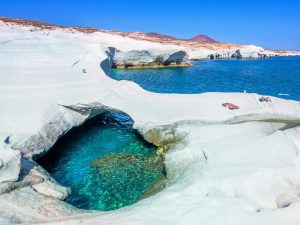
Personal responsibility also plays a part. That was the response of Milos Mayor Manolis Mikelis, speaking to tanea.gr, after a tourist nearly drowned at Sarakiniko, the striking white-rock beach that ranks among the most photographed spots in Greece.
Video of the woman struggling against the waves, at risk of being thrown against the rocks, spread quickly across social media. It brought back memories of the double tragedy of August 2025, when two tourists from Vietnam lost their lives at the same spot.
The mayor said Sarakiniko is staffed by lifeguards from 10 a.m. to 6 p.m., with buoys and warning signs in place. But the head of the Panhellenic Union of Private and Professional Yacht Crews, Giorgos Vallis, told tanea.gr the safety measures fell seriously short, warning that Sarakiniko risks claiming more victims. Mikelis pushed back with his own account of conditions at the site.
1.2 million euros for lifeguards on Milos
According to the mayor, Sarakiniko has organized lifeguard coverage for the first time this year, beginning June 1, 2026, after a three-year effort to secure it. Two lifeguards patrol the area continuously from 10 a.m. to 6 p.m.
Mikelis noted that Milos has 74 beaches, and not all of them can be covered by lifeguards. Getting approval for Sarakiniko took work, he said, because the site is not officially classified as a beach.
“We made a big effort, since it is not a beach, to get approval and permission to place lifeguards there,” he said. He added that the municipality is spending roughly 1.2 million euros to provide lifeguard coverage, including at spots that are not especially crowded but carry greater risk.
“There are two lifeguards who move constantly across the whole of Sarakiniko,” he said. “At the entrance there are information signs about the dangers, and buoys have been placed in the water so that in an emergency a swimmer can hold on until help arrives.”
The danger rises sharply, he explained, when strong northerly winds blow. “When it is blowing seven on the Beaufort scale and there is heavy swell, it is not safe to dive from the rocks. That is why we are constantly informing people, and the lifeguards keep advising visitors,” he said, noting that lifeguards “can only give advice. They cannot make an arrest.”
Why a private security proposal was turned down
Pressed on the safety complaints, the mayor was also asked about a proposal made after the 2025 tragedy by Dimitris Poulakis, head of the Milos Association of Room Renters, a local body representing owners of short-term rental accommodations.
Poulakis had written to the municipal authority offering to have his association cover the cost of stationing security personnel at Sarakiniko after the lifeguards’ shift ended, to discourage visitors from making dangerous dives in the evening hours.
The mayor replied that the proposal concerned guarding the site rather than the safety of swimmers. “This is something we are discussing, but it is about guarding the area. It is not about the safety of swimmers,” he said.
When it was pointed out that, according to Poulakis, the proposal called for security to be present at all hours, including after the lifeguards went off duty, so that swimmers could be warned, the mayor argued that swimmer safety requires trained specialists.
“For the safety of swimmers you need specialized people,” he said. “Putting a security guard there is not going to help someone who might get into danger on a dive.” He added that the lifeguards “even have bullhorns so they can call out to swimmers who need to be careful.”
Source: TA NEA