On the small eastern Aegean island of Thymaina, Greece’s demographic crisis has taken on a very human scale: there are just two children in the local primary school.
The sight of two pupils in a school that once served dozens captures the pressures facing many of Greece’s smaller islands, where falling birth rates, high living costs and limited transport and public services are making it increasingly difficult to attract and retain younger families.
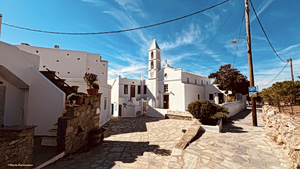
Thymaina is part of the Fournoi Korseon island complex, lying between Ikaria and Samos. Covering just over 10 square kilometers, it is the second-largest inhabited island of the group after Fournoi. The island has a rugged coastline, numerous coves and a landscape characterized by dry-stone walls and traditional architecture. Its name is believed to derive from the abundant thyme growing across the island.
The island’s primary school is now operating with two pupils.
“When these children finish primary school, the school will be suspended and, after a few years, it will close permanently,” educator Konstantinos Fantelas said.
Thymaina has no kindergarten or secondary school. Older children must travel by boat to neighboring Fournoi to attend school, a routine that can become difficult when weather conditions deteriorate.
The daily journey also illustrates the island’s dependence on its larger neighbor. Fournoi is the administrative and transport hub of the island group, with Thymaina linked to it by small passenger vessels. Thymaina does not have a direct ferry connection with Piraeus and is reached via other islands, including Fournoi, Ikaria and Samos.
For families, the challenge extends beyond education.
“Why should young people stay on the island? What does the state offer to make them stay here?” retired resident Stelios Grammatikos said, describing the difficulty of maintaining basic services and the high cost of living.
Residents say food and other everyday necessities can cost substantially more than on the mainland because virtually everything has to be transported to the island.
The contrast with the past is particularly striking.
“There used to be more of us and there were many children,” retired resident Aikaterini Markaki said. She recalled families with seven, nine or even more children and noted that the primary school had once had 45 pupils.
Today, Thymaina has fewer than 200 permanent residents, according to the latest census, with older people making up a significant share of the population. The number of children and young families remains a central concern, particularly because the viability of schools and services depends on a steady younger population.
The island’s demographic trajectory has not been entirely linear. Census figures recorded 143 residents in 2011 before the population rose to 191 in 2021. But the much smaller number of children and young families remains a central concern.
For fishermen such as Giannis Mitikas, the problem is not simply that young people leave to study. It is that they rarely return.
“Children who grow up here eventually leave,” he said. “They go to Athens, find work or go to sea and work on ships. They no longer return to the island to settle and live here.”
That creates a cycle that is difficult to break: fewer young families mean fewer children, fewer children threaten the viability of schools and other services, and fewer services make the island less attractive to people considering moving there.
Thymaina is not simply an island defined by depopulation. Its waters are part of an ecologically important archipelago, with the wider Fournoi complex included in the Natura 2000 network and recognized for its biodiversity and importance as a habitat for birds, including Eleonora’s falcons and Aegean partridges.
But the island’s future is increasingly being measured in schoolchildren.
Two pupils are enough to keep the primary school open for now. What happens when they leave may determine whether the school — and, in a broader sense, the community around it — has a future at all.
H.T.