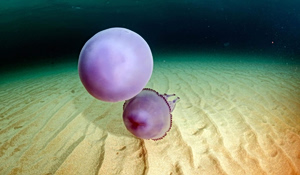
An estimated 14,641 Cassiopea andromeda jellyfish have been found in a small, semi-enclosed rocky lagoon in Kallithea, Rhodes, in what scientists say is the largest known concentration of the species ever recorded in the Mediterranean.
The unusual finding was made in a lagoon covering just 430 square meters, according to a new scientific study by Greece’s Hellenic Centre for Marine Research (HCMR).
Cassiopea andromeda is commonly known as the “upside-down jellyfish” because it spends much of its time inverted on the seafloor.
An expanding non-native species
Cassiopea andromeda is a non-native species originating from the Indo-Pacific that has become established in the Mediterranean.
In recent years, the species has been spreading, particularly in the eastern Mediterranean and the Aegean Sea.
Scientists conducted measurements on 275 jellyfish as part of the study and found a wide range of sizes among the animals.
According to the researchers, the variation in size indicates that the population is undergoing continued reproduction and growth.
The species’ identity was also confirmed genetically using DNA barcoding, a method used to identify organisms through specific DNA sequences.
Small coastal areas can become refuges
The researchers said the findings highlight the need for systematic monitoring of semi-enclosed coastal ecosystems.
Such locations can serve as “pockets” where non-native species become established before spreading further, according to the study.
The research was conducted by scientists from the Rhodes Hydrobiological Station and HCMR’s Institute of Oceanography, in collaboration with the Department of Biology at Aristotle University of Thessaloniki.
The study was published in the scientific journal BioInvasions Records.