
Wrapped parcels, festive paper, and bright ribbons are now inseparable from Christmas. Each year, children and adults alike relive the childlike anticipation of giving and receiving gifts, sharing moments with family and friends in a season when solidarity and reciprocity seem to reach their peak.
Yet the history of the Christmas gift—today almost synonymous with the holiday’s atmosphere—is far older and deeper than its modern, consumer-driven expression.
Thirty years ago, on Dec. 24, 1995, TO BHMA published an article by Minas Al. Alexiadis, then Associate Professor of Folklore at the University of Athens, titled “The Ideology of Christmas.” Drawing largely on international scholarship, the piece offered a historical and folkloric survey of gift-giving customs, tracing their origins well beyond Christianity.
Pre-Christian Roots and Winter Rituals
As Alexiadis notes, the exchange of gifts did not originate in Christianity. Its roots lie in pre-Christian societies and are closely tied to winter religious festivals. In these contexts, gifts were not mere gestures of courtesy but symbolic acts marking the transition to a new cycle of time—one associated with productivity, fertility, and abundance.
As the British folklorist Christina Hole observed, gifts were exchanged among members of different groups during winter religious celebrations, often around the winter solstice. This period marked not only the turning of the year but also the beginning of a new cycle of production essential to human life.
Roman Strenae and the Symbolism of Abundance
In ancient Rome, the wealthy customarily offered money or clothing to poorer neighbors during the seventh day of the Saturnalia. During the January Kalends, gifts were exchanged across all social classes. These gifts were known as strenae, a name derived from a tradition linking them to simple green branches gathered from groves sacred to the goddess Strenia.
Their purpose was clear: to invoke and secure renewed productivity and fertility. Beyond their decorative use, the greenery symbolized contact with the spirit of vegetation itself. In later Roman times, strenae were even dipped in honey, a transparent and widely understood symbol—wishing the recipient a new year filled with light and sweetness.
Integration into the Christian Festive Calendar
Over time, gift-giving was gradually absorbed into the Christian festive cycle, particularly Christmas—a celebration that coincided, not by chance, with earlier winter festivals.
Across Europe, different figures took on the role of gift-bringer. In many countries, according to Hole, Saint Nicholas—dressed in episcopal robes—visited homes on the eve of his feast day (December 5), on Christmas Eve, or on a day during Advent. Elsewhere, gifts were brought by Saint Martin or by a mysterious figure known as Knecht Ruprecht, a wild-looking character clad in animal skins and straw, who appeared on Christmas night.
In parts of Germany, it was the Christ Child himself who delivered gifts, responding to letters children left on windowsills days before Christmas. In France, gifts were traditionally exchanged on New Year’s Day, while in Spain they were given on Epiphany. There, children placed their shoes on balconies or windowsills on Epiphany Eve, trusting that the passing Three Kings would fill them with gifts.
From Santa Claus to Modern-Day Gift-Giving
In Sweden’s urban middle classes, as recorded by Clement Miles, Christmas gifts were once delivered by two elderly masked figures—a man and a woman. The man rang a bell, while the woman carried a basket filled with sealed packages to distribute.
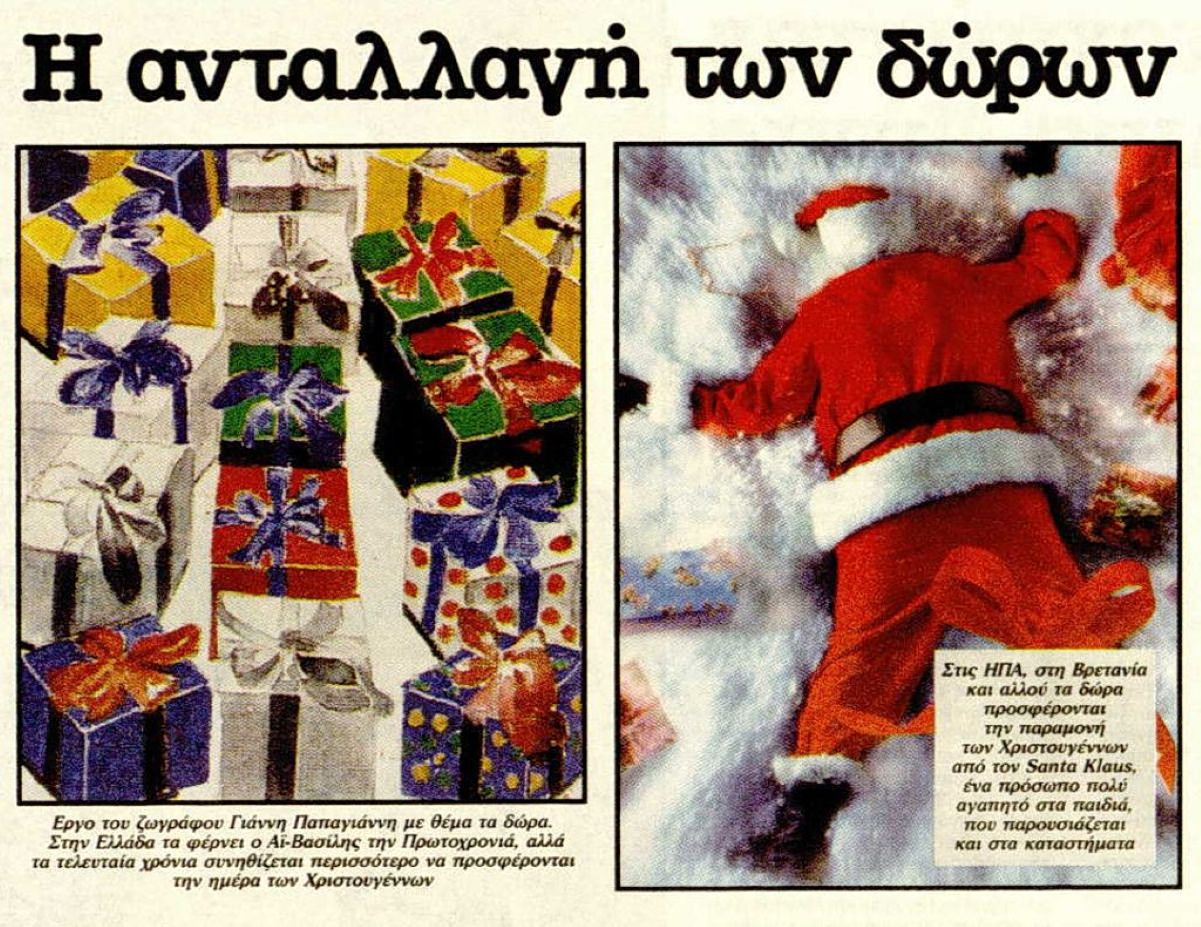
In Great Britain, the United States, and much of the English-speaking world, gifts are brought on Christmas Eve by Santa Claus, a figure deeply beloved by children and ubiquitous even in shop displays.
In Greece, gift-giving was traditionally associated with Saint Basil and New Year’s Day.
By the 1990s, however, the custom had largely shifted to Christmas Day itself. Gifts now gather beneath the Christmas tree, enhancing the festive spirit and lending added warmth and cheer to these treasured hours and days.