In May 2026, the Hellenic Aquaculture Producers Organization (HAPO) gathered in Athens to promote the industry as the future of sustainable food security. Flanked by industry titans, the European commissioner for fisheries and oceans, Costas Kadis, painted aquaculture as a solution to the pressures of climate change, pollution, and overfishing. “In the European Union, aquaculture is at the epicenter of our priorities,” he said. The chairman of HAPO, Apostolos Touralias, went one step further in endorsing the industry’s future importance:
“Aquaculture is the most sustainable form of animal protein,” he said. “Aquaculture needs less space, less feed, less freshwater. It produces the lowest carbon footprint regarding all other sectors.”
After the 2011 debt crisis, Greece bet its coastal future on the blue economy by mapping out 25 “Areas of Organized Development” (POAY). While many of these zones still remain in the final stage of legal approval, the plan earmarked potentially exclusive use of almost 60,000 acres of coast to multinational firms. Expanding the industry’s footprint 24-fold came with a simple economic pitch: People want more seafood, the limit of what can be viably pulled from the wild is quickly being reached, and fish farming is the way to meet the growing demand while slowing the collapse of the oceans.
From the Ionian Sea in the west to the Euboean Gulf in the east, the Greek farmed finfish industry is now the most valuable in the European Union. Producing over 120,000 tons annually, Greece is the bloc’s top producer of sea bream and sea bass. This export-driven industry sends over 80 percent of its harvest abroad—primarily to the culinary hubs of Italy, Spain, and France, which absorb nearly three-quarters of these exports.
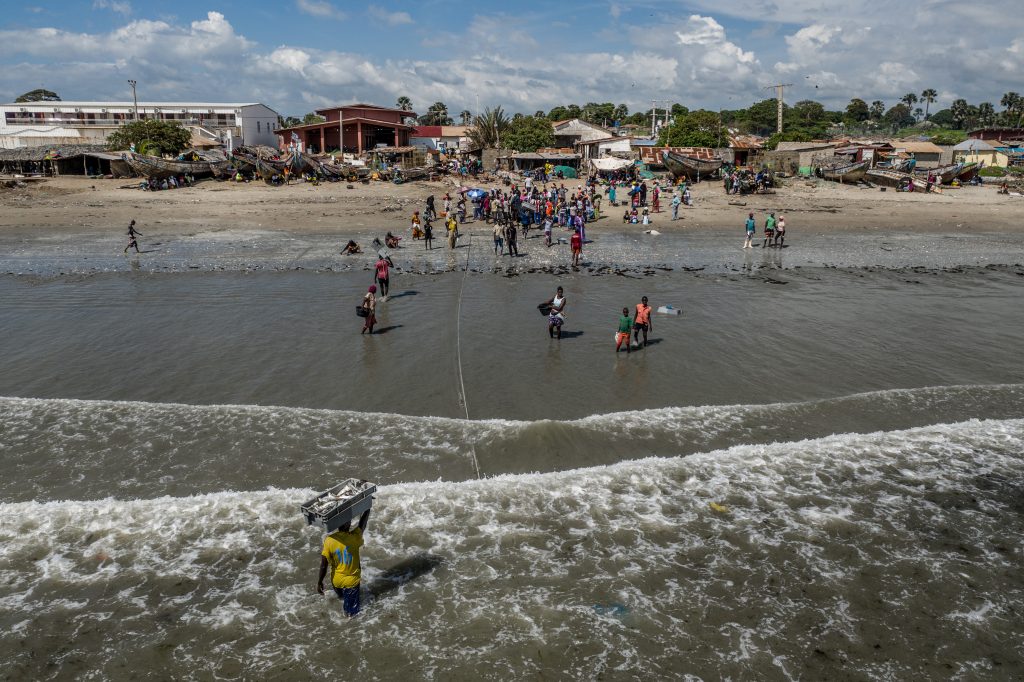
Caption: Workers carry crates of fish to shore in Gunjur, The Gambia, in 2019. Much of this same catch previously provided an affordable source of protein for local communities, but the higher prices fishmeal plants offer have since redirected the catch into the export market.
Credit: Fábio Nascimento/The Outlaw Ocean Project
Now accounting for over two-thirds of the nation’s total seafood production, fish farming provides a valuable maritime economy to remote coastal communities employing roughly 4,000 people directly and another 6,000 indirectly. Globally, the ocean-sustainability argument for fish farming—“grow more, so we can catch less”—is one of the reasons that the $313-billion aquaculture industry is currently the fastest-growing food sector, and why half of the seafood eaten around the world is now farm-raised rather than caught at sea.
There is a problem, though.
“The aquaculture industry’s sales pitch is flat wrong,” said Daniel Pauly, project director of the Sea Around Us initiative at the University of British Columbia.
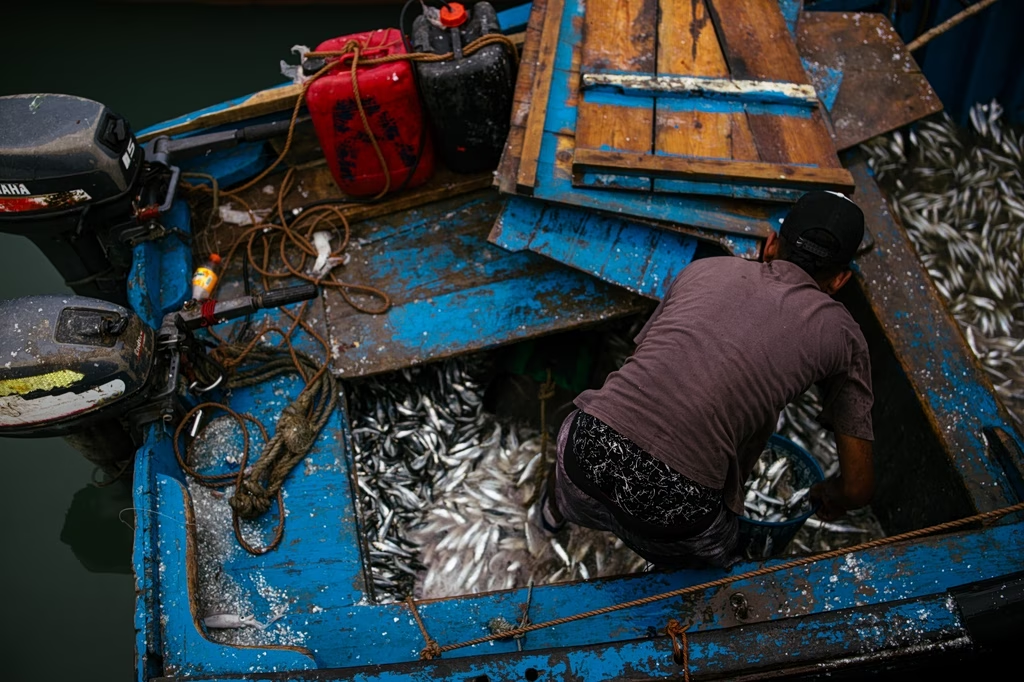
The most popular types of farmed seafood produced in Greece—sea bass and sea bream—are fed the kinds of wild fish that aquaculture claims to be saving, thereby accelerating ocean depletion, not slowing it, he explained. Two-thirds of global aquaculture grows species that are fed fishmeal and fish oil, ingredients made by cooking and pulverizing wild-caught fish. Before it reaches market, a farmed seabass or sea bream, for instance, eats at some Mediterranean farms more than two-and-a-half times its weight in wild-caught fish.
The concerns about aquaculture extend far beyond the fate of the oceans. The feed that powers most of this industry comes with a huge variety of other hidden costs, many of them borne by communities far away from Greece, according to a wide-reaching investigation by The Outlaw Ocean Project, a news organization based in Washington, DC. These costs include the loss of artisanal fishing jobs, chronic chemical exposure, avoidable worker deaths, and violent protests typically spurred by the horrid stench from fishmeal factories as countries compete for scarce sources of protein.
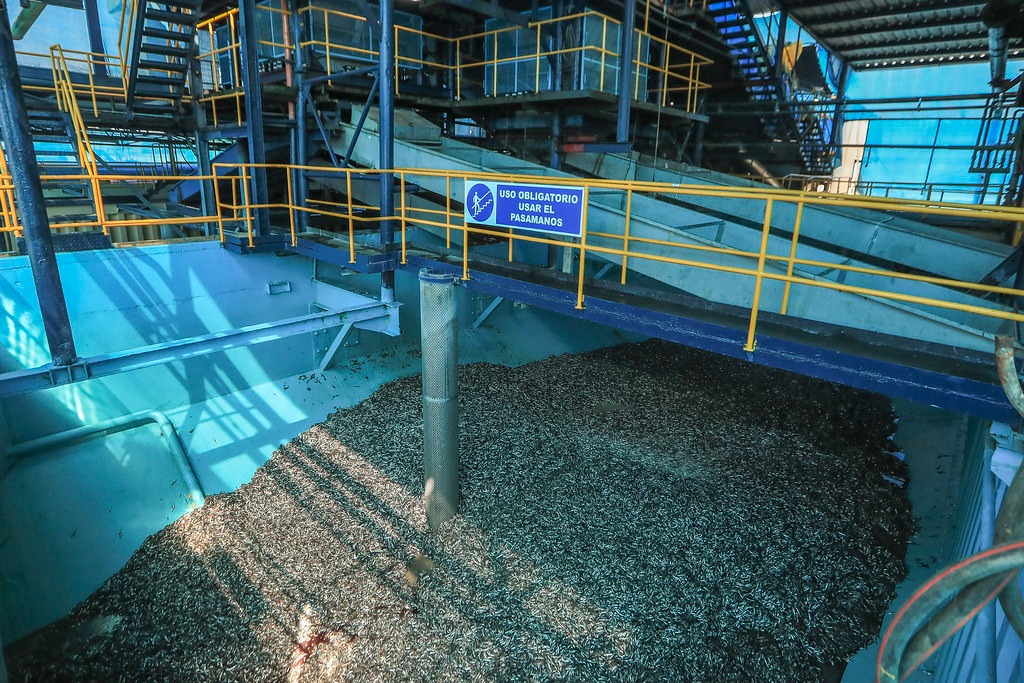
Caption: Fishmeal plant along the northern coast of Peru on April 25, 2025, during the start of the fishing season.
Credit: Presidencia Perú
What economists often call “externalities,” these social and environmental impacts exact a price primarily paid by the poorer countries where the feed ingredient is harvested and processed, far from where the resulting luxury seafood is eaten. For example, sea bass and sea bream produced in Greece and sold at major European retailers were fed fishmeal tied to illegal sourcing from occupied Western Sahara as recently as 2025, more than a dozen environmental enforcement actions in US waters between 2018 and 2025, and humpback whale deaths in the Southern Ocean in 2024, according to The Outlaw Ocean Project’s investigation.
The reporting revealed that the fishmeal industry also contributes to geopolitical tensions. In 2021, a dozen Turkish bottom trawlers fishing illegally in the Aegean Sea tried to ram a Greek research vessel when the scientists began filming their activity. In 2018, riots broke out in Saint-Louis, Senegal, after the Mauritanian Coast Guard shot and killed a fisher during what the Mauritanians said was a cross-border raid by a fishmeal boat.
In Greece, two of the largest aquaculture players were illegally sourcing fishmeal from Western Sahara as recently as 2025, according to trade records and audit reports. Since the mid 1970s, Morocco has militarily occupied Western Sahara, a presence that more than 10 EU Court of Justice rulings and various UN resolutions have deemed illegal. Still, Moroccan ships routinely fish in Western Saharan waters, turning their illegal catch into fishmeal in Western Saharan plants, before exporting it to farms globally labeled as Moroccan. A violent clash over trucks, many of them carrying this fish and fishmeal out of Western Sahara, led to the collapse of a 29-year ceasefire between the countries in 2020.
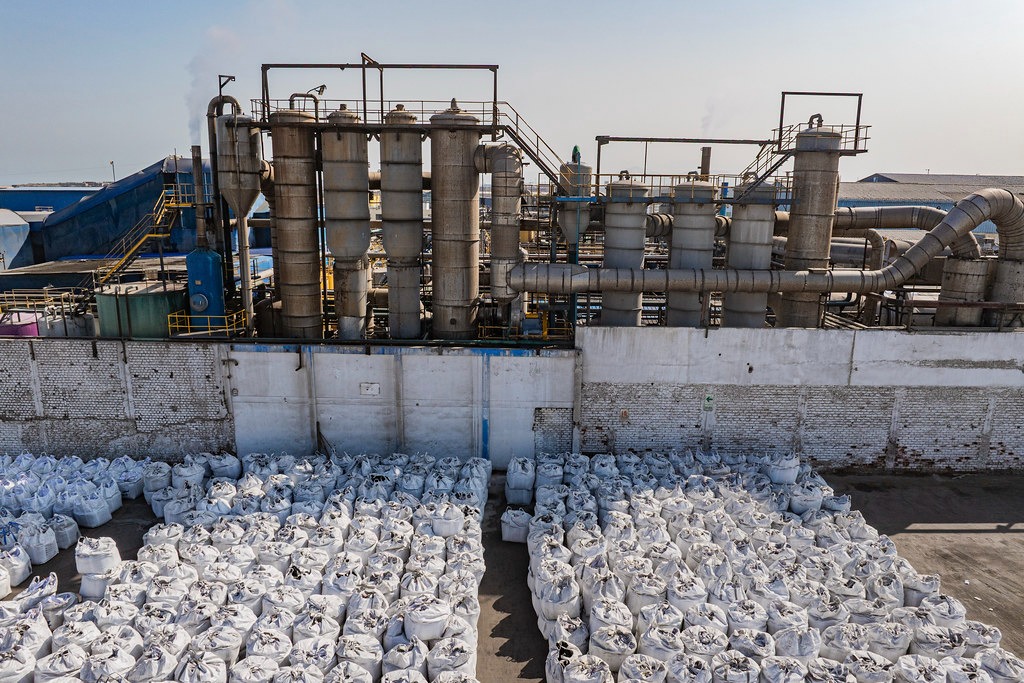
Caption: Fishmeal plant along the northern coast of Peru on April 25, 2025, during the start of the fishing season.
Credit: Presidencia Perú
Avramar—which was recently acquired by the Canadian company Cooke Inc., and rebranded in August to Cooke Hellas—controlled 70 percent of Greek production and exported to 40 countries, importing raw materials and ingredients from more than a dozen Moroccan companies, as of November 2025. Additionally, one of its subsidiaries, Perseus—which was absorbed into Avramar’s larger operations—recieved shipments of fishmeal from Western Sahara as recently as 2022. Meanwhile, Irida—Greece’s largest feed manufacturer and a supplier to Avramar—also received raw ingredients from two companies primarily based in Western Sahara in 2024 and 2025, respectively: Copelit and Protein and Oil Industry, according to trade and audit records.
When asked about these issues, none of the companies responded to a request for comment. In regards to Avramar, Cooke recently responded, “We do not offer comment regarding companies we had no involvement or ownership in.” Illegally fishing without the permission of the Sahrawis, and importing to EU markets under false Moroccan labels, has ecological and humanitarian consequences. Some 180,000 Sahrawi people live in refugee camps in Algeria, while overfishing undermines local food security. Greece is not alone in sourcing fishmeal from Western Sahara; so do France, Spain, Germany, and the Netherlands.
Issues with Greek aquaculture’s supply chains extend to food safety, as well. In 2023, shipments of fishmeal and fish oil from Oman were rejected entry to Piraeus Port for salmonella contamination and falsified veterinary health certificates, according to court documents. Destined for an otherwise unaware Greek feed mill that itself exports to the US and Canada, the 500 metric tons were accompanied by fraudulent documents falsely claiming the exporter was approved under EU law to ship food-grade products.
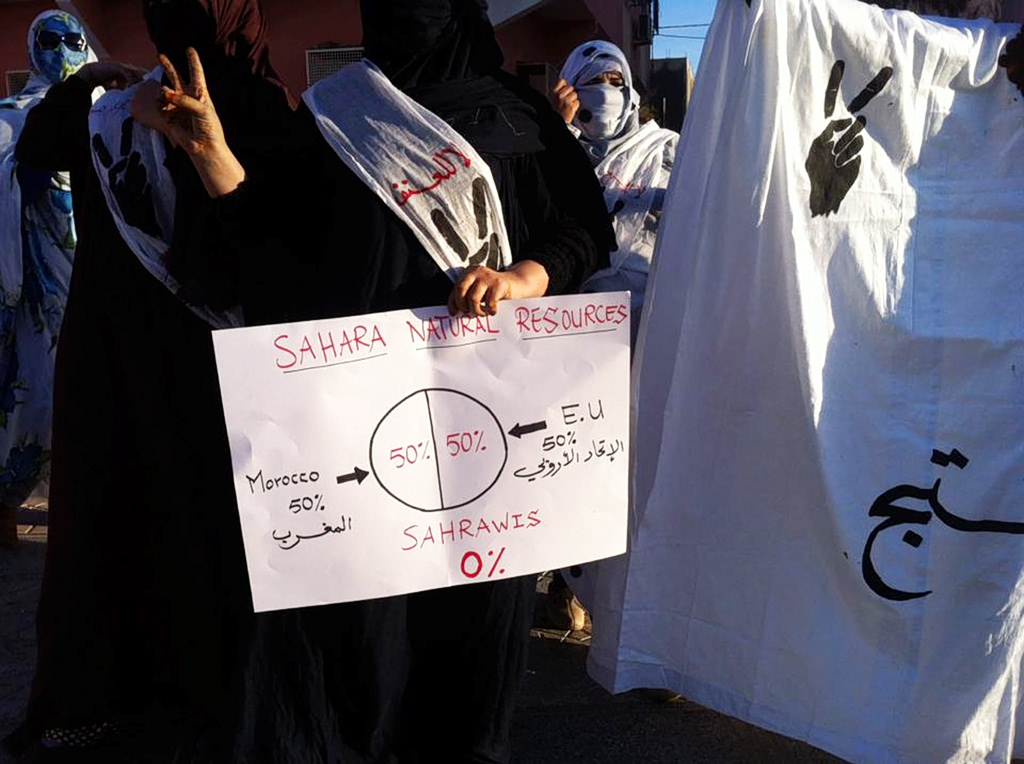
Caption: A Sahrawi demonstrator holds a sign criticizing resource-sharing between Morocco and the European Union in Western Sahara. Between 2018 and 2021, the EU paid Morocco about 208 million euros for fishing access under a partnership agreement. Sahrawi representatives have argued that the people of Western Sahara did not consent to the arrangement or receive its proceeds.
Credit: Western Sahara Resource Watch
While companies like Avramar claimed a “commitment to safeguarding marine biodiversity,” their reliance on “overexploited” West African sardines tells a different story. By the company’s own marketing standards, the wide-scale extraction of vital West African foodstuffs to feed luxury seafood for wealthy markets falls far short of responsible sourcing. Avramar acknowledged a request for comment but did not respond further.
Environmentally, the investigation found that in countries where there was available data, at least half of the species landed by fishmeal vessels were classified by scientific studies as “overexploited” or worse. Most of the vessels in this fleet are purse seiners or trawlers, which deploy vast nets to capture dense schools of fish. Both gear types are associated with high levels of waste, routinely hauling in large volumes of bycatch and non-target species. At least 165 of the ships in the global fishmeal fleet were bottom trawlers, conducting a particularly destructive form of fishing that uses weighted nets that scrape the ocean floor, destroying virtually everything in their paths. The problem of unsustainable fishing is compounded by heavy government subsidies that keep too many vessels operating, accelerating pressure on already stressed fisheries.
“Any accounting of the true impact of aquaculture has to start not with the farm, but with the feed,” said Pauly. “And that kind of accounting offers a very different picture than the industry offers.”
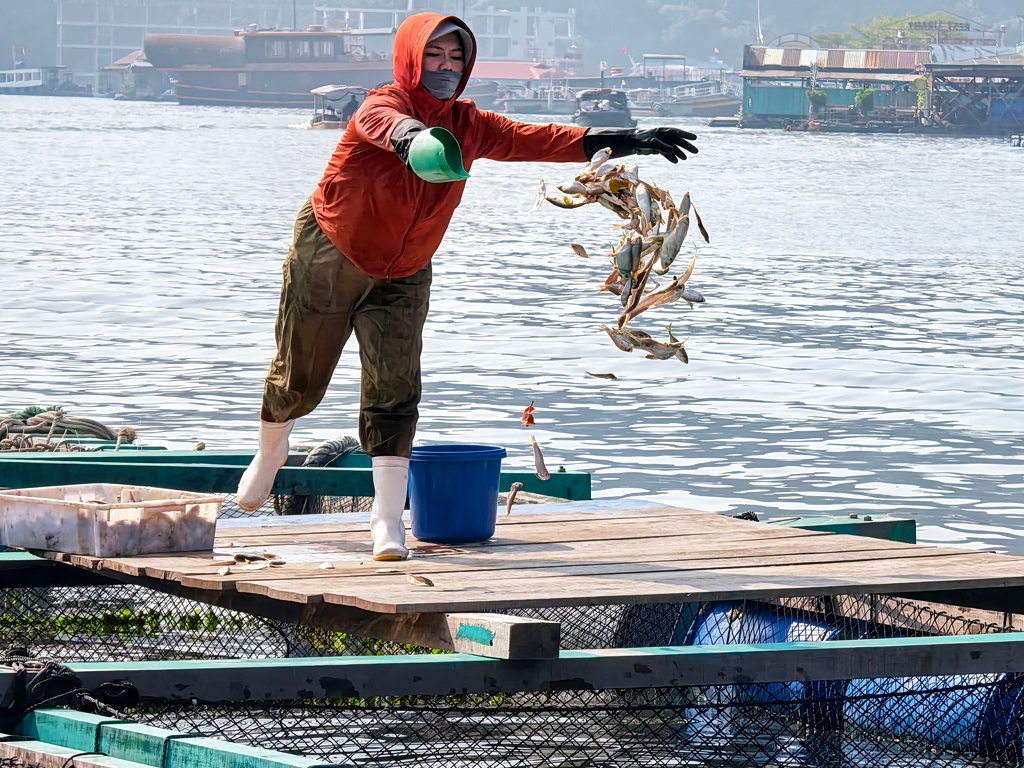
Feeding farm-raised carnivorous fish in Vietnam. Credit: Vietnam Hidden Light
***
For most of human history, we ate what ecosystems produced on their own: wild fish, grazing animals, and crops grown for people. Livestock survived largely on grass and agricultural leftovers that humans didn’t eat. Today, we do something different: We grow or catch food that people could eat and feed it to animals instead, especially in industrial livestock and fish farming. These calories are converted before they’re consumed.
This global transformation has rewired the trophic chain, turning farms and oceans into engineered calorie-processing systems. The natural food web, consisting of who eats what and how energy moves from plants to animals to humans, is no longer mainly determined by ecosystems. It’s now shaped by industrial design.
Animals have become less like savings accounts that turn waste into food, and more like biological factories steered by globally traded feed commodities such as soy and fishmeal. Roughly 90 percent of the catch used to produce fishmeal globally is edible to humans, according to a 2017 study published in the Fish and Fisheries journal. Most fishmeal plants around the world rely on whole fish rather than processing waste or inedible byproducts, further intensifying local protein scarcity.
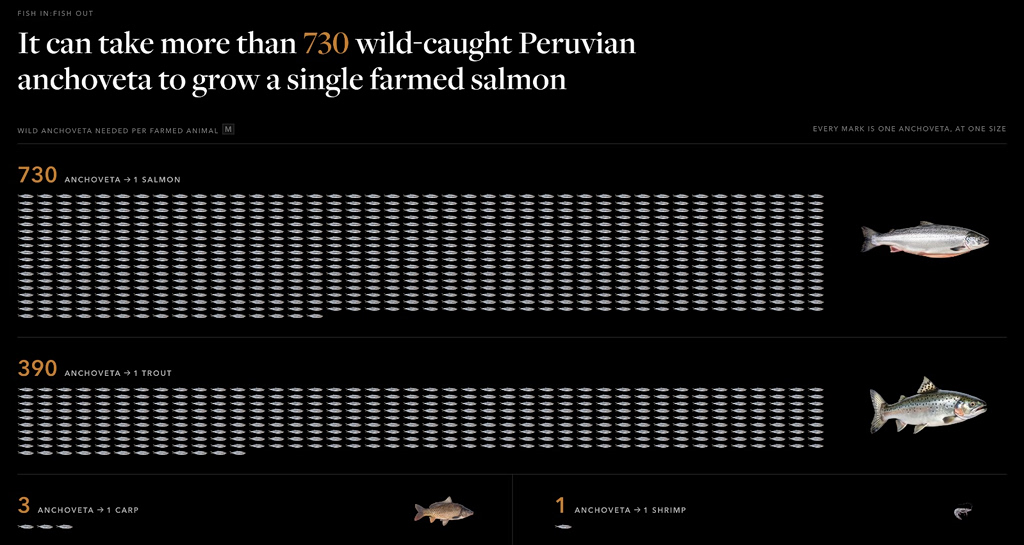
The Outlaw Ocean Project
The feed industry has emphasized that it is decreasing its reliance on fishmeal and fish oil, and especially on the use of whole fish or fish that can be eaten by people. However, as aquaculture overall grows, so does demand for fishmeal. The total amount of global fishmeal production is predicted to rise by nearly 10 percent, mostly from trimmings, between 2022 and 2032, according to the Food and Agriculture Organization.
Asked about sustainability concerns tied to her industry, Véronique Jamin, a spokesperson from the international fishmeal association, the IFFO, said that fish farming is “the most efficient animal protein system.”
She added that her organization’s “role is not to advise which markets should use fishmeal and fish oil.” Sustainability frameworks won’t work “if they ignore real-world economics,” she said, and seafood companies have to respond to “what people actually want to buy and eat.”
Efforts to move away from fishmeal and fish oil have struggled. Researchers have identified various potential alternative food sources for carnivorous farmed fish—including seaweed, cassava waste, soldier-fly larvae, single-cell proteins produced by fungi and bacteria, and even sewage. None are being produced affordably at scale, however. The alternatives often lack the full range of nutrients that support the growth of farmed fish, especially omega-3. Certain “green” options, like insect meal, are expensive, and as a result, there has been limited interest among feed companies to pay a premium for them.
***
As the production of seafood has grown more globalized, its supply chains have stretched longer, and it has become tougher for consumers to know whether it was harvested sustainably or legally. Most grocers who sell seafood are in the dark as well, because tracking is difficult and costly. Robert K. Stumberg, professor at Georgetown Law and supply-chain expert, said this is partly because grocers typically buy from wholesalers and rarely track their suppliers. The other reason may be plausible deniability, he added. “Companies can escape blame or the need to fix problems if they’re unaware of them.”
Where government regulators have proven lacking in ensuring that supply chains are free from unsustainable, illegal, or unethical practices, industry-led certification programs have sought to fill the gap. Critics say these programs serve more as a sustainability smokescreen, while giving downstream customers a way to avoid looking deeper into their supply chains.
Devan Meserve, a spokesperson for The Global Seafood Alliance, which runs a program called Best Aquaculture Practices (BAP), said that her organization represents the “most comprehensive program for farmed seafood,” partly because it covers the “entire aquaculture production chain.” Protecting workers on the fishing vessels that supply feed mills is, however, an “immense challenge,” she noted, because audits occur strictly at port and do not witness harvest conditions. She added that her organization helps the industry counter illegal and overfishing by requiring feed mills to source most of the fish they use in fishmeal or fish oil from fisheries accredited by certification programs like MarinTrust and Marine Stewardship Council.
None of Greece’s mills, hatcheries, farms, or processors are currently BAP-certified.
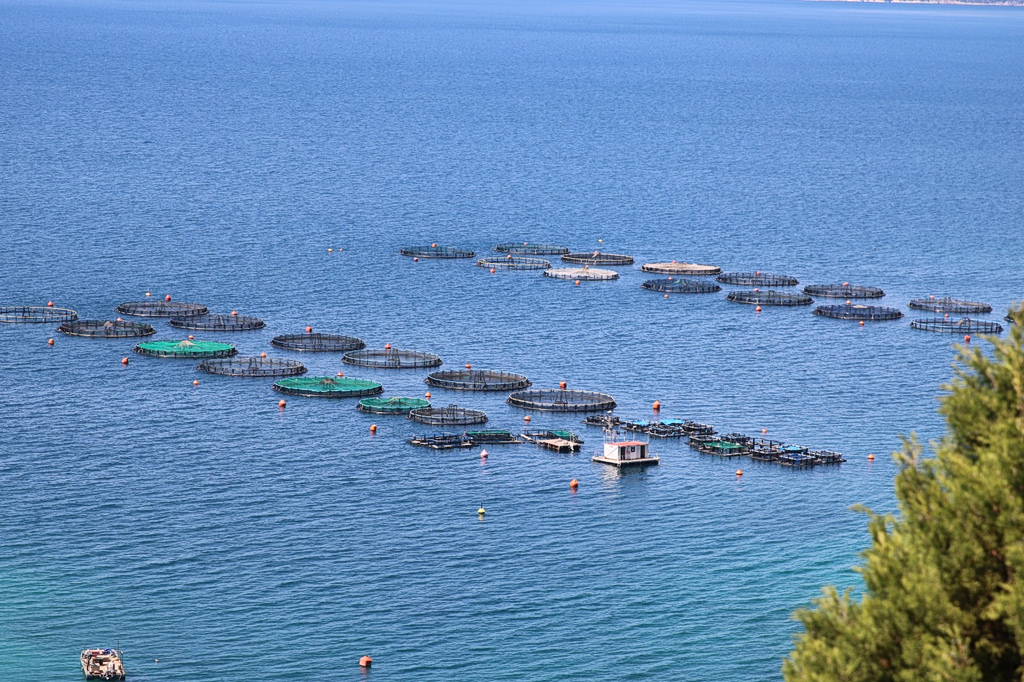
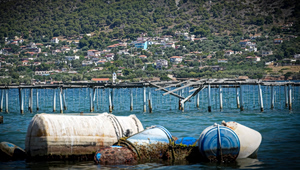
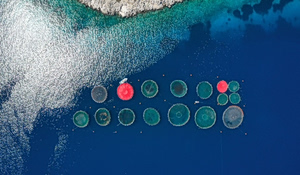
Caption: Fish farms along the Xiromero coastline in Greece in 2026. The local municipality has submitted an appeal to the country’s highest court opposing proposed expansion plans.
Credit: Johnny Sturgeon/The Outlaw Ocean Project
Partly bolstered by these certification programs, seafood companies routinely make marketing claims about the ethics and sustainability of their seafood. Often, these claims fail to reckon with crimes or social concerns further up their supply chains, including on the ships or at the plants that produce the feed for the fish farms. This disconnect is creating growing legal risk for seafood companies and grocers: Since 2020, at least nine lawsuits alleging false sustainability marketing have been brought against six seafood companies in the US. The Outlaw Ocean investigation assessed more than 800 seafood companies that made marketing claims comparable to—or stronger than—those cited in the lawsuits and found that over half of the companies had documented crimes or concerns within their supply chains.
As Greek aquaculture looks to expand, the disconnect between its sustainability claims and external feed poses a legal and reputational risk. While the EU is introducing fines for supply chains that fail to independently undertake due diligence, these won’t enter into force until 2028. Until then, the onus will remain with Greece to untangle the legal and environmental mess of its own waters.
Dana Cleaveley, a research consultant formerly with SeaChoice, a Canadian sustainable-seafood group, said many industries have already had to begin reckoning with the human rights and environmental abuses buried in their supply chains. She cited sweatshop garments, blood diamonds, and fair-trade coffee as examples. Seafood, she said, has been slower to face that kind of scrutiny. But as the world searches for more protein and leans further into aquaculture, that may change, particularly if more governments begin restricting imports tied to illegality or unsustainable practices. “That’s when investors will begin to see material, not just reputational, risk,” she said, “and companies will have to adjust.”
This story is part of a larger investigation conducted by an international team of journalists based at The Outlaw Ocean Project, a news organization in Washington, D.C.
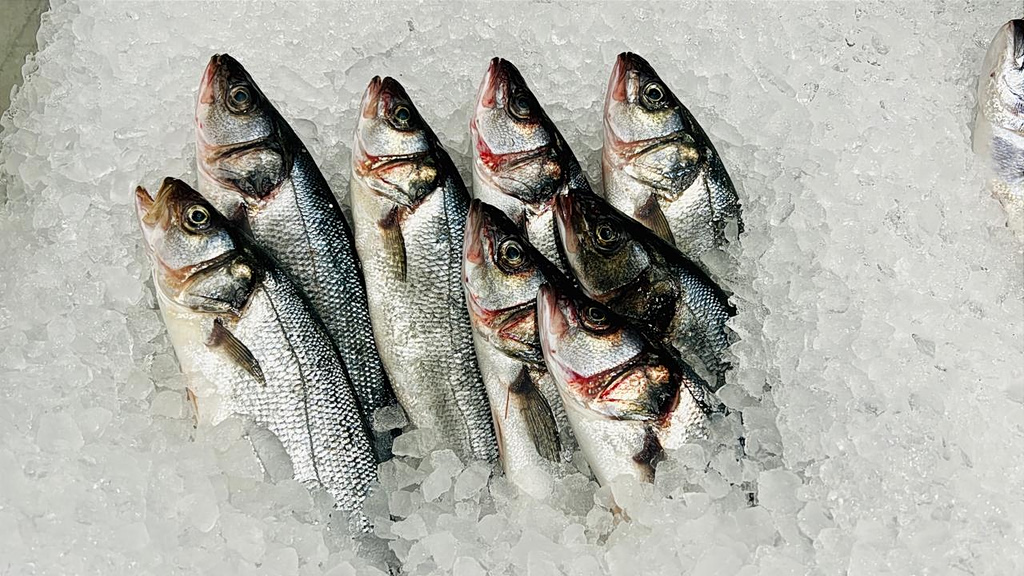
Image of farm-raised fish at a Greek supermarket. Credit: C Novak
The Food for Feed Investigation
Over five years, The Outlaw Ocean Project carried out an extensive investigation into fishmeal and fish oil. The reporting effort mapped a vast segment of the entire global fishmeal industry, including more than 1,400 fishmeal factories across 64 countries. It traced supply chains from fishing vessels to processing plants, feed mills, fish farms, and seafood retailers. The reporting involved dozens of journalists from around the world, conducting visits to factories and farms and boarding fishmeal ships at sea.
The investigation found that the oceans bear an especially heavy and largely invisible burden from the fishmeal and fish oil industry. More than a fifth of wild-caught fish around the world is used for non-human consumption, especially as feed for fish, but also for chickens and pigs. The reporters assessed more than 2,400 ships tied to fishmeal production, operating in the waters of at least 30 countries. They found that most of these ships do not fully comply with the Global Charter for Fisheries Transparency, a guide created by leading ocean-focused civil society groups detailing accountability standards for industrial fishing fleets. For example, less than 30 percent of the fishmeal fleet had publicly available location information, and under 25 percent had a unique vessel identification number, or ship license plate. Such opacity makes the fleet difficult to police.
In The Gambia and Mauritania, the series documented how the industry drives food insecurity as fish that once sustained local communities are increasingly being diverted to fishmeal factories for export. In remote islands in Russia’s far east and in China’s Xinjiang region, the reporting detailed the use of forced labor on ships, at farms, and in factories. In other countries, including India and Peru, this industry was tied to at least 80 incidents of civil unrest, some of them violent, usually in the form of labor strikes and community protests sparked by the water pollution or the stench from factories cooking thousands of tons of decomposing fish, according to Bait to Plate, an online tool that tracks the fishing and seafood industries.
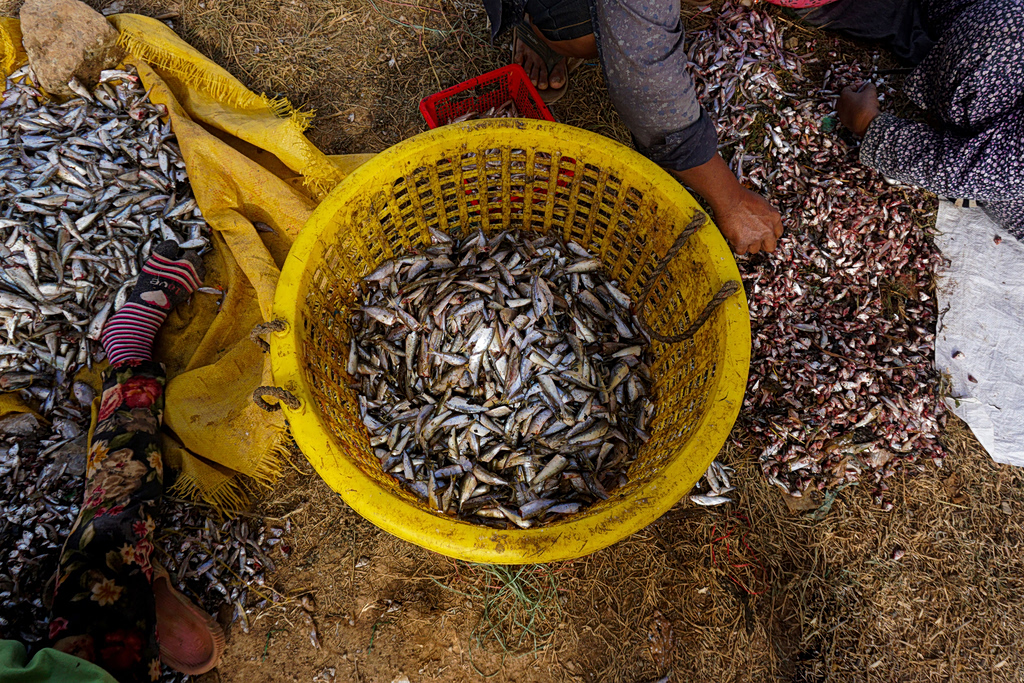
Ariel image of people sorting fish in Cambodia. Credit: Khun Sodara
Greek fish farms draw some of their fishmeal from the waters of India and Peru. As recently as 2025, the Greek feed mill Irida sourced fishmeal from the Indian fishmeal plant TJ Marine Products. The investigation found that this plant partially relies on Indian oil sardine and mackerel, which were classified as “overexploited” in national waters in 2021. TJ Marine Products did not respond to a request for comment.
The reporting also unveiled the hidden role of forced labor and land appropriation in China’s growing aquaculture industry. In 2024, Greece imported more than $23 million worth of seafood from China, which is rapidly expanding its aquaculture industry. China now raises more than four times the amount of fish it catches. One of the fastest-growing regions in this boom is its mountainous and desert inland west, particularly Tibet and Xinjiang, two regions known for intense political repression.

The reporters mapped more than 1,000 fish farms in Xinjiang and Tibet that produce an estimated half-billion dollars’ worth of farmed seafood annually, much of which is exported to more than a dozen countries. China’s effort to promote fish farming in Tibet and Xinjiang is partly facilitated by severe state repression, including the widespread appropriation of land, intense police surveillance, and incarceration of tens of thousands of residents.
Globally, demand for this fishmeal and fish oil is on the rise, while supply seems to be heading in the opposite direction. Five of the world’s largest salmon companies increased their absolute use of fishmeal and fish oil made from whole wild fish by as much as 39 percent between 2020 and 2024, according to a report from the Farm Animal Investment Risk and Return Initiative. Most global fisheries now operate under quota regulations, suggesting production of marine ingredients has already peaked, according to Novel Sharma, a Rabobank analyst specializing in the seafood and aquaculture industries, who suggested that global supplies of fishmeal could be tapped out as soon as 2028.
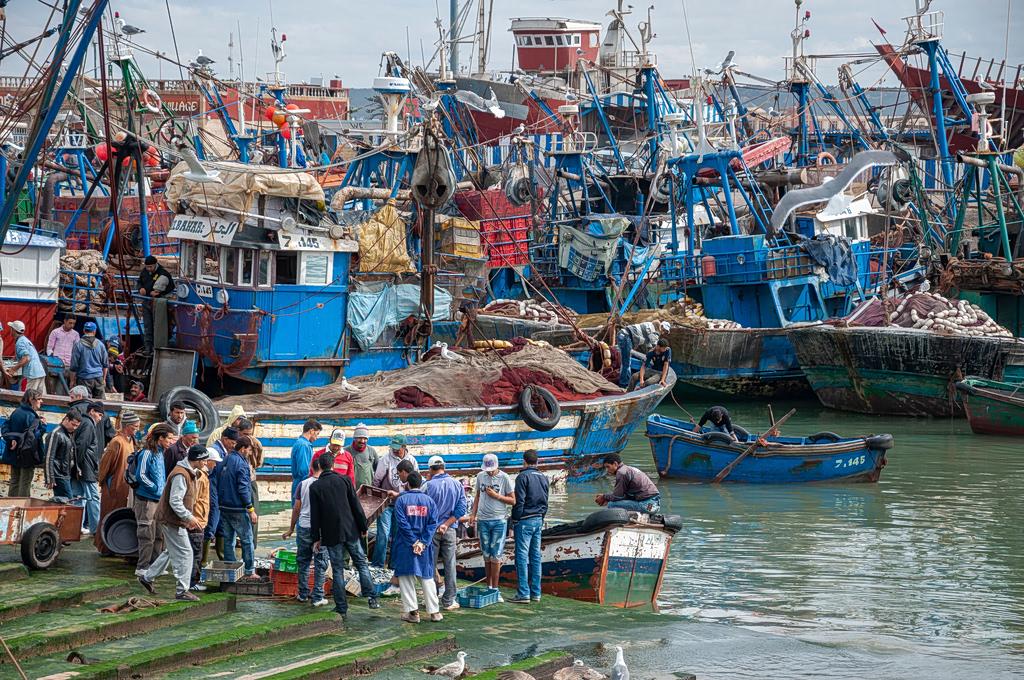
Caption: Local fishermen work in the bustling port of Essaouira, Morocco, surrounded by vibrant boats. Credit: Piotr Arnoldes
*Ian Urbina is an investigative journalist and the director of The Outlaw Ocean Project. Johnny Sturgeon is a London-based reporter for The Outlaw Ocean Project