 Μake us preferred on Google
Since 2020, the world has gone through a remarkable period of instability that is the result of political players re-aligning their international standing as well as escalating geopolitical moves shaking up the foundations of the established order. We have seen everything from Brexit in 2020, to war returning to Europe with Russia’s full-scale invasion of Ukraine in 2022, to the war in Gaza in 2023. The most recent shakeup was the Iran conflict this year.
Meanwhile, the United States has been stepping back from the institutions it helped build and lead, freezing USAID, withdrawing from the World Health Organization (WHO) and the Paris Climate Agreement. Also, China, once seen as a rising power, is now the closest contender to the US for global leadership. The Sword of Damocles of nuclear weapons hangs ever lower as well, as doubts about American reliability are leading countries like South Korea and Japan to consider whether they need deterrents of their own to counter a rising China and a nuclear-armed North Korea.
It is a far cry from the optimism of the post-Cold War years, when Francis Fukuyama famously declared “the end of history” and the ultimate victory of Western liberal democracy.
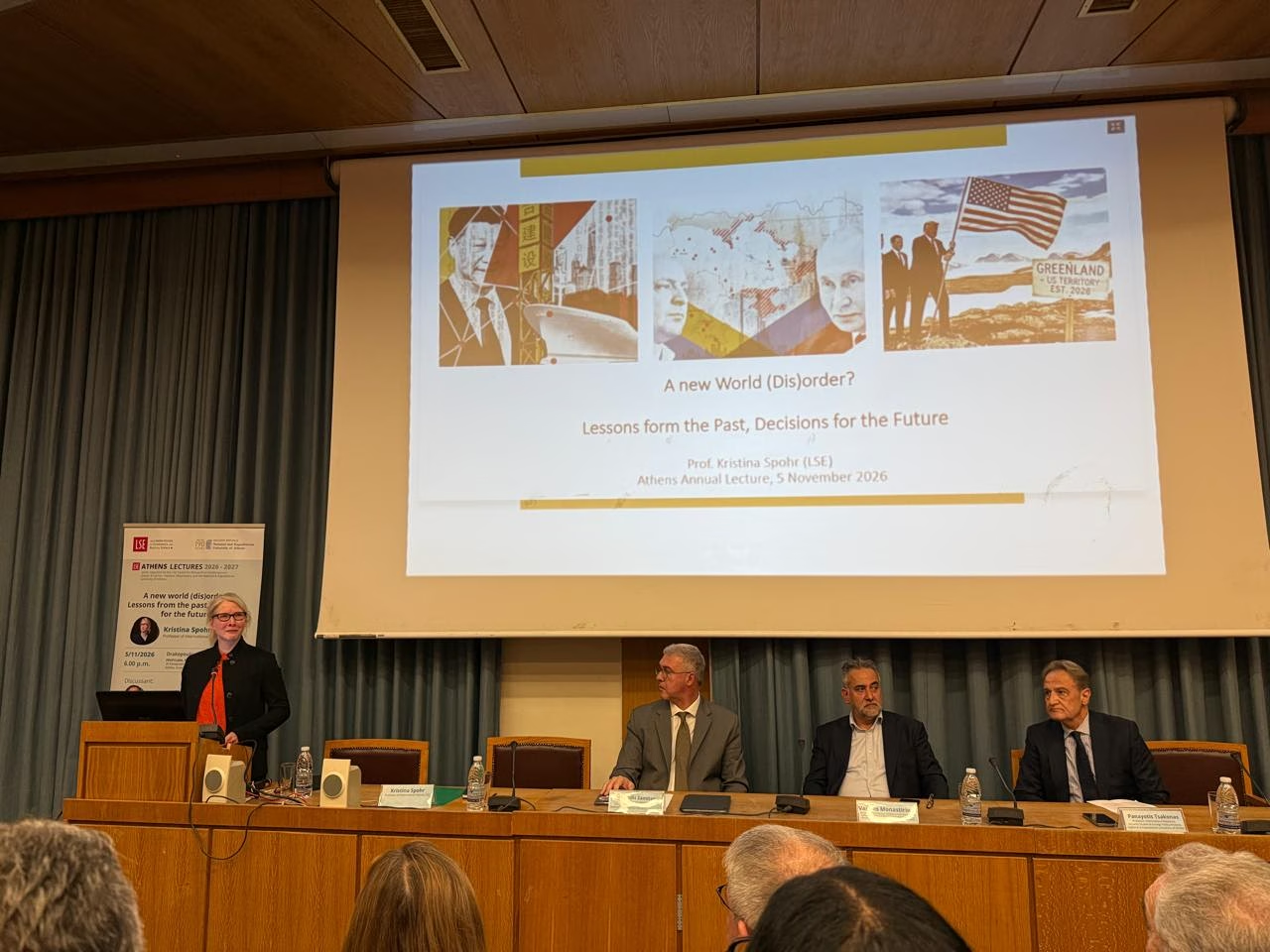
In Athens, following her LSE lecture “A new world (dis)order?”, To Vima International Edition spoke with Professor Kristina Spohr of the London School of Economics (LSE) about whether Russia could ever have been integrated with the West, the rise of China and the return of great-power politics, and what Europe should stand for, not merely against, in an increasingly multipolar and authoritarian world.
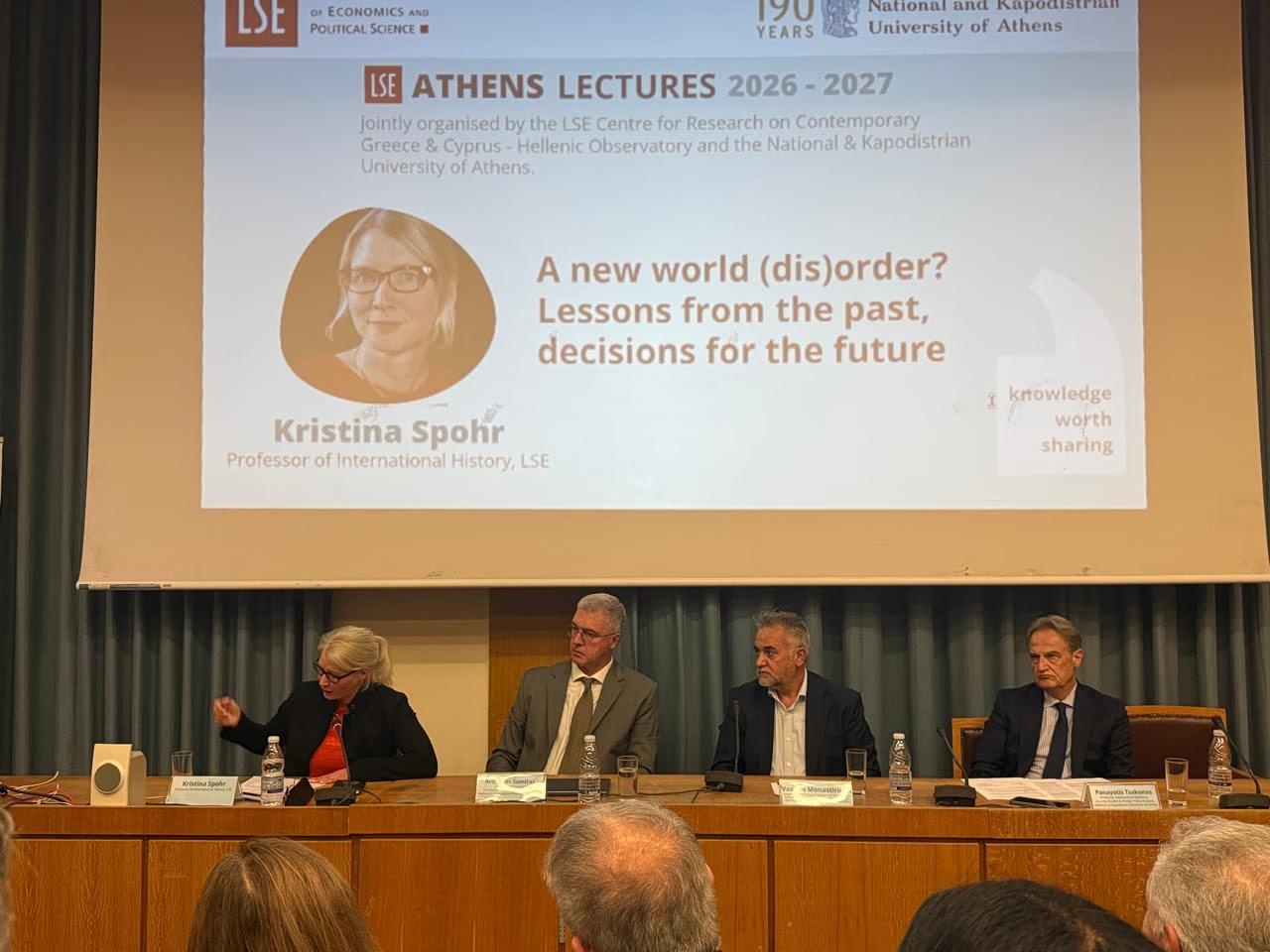
Professor Kristina Spohr on a panel alongside Aristeidis Samitas, Professor of Finance and Director of the MSc in FinTech at the University of Athens; Vasilis Monastiriotis, Professor of Political Economy and Director of the Hellenic Observatory; and Panayotis Tsakonas, Professor of International Relations at the University of Athens. Photo by Angelos Gassenschmidt for To Vima International Edition.
Russia’s war in Ukraine is now approaching its fifth year, and Putin seems determined to see it through to the bitter end. When he launched it, he framed it largely around security against NATO’s eastward expansion and fears of encirclement. If we were to trace today’s problems back to the dissolution of the USSR, was Russia’s integration mismanaged in the 1990s, or was confrontation already baked in?
I think the real question is, whether Russia really wanted to be integrated. Because when you integrate into clubs, into particular organizations or into a particular community, you have to sign up to the rules that pre-exist, unless you start from scratch, build something new and thus create new criteria of membership and rules of the game.
Also, if a state believes in its great power status, and Russia sees itself as one of the global ordering powers, then the problem of post-Soviet Russia’s relations with the West is that it sees itself humiliated. Not that Russia was pushed to the margins. It marginalized itself as it failed to accept that Soviet disintegration was a kind of process of decolonization. So the problem is the Russian Federation suffered and is still suffering from post-imperial trauma. Russia in the 1990s also struggled with enormous economic and social debasement.
When the Soviet armed forces withdrew from the Eastern bloc states, GDR, Poland, Hungary, Czech Republic, the West Germans as part of the unification deal paid 100 billion Deutsche Marks (DM) over four years for Red Army retreat (clean-up of military East German sites, transport back to the USSR, building of housing after 1991 in the post-Soviet (mostly Russian) space, salaries in DM to the military personnel, while still stationed on eastern German soil till 1994). Besides, Chancellor Helmut Kohl – of a United Germany – pressed for Soviet debt rescheduling and even relief in the international organizations like the Paris Club and the IMF, while offering massive billion dollar packages of financial aid and material assistance to Russia.
The Germans with the Americans also pressed for Russian G7 membership to elevate its status, even though, we all know, Russia is not one of the world’s greatest industrial nations in terms of GDP or the production of industrial / high tech goods. Russia’s economy, like the Soviet one, is still raw material based – oil, gas, precious metals and minerals.
So, a lot was done to help this smaller post-Soviet Russian rump state come to terms with the loss of the Soviet empire: the Soviet satellite Warsaw Pact states, the Baltic states (which the Soviets had annexed in the Second World War through the Hitler-Stalin Pact of 1939), and all the other Soviet socialist republics on its southern rim. Still the Russian Federation today, in terms of sheer size, is still a Eurasian empire, stretching from Kaliningrad (formerly Koenigsberg, East Prussia!) by the Baltic Sea all the way to Chukotka and Kamchatka in the Pacific. It is not smaller in fact than the RSFSR inside the USSR. And in terms of power projection it still has the Soviet nuclear arsenal, and its Northern fleet is still in Murmansk by the Barents Sea, it uses Sevastopol in Crimea as its Black Sea fleet port, the Pacific fleet is based in Vladivostok.
Still, to come back to your question, huge efforts were made to help Russia transform (which President Yeltsin wanted himself – he spoke of democratization, common values, of friendship, partnership even alliance with the West) and to help it integrate. But since it was the Western organizations that survived the Cold War and became pillars of new order, Russia was looking in effect at joining pre-existing western clubs. And that did not sit well, especially with Russian nationalists, ex-communists and imperialists.
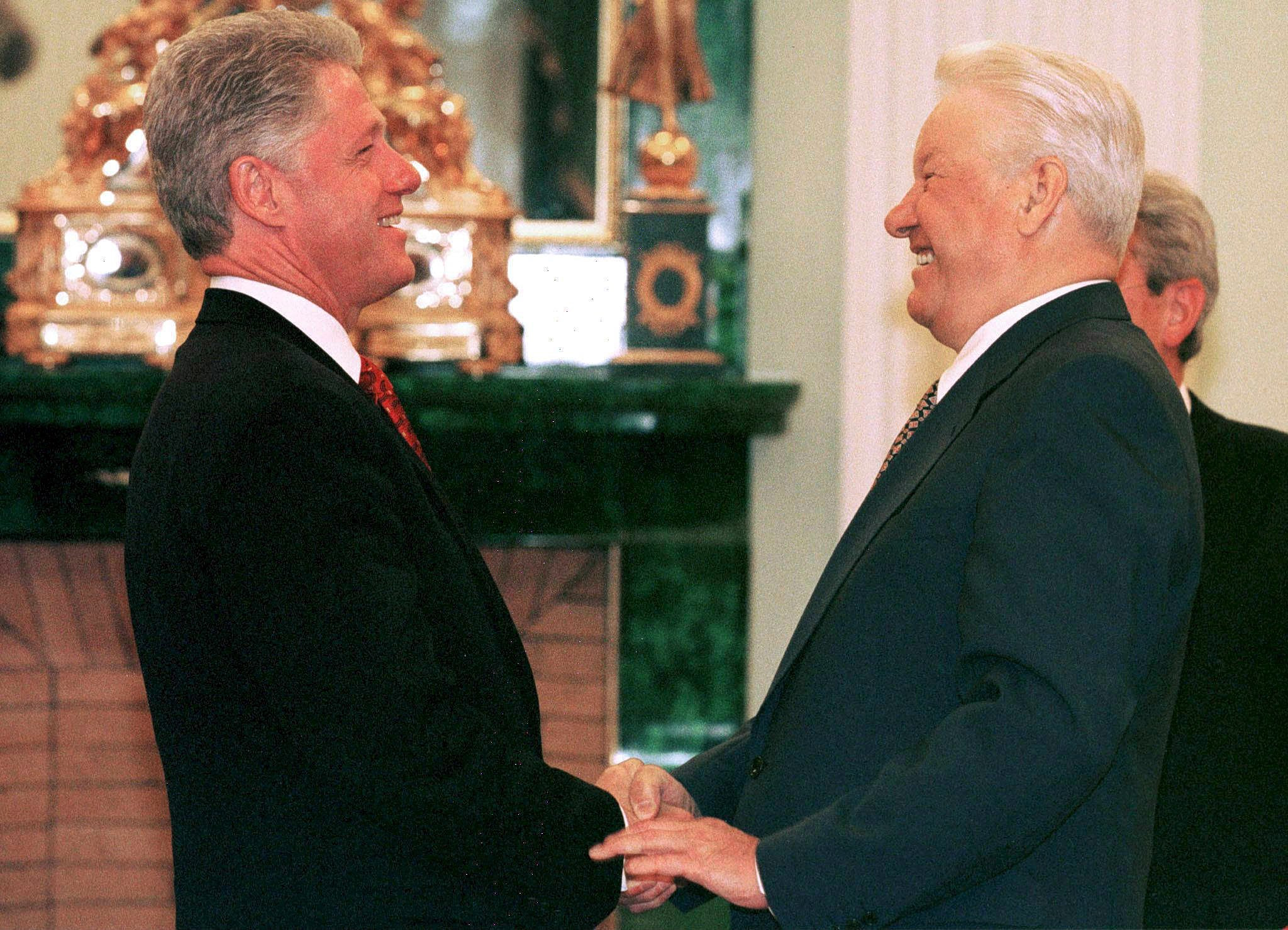
A file picture dated 01 September 1998 shows Russian president Boris Yeltsin (R) and US president Bill Clinton share a warm laugh before their talks at the Kremlin. EPA/Sergei Karpukhin
For example, on NATO, we had the NATO-Russia Permanent Joint Council (PJC) created to alleviate Russia’s potential concerns over Poland, Hungary, and the Czech Republic joining the Alliance in 1999. But the PJC was about consultation and partnership; it did not give Russia a veto in NATO’s internal decision-making. Russia remained its own entity; it was offered a special relationship, recognizing it as a great power in the Euro-Atlantic area.
So there is a case to be made about potential feelings of humiliation, perhaps?
I think the Russians have cultivated that narrative that they have been humiliated. They may feel so indeed. But I think it’s a misunderstanding of how Western allies have approached them. And for all the US triumphalism in part, America and Europe tried to support Russia in its transformation processes. Of course, Communism was gone, the Soviet Empire had collapsed. Of course, to Russians who had dominated that state and held that huge sphere of influence it was a shock. But besides their claim to great power status there was the chaotic reality: lack of law and order, corruption, political strife, stillborn democracy, and quite quickly in certain circles an expression of revisionist aspirations, talk of “Russkiy Mir” (Russian world) and of the “near abroad” – imperialistic rhetoric that undermined the legitimacy of the newly independent states on Russia’s southern rim.
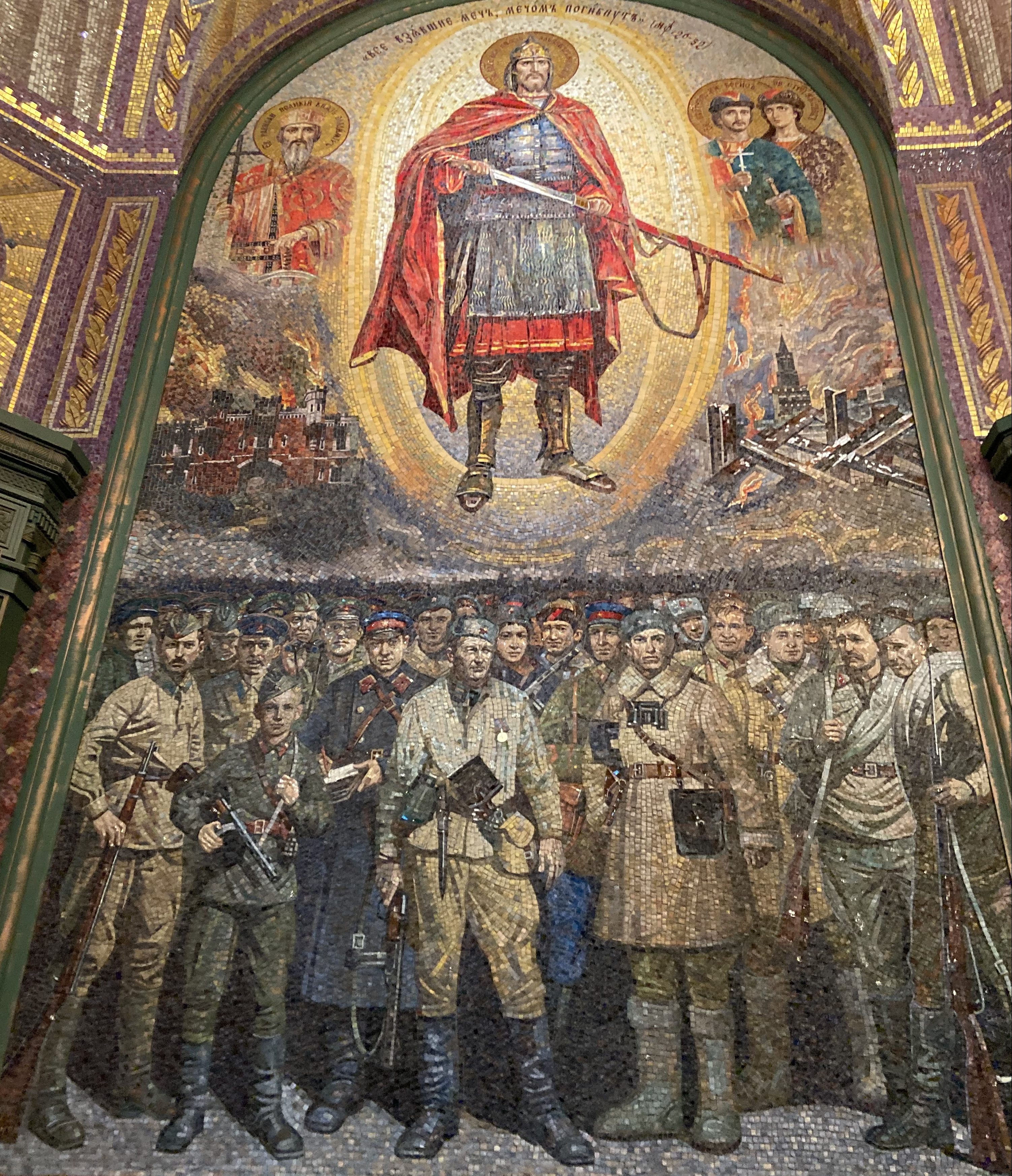
A mosaic in the Main Cathedral of the Russian Armed Forces blending Eastern Orthodox iconography with propagandistic socialist realist art styles. Credit: Natalia Senatorova via Wikimedia Commons
The realities of the 1990s were, too, that Russia had signed up to the principles of sovereignty, the inviolability of borders, that countries have a right to choose an alliance. Remember the Helsinki Final act of 1975, renewed in the Charter of Paris in 1990, and the UN Charter of 1945. The Helsinki Accords imply, that you can join the alliance you want freely. Nobody should have a veto. This matters to small states to safeguard their independence, especially those in Eastern Europe bordering Russia, given their history behind the iron curtain.
But if, like Russia, you see yourself as a big cheese and you want to dictate to the existing club what you want were you to join, then it’s not going to work. And I think that was one of Russia’s problems. Russia wanted NATO membership in order to change it, or to constantly veto things. But everybody else is in NATO because they are for something. Russia, if not a threat, was certainly still seen as risk in the 1990s, and club members agree on territorial defense and deterrence. And most small states in Central and Eastern Europe wanted to join NATO because they wanted to be under the American nuclear umbrella to deter a revisionist perhaps even revanchist Russia. Looking back they were right, weren’t they?
Think: we had one key agreement where Russia was part, the Budapest Memorandum 1994, which was to guarantee Ukraine’s inviolability of borders underwritten by Russia, Britain, and the United States. In return Ukraine had to give up its Soviet nuclear weapons to Moscow.
Then look where Ukraine ended up in 2022: You could argue that if Ukraine hadn’t given up the nuclear deterrence, Russia would never have invaded. And the Memorandum meant nothing…
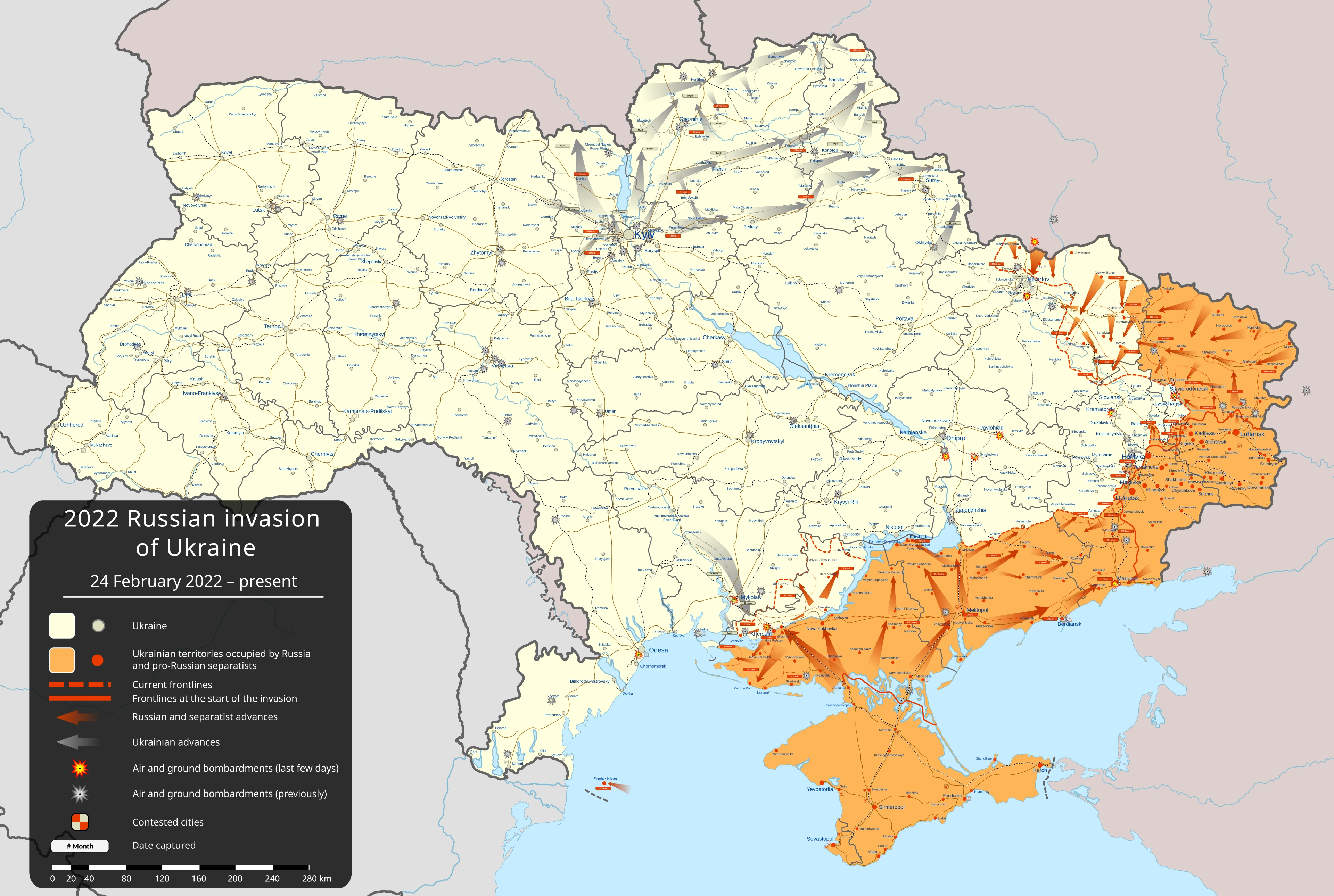
Russian invasion of Ukraine 2022 new – colours adjusted for improved colourblind readability. Source: Eoiuaa via Wikimedia Commons
Is there merit to the idea of Russian insecurity requiring “buffer zones” with respect to Ukraine, in order to feel secure?
Security from what? Do we think of invasion, like say, Napoleon and Germany’s Ostfeldzug? Look at the world post 1945: Nobody in the West dreams of invading Russia. Germany in the Second World War got defeated, then occupied, and divided. The Germans really got punished. The French are not going to invade, nor are the British, nor is NATO. NATO is a defensive alliance. It has only ever used Article 5 once, after September 11, leading to a NATO out-of-area operation, in response to this attack on US soil, in Afghanistan (to chase Osama Bin Laden and the terrorists).
Now: Russia is the state that has invaded Ukraine. Russia conducts a “war of conquest.” How do you punish that breach of the European, yes even world order? Russia is too big to totally fail; and who would take on Russia and how?
There will always be a huge, rump state of Russia, because the way Russia expanded across the centuries took a form that you have this absolute massive landmass, a colossal empire. It’s the biggest country in the world.
With this geographic heft, underpinned by a huge nuclear arsenal, comes the desire for particular political standing, and although economically Russia is not performing like China — it also has a much smaller demography —Russia has used its oil and gas money to build up militarily. Russia need not fear a NATO invasion, but Putin is obsessed with Europe and the West. He talks about NATO encirclement of Russia (but look at the map, only Norway, Finland, the Balts and Poland border Russia, a small fraction of Russia’s land borders!). What Putin wants is America out of Europe, that would make Russia the dominant force. And nobody else in Europe wants that.
Great-power politics is back with the US, China, and Russia in the lead, while Brazil, India, Turkey, and the Gulf states hedge between them. Alignments today are less about ideology and are more centered on energy security, geopolitical standing, and business interests. As you said in your lecture, global competition is becoming increasingly zero-sum. Is this multipolar world more or less stable than the bipolar Cold War?
Much less stable. In the Cold War order, when it’s set firm, you had these two superpowers: bipolarity. Yes, the East-West conflict found expression in localized hotspots, but the competition was ideological; it was about the 2 socioeconomic models, the planned economy versus capitalism, and the 2 political models (liberal democracy, pluralism vs one-party rule, communist authoritarianism). Given the nuclear stalemate, there was a certain stability, and diplomacy predictability and calculability. You knew who your friends and foes were. You knew how to balance deterrence and defense. We saw an “Empire by invitation” – desired by European on their continent, and the “Empire by imposition” where the Red Army remained after WWII, behind the iron curtain. Besides hard power, the US notably had soft power, economically, socially, culturally. American power was very attractive.
Today we have a new major player: China, a country with about 1.4 billion people. But if you look at China’s peripheries and geography, you realize that’s also an old empire because there are also other peoples than just the Han Chinese in its borders: Uyghurs, Tibetans, etc. We have seen how Beijing has taken hold of Hong Kong, and we will see very likely at some point the PRC’s grab for Taiwan.
On top of that, they have the Belt and Road Initiative (BRI), the Silk Road idea, which means that they’re spreading their economic influence, overland and across the sea, with little footholds – eg port holdings from Piraeus to Sri Lanka like pearls on string, so they can control shipping operations and dominate sea lanes – and through debt dependencies (see mining and infrastructure projects in Africa). Xi presents this with historical references to China in the 15th century, when China ruled the seas from Somalia to Malacca.
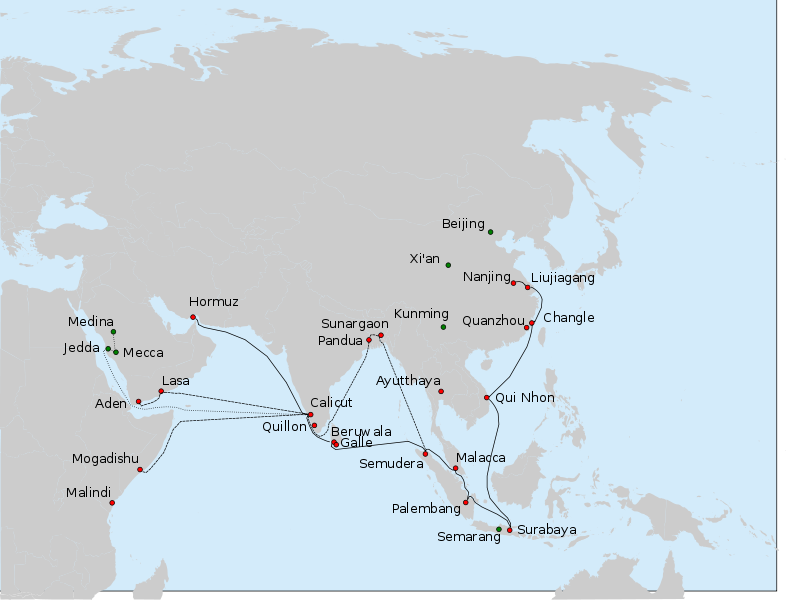
The Seven Voyages of Zheng He, between 1405 and 1433 AD, during the Ming Dynasty (1368 – 1644 AD), frequently cited by Chinese President Xi Jinping to frame China as a peaceful maritime power and to frame modern bilateral commercial ventures in historical context. Credit: Vmenkov, via World History Encyclopedia
So China has its own politico-economic design for how to exert influence, quietly dominate, and exploit resources. I’m not saying Xi will want to go to war all over the place for the PRC’s rule. I do think though that where Beijing may be willing to use military force is Taiwan. This “unification issue” they present as internal, “domestic,” matter, unfinished business since 1949.
But, even then, it won’t be easy. Look at Ukraine. Russia thought it would absorb the country really quickly. This did not go to plan. Lots of other things come into play – war logistics, resistance, and other players. Wars get very nasty and can get drawn out. China has to consider: what will Japan do? What will South Korea do? Who else gets drawn in, the US? Before you know it, it’s complicated. And that’s one big, unstable mess.
When we think about multipolarity, you mentioned Brazil. Now we have Lula, we have gone on the political spectrum from right to left. But is Brazil going to be so consequential? Is Argentina or Venezuela? Or do we need to think and worry more about the countries that own nuclear weapons? India, Pakistan, or North Korea. How long will South Korea watch Kim cozying up to Putin and Xi? And if they don’t feel the Americans are reliable, they might say they want nukes themselves.
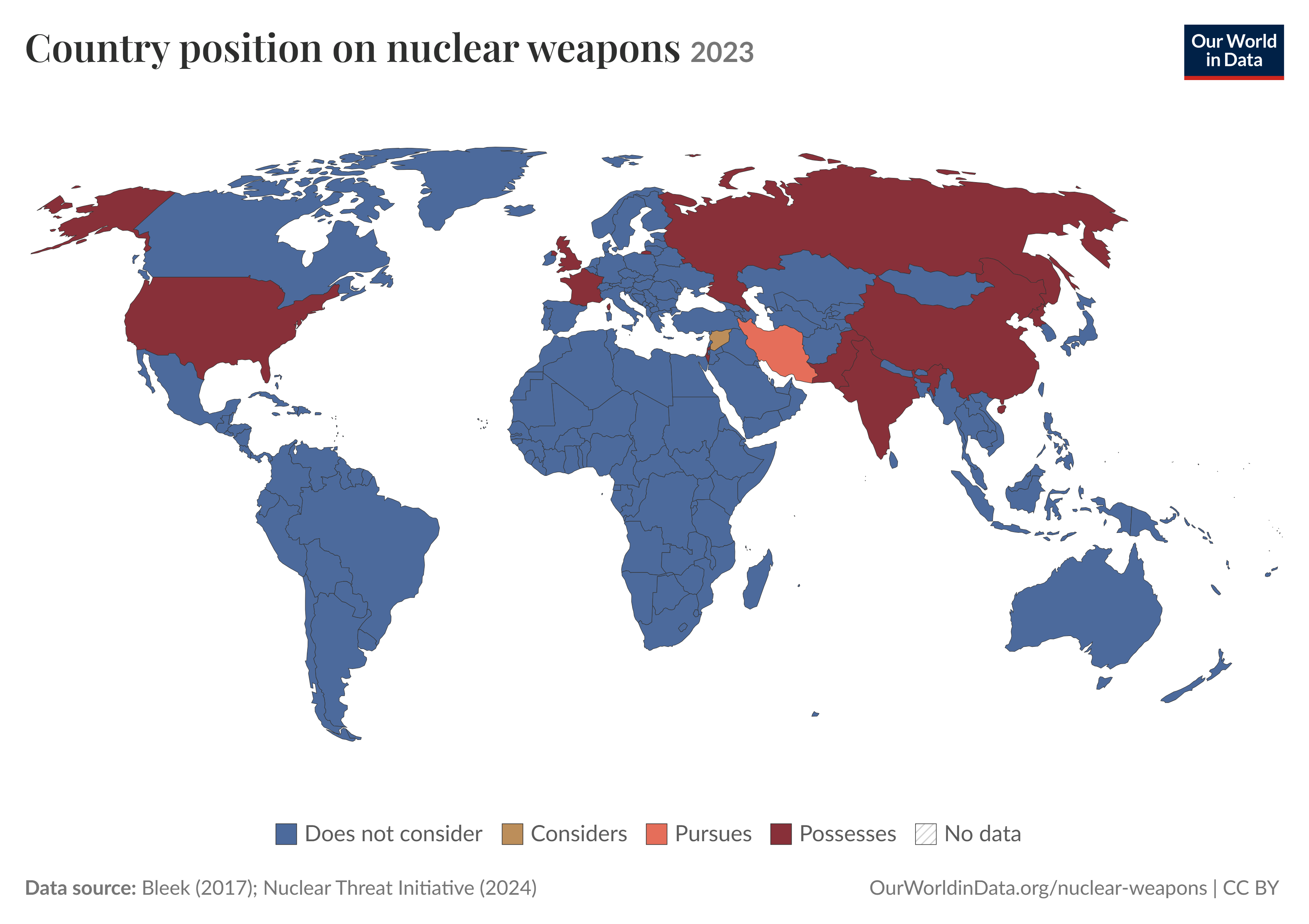
Country position on nuclear weapons as of 2023. Source: Bleek (2017); Nuclear Threat Initiative (2024) via Our World in Data
And if South Korea has nukes, the Japanese might say we don’t trust Sino-US, US-Russian, and Sino-Russian relations, especially under Trump 2.0. We must have our own. And before you know it, the nuclear balance starts shifting. So nuclear proliferation, which already of course started in the Cold War, is definitely one of those elements that makes our world more unstable and brings other actors into play.
In the complexity and chaos of today’s world, it has become more and more difficult to impose what we might call the “rules-based order”. However, did the rules-based order ever really exist, or was there always a great power, like the US since 1945, behind it?
The rules-based order is a terminology used by many. I would prefer to say an international legal order. Rules, when broken, imply something absolute. Somebody has to re-impose them; the breaker has to be punished. But who will be the one to check on the rules and hold the rule book? If we speak of a legal order, there are principles we’re trying to adhere to, there are grey areas of interpretation in law, and so forth. Perhaps more accurate for our UN based world order post-1945.
The U.S. was behind the post war world order; at Yalta they agree upon the idea of a UN on the UN Security Council. After the Second World War, there were five permanent members, akin to world police men (US, USSR, FR, UK and ROC [not the PRC (!) until 1971]). And that of course is different from the League of Nations where all members were equal, all the small and big states, which, given the Second World War, we know didn’t work.
So now we have the UN where we have the five “good” powers trying to make sure that everybody else behaves. And out of those five, two are increasingly showing that they’re no longer as influential as they once were.
Like Britain and France.
That’s right. These two victor powers were about to lose their empires through decolonization. During the Cold War, the Security Council was paralyzed by ideological antagonism. The PRC (after 1949) did not sit on it, was allied with the USSR and the latter vetoed whatever America proposed, and vice versa.
After the Cold War, it worked once or twice, see the Kuwait crisis – sovereignty was reestablished, Iraq pushed back. But then how to enforce peace in civil wars, wars of secession? Look at Somalia in 1992. It’s basically a civil war, there is drought and hunger, and by then we have 24-hour television, so we can watch these people starving on CNN all the time. Everybody says America needs to do something. Nobody says Russia, China or France needs to do something. Everybody looks to America as a quasi-world’s policeman.
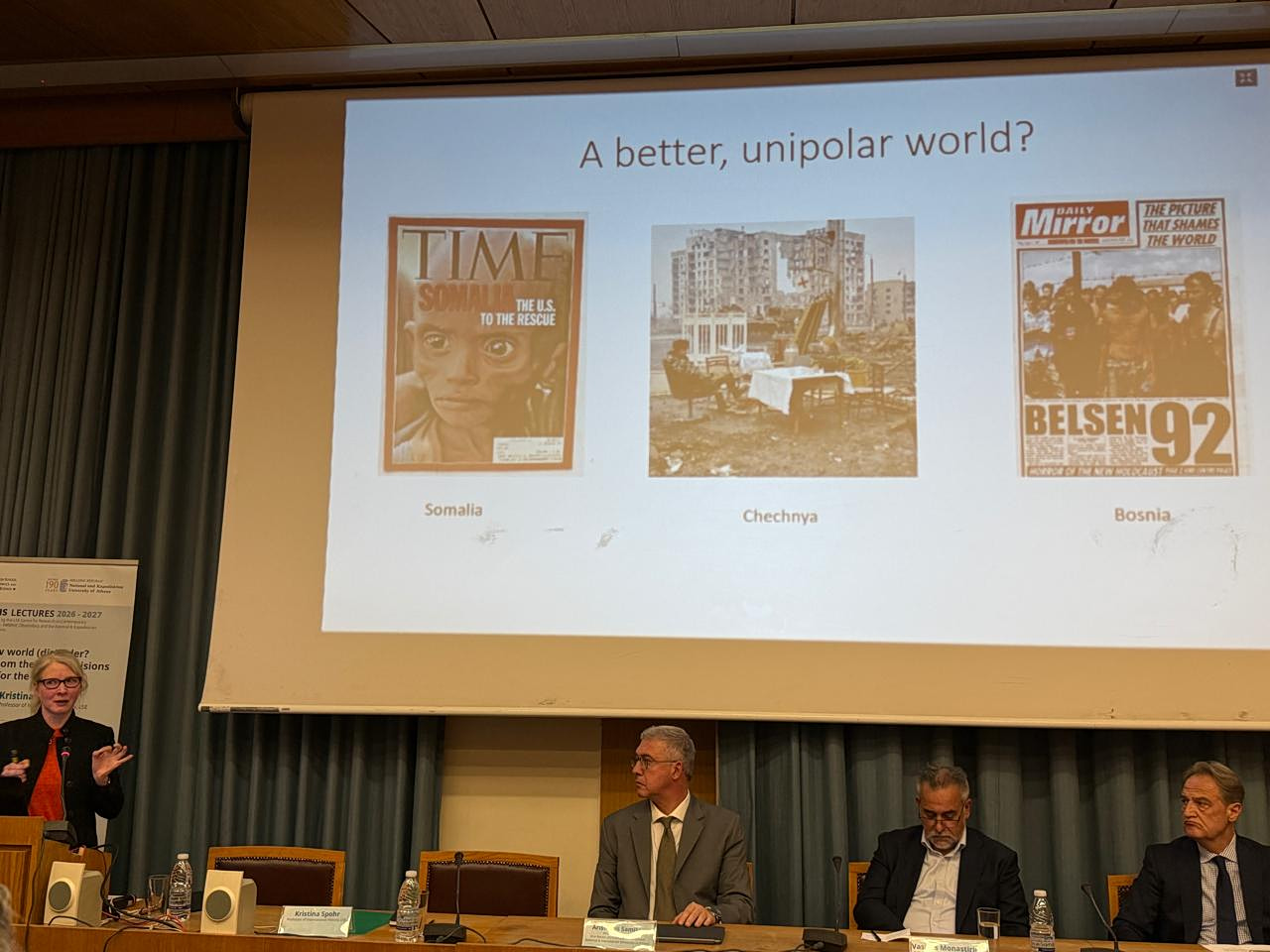
Professor Spohr explains the various crises that arose post-Cold War and how the US, as the sole superpower at the time, intervened to resolve them. Photo by Angelos Gassenschmidt for To Vima International Edition
That’s why the Americans get drawn in: because they were able to project power, not necessarily because they so wanted to go into Somalia. And when you have the Black Hawk Down incident, and the Americans pulled out because there were dead Americans, which the US public would not stomach. So it becomes a question: where are you fighting your battles? What are you picking and choosing? Do you fight a rich man’s war, but not the poor man’s?
Some complained about unipolarity. But you could also ask, why did the whole world always look to America? They didn’t say, “Oh, why doesn’t the PRC get involved?” Or “Why don’t the Middle Eastern oil states get involved in a country just across the sea?” Maybe this is because the US, a benign hegemon, built this in the first place, what we call the liberal or international legal order. Perhaps it’s about who’s actually willing to send in the troops and who can actually do it. Money not just power talks …
And that’s when you realize most countries haven’t got the capacity. So that’s why everybody then looks at America whether they like it or not. So the US ends up being the good guy and the bad guy, right?
Funnily, depending on how you look at it, you get the blame. If you don’t do something, you get the blame because you’re not supporting or helping the people, although you’re rich. And if you do get involved, then it’s like, do you get involved too much? Are you then the world policeman and nasty hegemon?
And then suddenly you have this whole responsibility that you would have to be involved everywhere. But can you? Do you want to? So you see, the UN’s problem is that the UN has no military capability of its own. They can’t enforce anything. They have a nice charter. But unless there’s a coalition of the willing that acts under a UN mandate, they can’t do anything. And in Yugoslavia’s Srebrenica massacre, and peacekeepers under fire, we saw the impotence of the UN. The US could not enjoy their post-Cold War peace dividend, they got pulled back in, in part by the UN, in part due the Europeans’ / the EU’s impotence to help prevent genocidal civil war .
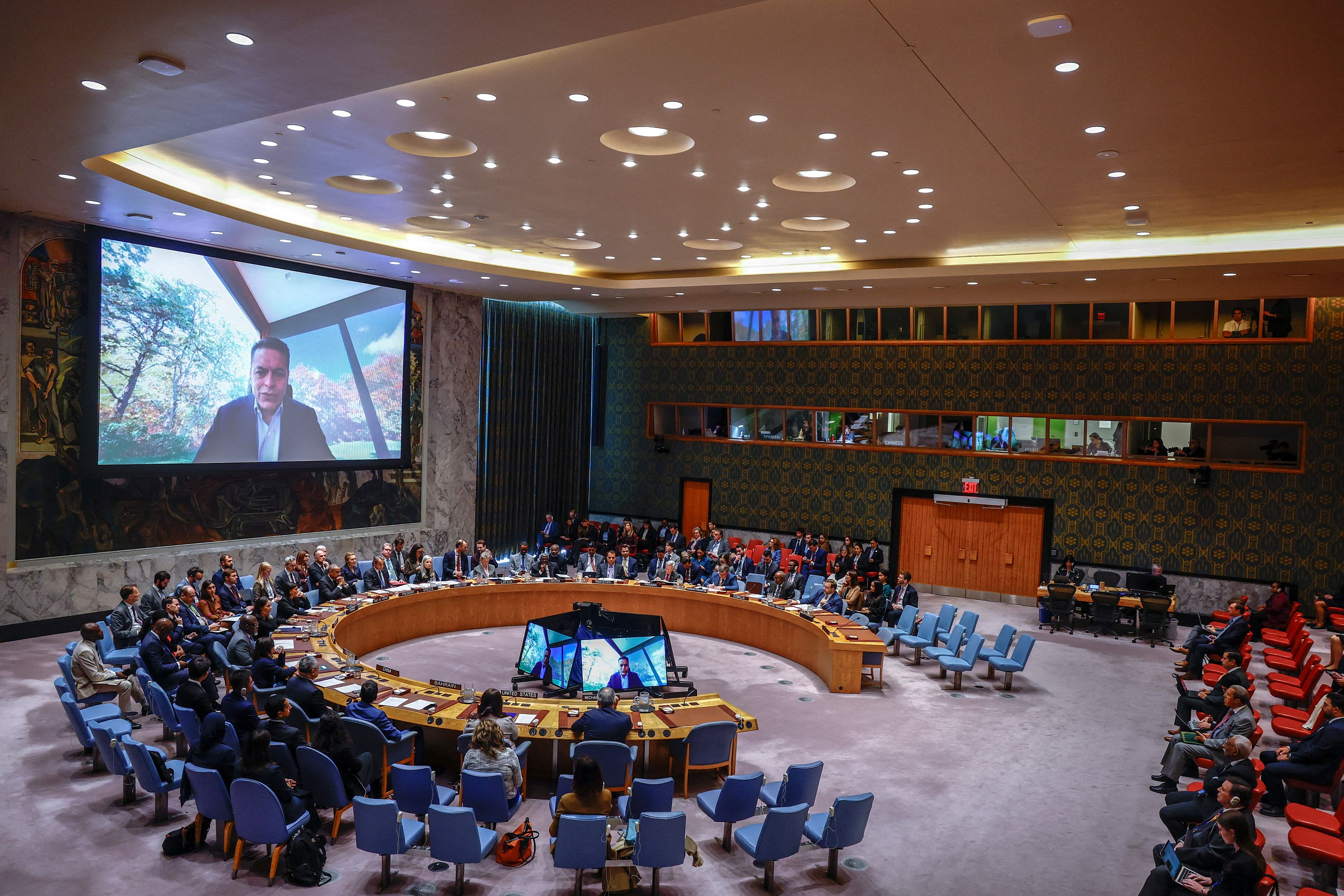
Journalist Fareed Zakaria is shown on a screen while he is speaking during the United Nations Security Council meeting titled “Maintenance of international peace and security” at UN headquarters in New York City, US, October 29, 2026. REUTERS/Jeenah Moon
China’s authoritarian capitalism offers an alternative to the Western model, which is itself under strain from populism, nationalism and declining respect for international law. In your talk, you discussed Francis Fukuyama’s The End of History, stressing that nothing is inevitable. So what choices does Europe face now: to stay aligned with the US, or to seek greater sovereignty of its own, perhaps even moving away from the European framework?
It’s absolutely necessary we Europeans stick together, not least in the face of an unreliable US. Otherwise we have no clout in the world. I mean, the whole business about our free market is that we can actually speak when we negotiate trade deals, right? United, we are much stronger.
Look at the COVID pandemic when we were trying to create a vaccine. It was possible because we got the EU behind our pharmaceuticals to actually produce and roll it out on a vast scale. We did this very well with BioNTech and Pfizer and AstraZeneca and Oxford University. If you just think of a crisis, something like the pandemic, you need combined power, otherwise you are dependent. Look at our dependence on imports of Chinese masks, right? We didn’t have any masks because we didn’t even produce any ourselves.
And in view of Russia’s war on our continent: Staying united is very, very important. We must stop this constant bickering amongst each other. Putin wants to divide and rule. Of course, a Finn and a Greek and a Portuguese have very different security concerns, for how they deal with their borders. Greece has an immigration problem from the sea, Finland has a Russian problem, and the Portuguese basically sit in Western Europe on the Atlantic. But if we all buy into something together, we have to work together, must make a common effort for our common good.
For a long time we did free ride on US defense support. Regarding security, we offloaded responsibility onto the Americans. Now each country inside Europe has to spend more to be able to defend themselves, not only together, but also as each individual state. We neglected that outright because we like to think that we were in this nice post-Cold War world. That was completely naïve; it was also convenient. You didn’t have to do defense spending. So you could focus on other things. We grew complacent.
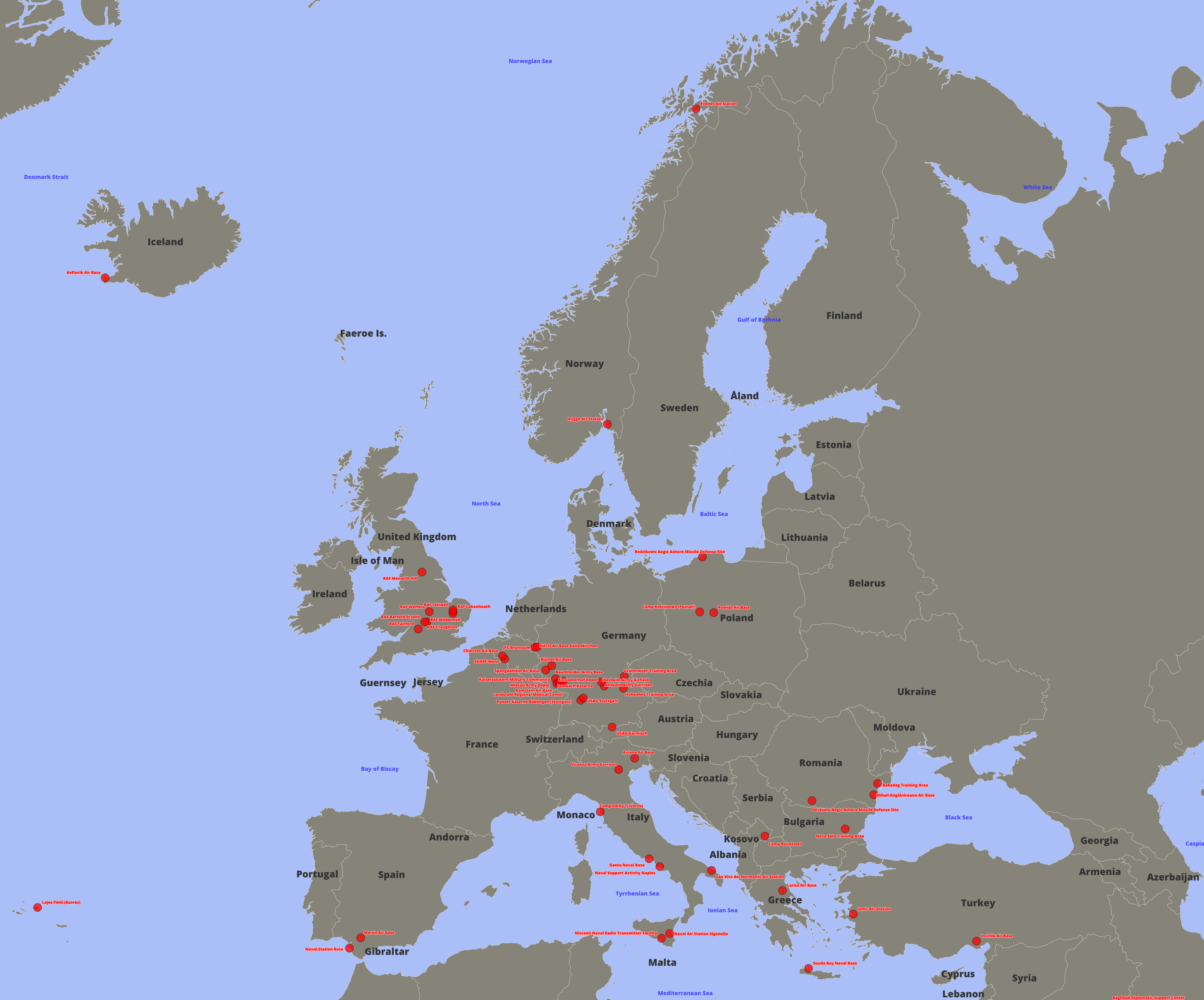
United States foreign bases in Europe, Credit: Wikideas1, via Wikimedia Commons
I also think that because of populism, there’s a lot of heated debate. But we have forgotten that a democracy can only work when the center, the moderate left and the right, that big middle, holds together. It is our lowest common denominator which allows us to function as a society.
If everybody is just completely individualistic, the fringes become strong. If we all just think about ourselves, we do not come together as a society. Currently we are seeing a social stratification of the rich and the poor. It’s too big, that difference. And so people rightly are offended and upset; we are losing the middle ground.
People express their frustration at the ballot. Protest voting ensues. People don’t really express what they are for, only what they are against.
Let’s look at the 1990s: the European community moving towards European Union wasn’t perfect. There were question marks even in Germany, like why give up the Deutsche Mark for the Euro? The Deutsche Mark was the only thing West Germans could be proud of after the Second World War. The DM and economic miracle made you feel like you have something to be positive about, since you can’t be joyfully patriotic because of the Nazi past and division.
So then you give that Deutsche Mark up for the Euro. But the point was it is a common currency, it was something that united us. This was communicated, people understood the benefits.
To me personally, Brexit showed what the British lost. Young people can’t even go and study anywhere in Europe easily and vice versa. Border regimes are tight; it’s bad for business. Hopefully this upcoming UK-EU agreement will help.
People are taking out other domestic problems on the EU which no doubt as an organization is cumbersome. I mean it’s obvious that a club of 20+ plus members is difficult to manage. And so maybe you can’t have unanimous votes on certain things. You must have majority votes. That raises questions of power differentials: where do the smaller powers stand, will big ones rule the roost? But overall, institutions need to adapt and we can all see, everything is adapting too slowly.
To take it to Greece because that’s where we are talking from. How does this shifting order look from a small country such as Greece that finds itself at the crossroads of the EU, NATO and the Eastern Mediterranean?
Well I guess you have your own particular interests in the Mediterranean area: you are closer to the Middle East, you have difficulties with a neighbor called Turkey, despite being in the same NATO alliance.
Because you have shipping magnates and shipping is one of the big industries, you’re part of global trade, so you’re not just in Europe. So, I guess you have to think how you position yourself, like how do you keep prosperity and democracy? How do you keep your budget aligned so that you are a good member in the EU and others don’t feel that they’re subsidizing Greek (fiscal) management or rather mismanagement?
We can talk about how Greek ports engage with the Chinese Silk Roads; that’s economically advantageous, but one also has to be careful not to become too dependent on the PRC. For example, if you get all the products from one country that’s producing everything, then you haven’t got enough diversification for a bad day. Remember, that’s exactly what happened to the Germans and the energy market. Too much trust in Russia; then they got totally outplayed.
But maybe this also brings it down back to the original discussion on bipolarity versus multipolarity stability? Because during the Cold War, you would go all in towards one camp, like Western Europe with the US, while countries in the Eastern Bloc were firmly aligned with the USSR.
Let’s be clear about voluntary and involuntary, benign and less benign alignments: the Americans gave the West Europeans the Marshall Plan, the Soviets declined, and drew reparations out of Eastern Europe. West Germany by the 1970s was the third biggest economy in the world (the GDR a country soon dependent on the Western DM to survive).
Now what do we want for Europe today? I think we need to make much more out of our European Union project. And in security, we need a stronger European pillar inside NATO. We need to invest in our defense and deterrence. The EU can then do the softer side of security, conflict prevention and resolution.
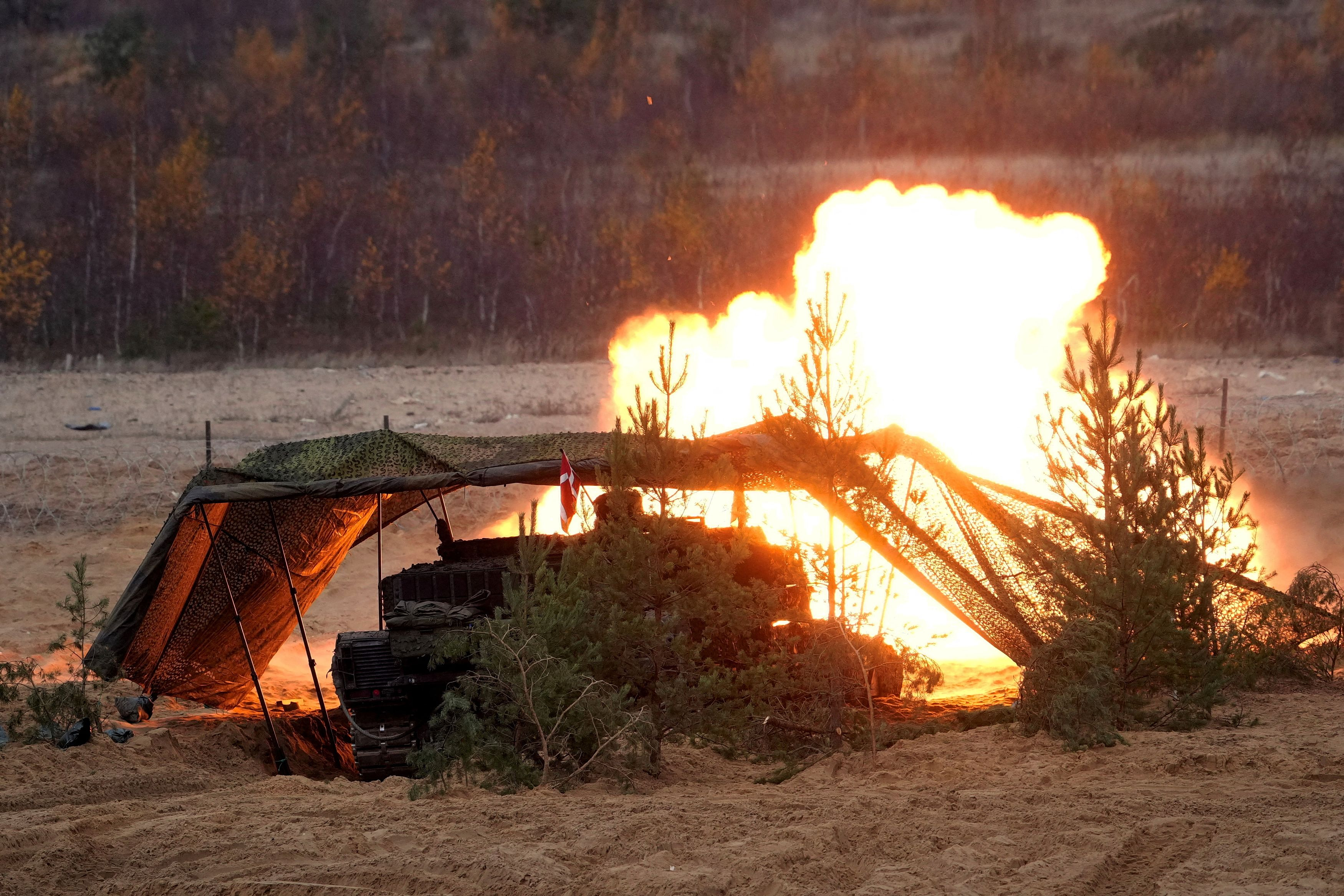
A Royal Danish army Leopard 2A7DK main battle tank fires during the DiBaX 2026 (Digital Backbone eXperimentation) program media day in the Adazi military field, Latvia October 30, 2026. REUTERS/Ints Kalnins
But I think especially on the economy and for our prosperity and, crucially, to uphold our democracy, we have to strengthen what we have in Europe and we have to find a better way of communicating with each other and to our societies.
In terms of projecting power outward (military deterrence), it is a problem that Britain is out of the EU. And at the moment there’s a question mark how well France and Germany work together. Poland is pushing for a larger role. We should also bring in Italy and Spain closer into the fold too.
We need to acknowledge that despite the north and south divide with respect to welfare levels, we do have open societies, freedoms, and relative prosperity. We actually still have welfare states, which the Americans don’t. That’s something we want to invest in but we need to collectively agree that that’s what we want to invest in, safeguard and defend against exogenous threats.
So if we were to leave this on a positive note for the EU, what would you suggest the direction ought to be?
We have to now invest in our peace and security so that we can have our prosperity and our social welfare states. And it doesn’t matter whether you’re a social democrat, liberal, or a center-right conservative. We need to focus on the center, which represents the shared ideas of liberalism and social market economies that we have.
Our leaders in the EU (and Britain) need to come together to think: “Okay, what is it that we want to give our people when we think about our domestic concerns?” Because an MP needs to always think about the local and domestic concerns first. “What do we need to give to our voters?”
And then, we need to explain to them why for now we need to have more investment in security and defense, so that we can safeguard what we have, our prosperity, which is also underpinning our social net. So that when somebody suddenly gets unemployed, there is an unemployment benefit. So that there is, up to a point, a national healthcare system.
We pay taxes so we get something out of the system. That is for our common good. That’s why also our tax regimes in each state need to be rigorous. That’s why we must work also on eliminating the corruption that has crept in. Which is perhaps also something here in Athens to think about. Our societies – Demos – need to come together again, our social contracts need reinforcing. Then we can face the messy, unpredictable world with inner strength and resilience.