Fashion trends have often asked women to trade health and comfort for style, and modern annoyances like flimsy ballet flats or oversized tote bags are mild compared to some genuinely dangerous fashions of the past.
Dizzying heels
The stiletto heel, introduced in the 1950s, drew mixed reactions from the start. While many women embraced it as a symbol of femininity and empowerment, others found it awkward to walk in, and doctors soon raised concerns about injury risk.
In 1953, a British magazine profile on the “dangers of the stiletto heel” cited warnings about sprains and fractures, concerns that modern research has echoed by linking high heels to musculoskeletal injury. Stilettos have also occasionally been used as weapons; one notorious case saw a Texas woman convicted of murder in 2013 for stabbing her partner with one.
The deadly corset.
Since the 16th century, corsets built from whalebone or steel were used to shape the waist, but “tight-lacing” drew growing medical criticism over the centuries.
In 1793, a German anatomist warned that prolonged tight-lacing could compress the ribs and organs and deform the chest, and an 1890 medical journal article detailed effects including broken ribs, organ damage, breathing difficulty, and even death. Modern shapewear draws similar concerns about restricted breathing.

Poisonous dresses
In the Victorian era, a striking emerald-green dye called Scheele’s Green became a fashion sensation, but it was made using large amounts of arsenic.
The danger wasn’t widely recognized until 1862, when a chemist published an exposé revealing the dye’s toxicity, prompting a satirical magazine to publish a cartoon depicting a skeleton in a ball gown. The dye caused ulcers, organ failure, and death both in wearers and, especially, in the young women who manufactured the dresses in factories.
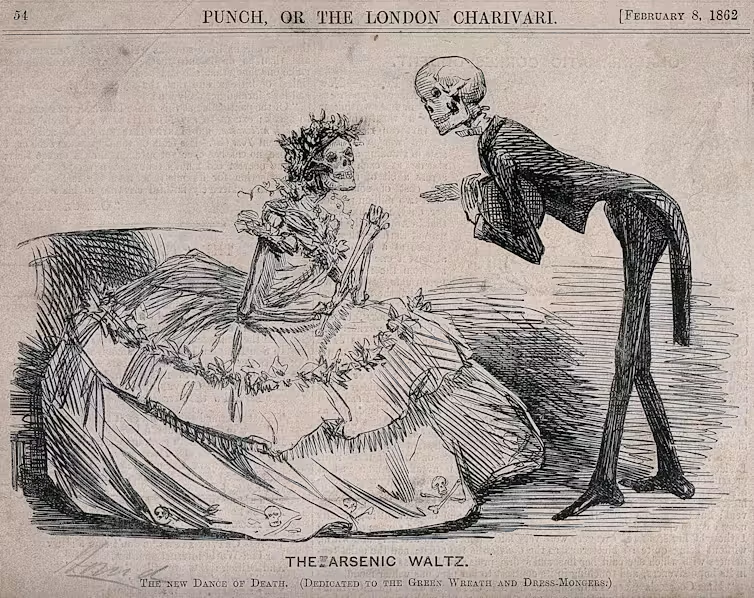
To achieve an emerald hue, dress dyes included arsenic. Source: Wellcome Collection

Toxic cosmetics
Queen Elizabeth I’s famously pale complexion, achieved with a lead-based Venetian makeup, is believed to have contributed to her death; researchers have since found the mixture allowed lead to be absorbed into the body more readily than other formulas of the time.
Lead-based cosmetics have an even longer history, going back to Cleopatra’s use of a lead-based eyeliner, though some research suggests that particular formula may have had disease-preventing effects.
Dangerous hairstyles
The pompadour hairstyle of the 1900s, named after the 18th-century courtier who inspired it, relied on toxic lead-based pomades for volume.
In the early 20th century, radium-infused hair tonics and oils became a bizarre and dangerous trend, some marketed as promoting hair growth or curing dandruff; long-term radium exposure caused lasting damage to bones and blood.
Flammable fabrics
In 1871, Oscar Wilde’s young half-sisters attended a Halloween party in Ireland wearing voluminous crinoline skirts, and both died after their skirts caught fire from a candle while dancing.
Their deaths were far from unique. More than 3,000 women reportedly died the same way during the Victorian era, and an 1858 New York Times report cited an average of three such deaths per week, making the crinoline one of history’s most dangerous fashion trends.