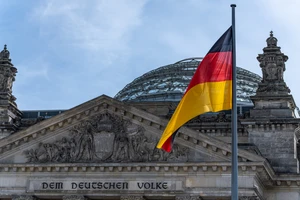
Germany was long seen as Europe’s rock of political stability, a country that rarely changed leaders mid-term. Now an unprecedented political thriller is unfolding.
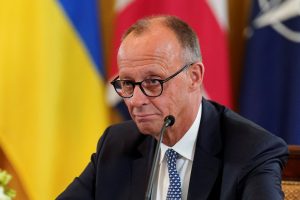
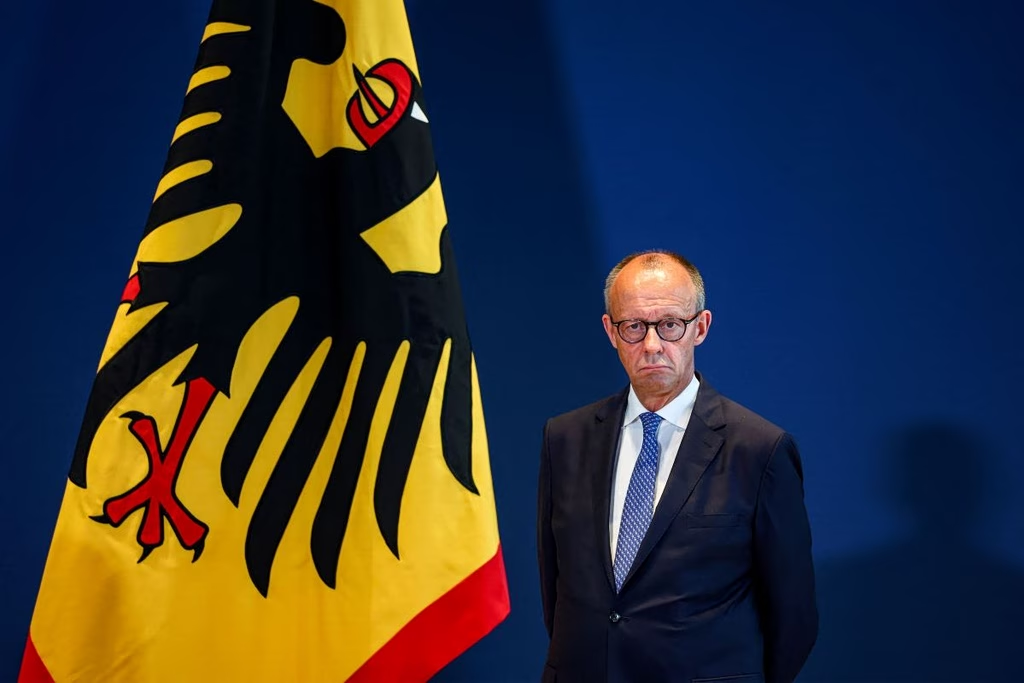
With his approval ratings hitting a historic low and the far-right AfD advancing threateningly ahead of critical regional elections, Chancellor Friedrich Merz faces the ultimate taboo of German politics: an internal revolt and a replacement scenario that seemed unthinkable until recently.
False Calm Before the Storm
German Chancellor Friedrich Merz doesn’t appear to believe his position will be at risk when he returns from his summer vacation.
He said last week that he expects things to have calmed down somewhat by September, after internal party disagreements over how he handled the cabinet reshuffle escalated dangerously. He may, however, be underestimating the pressure building within his own party.
The “Kanzlertausch” Taboo
Ahead of the critical September regional elections, in which the far-right Alternative for Germany (AfD) has a realistic chance of taking power in a German state for the first time, there is growing open discussion of a “Kanzlertausch,” or chancellor swap, this fall.
Public criticism comes mostly from those pushed out of government during the reshuffle. But behind the scenes, a growing number of politicians from Merz’s center-right Christian Democratic Union (CDU) are discussing a scenario that would be remarkable by German standards: replacing the leader after barely a year in power.
The Far-Right Threat Upends Stability
Europe’s largest economy has long been one of the most stable democracies, without a history of frequent leadership changes like postwar Italy or Britain after Brexit.
But the AfD’s expected success in the elections, in which the CDU is expected to lose ground, is upending the country’s traditional political dynamics.
The thinking behind a Kanzlertausch is that conservatives should cushion the fallout from the eastern state elections and give themselves momentum by replacing a leader unable to escape historically low approval ratings.
Historical Precedent and a Possible Successor
The risk is significant. The AfD, now the most popular party in national polls, will look to further exploit the coalition’s turmoil. Replacing a chancellor years before his term ends would mean entering largely uncharted political territory.
Only three sitting chancellors have been replaced by a politician from the same political camp in postwar Germany: in 1963, when 87-year-old Konrad Adenauer resigned to hand power to Ludwig Erhard; in 1966, after Erhard’s coalition collapsed; and in 1974, when Social Democrat Willy Brandt resigned over an espionage scandal.
The current Kanzlertausch scenario, in which Hendrik Wüst, premier of the western state of North Rhine-Westphalia, is seen as Merz’s most likely successor, has been widely discussed in German media, including a recent Der Spiegel cover titled “Palace Revolution.”
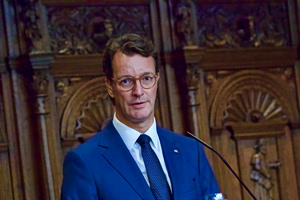
Münster, Germany. September 01, 2025. Chancellor Friedrich Merz (CDU) visits North Rhine-Westphalia, in the historic town hall with Hendrik Wüst (CDU), Minister-President of North Rhine-Westphalia. Source: Shutterstock
Fears of a “Rebellion” and Cooperation with the AfD
Conservative politicians confirmed the internal discussions to POLITICO on condition of anonymity, attributing the unease to a lack of confidence in the chancellor and fear he won’t keep the party united if the AfD prevails in September.
Polls put the AfD in first place in Saxony-Anhalt, Mecklenburg-Vorpommern, and Berlin, fueling concern that local CDU officials might back a far-right government, breaking Merz’s red line.
While the discussion remains “theoretical” and no one has spoken publicly, the level of unease is unprecedented for a party known for its discipline.
Keeping Calm
If Merz were forced out, it would seriously disrupt Germany’s consensus-based political system. The move would come less than two years after the collapse of the previous center-left coalition and could trigger early elections.
Kai Arzheimer, a political science professor at the University of Mainz, said the fragmentation of Germany’s party system, in which mainstream parties sometimes must form difficult coalitions to keep increasingly popular fringe parties out of power, has caused a shift.
He said that compared with the 1970s and 1980s, Germany has experienced relatively low political stability for some time now, but by the standards that have become the norm in many other European countries, one could say Germany has simply caught up to where others have long been.
How a Replacement Could Unfold
The least destabilizing path would be for Merz to step aside voluntarily, allowing his successor to be elected by majority.
If Merz refuses to go, his opponents would have to remove him through a constructive vote of no confidence, electing his successor simultaneously. Such an extraordinary parliamentary maneuver would risk breaking apart the governing coalition of the CDU, its Bavarian sister party CSU, and the Social Democrats.
Support with Warnings from Allies
For now, Merz continues to enjoy the backing of top conservative officials.
Markus Söder, Bavaria’s powerful premier and CSU leader, said in a weekend interview with public broadcaster ARD that he’s firmly convinced Merz will remain chancellor.
He said a possible replacement would plunge conservatives into total confusion and could even trigger new elections, adding that anyone pushing for new elections now, after this much preparation, is doing only one thing: helping radicals into power. His advice, he said, is to focus on the work at hand and spend less time on backroom scheming.
Historic Low Approval Ratings
Nationally, POLITICO’s Poll of Polls ranks the AfD as the most popular party at 28%, with Merz’s conservatives at 21%.
Meanwhile, just 13% of Germans say they’re satisfied with Merz’s performance, according to the latest ARD-DeutschlandTrend poll released last month, the lowest rating for a sitting chancellor in the survey’s nearly 30-year history.
Merz’s exceptionally low ratings reflect frustration over his efforts to revive Germany’s struggling economy and public skepticism toward sweeping pension and healthcare reforms that will be difficult to implement and are expected to cost the average voter money.