

 Μake us preferred on Google
TEL AVIV—Israel’s most critical alliance is confronting its toughest test in decades after midterm elections brought to power more Democrats who question U.S. support for the country and led Republicans from President Trump on down to call for a recalibration of the relationship.
Israel has long prepared for a changed alliance with the U.S., one that relies less on its most important ally. Now, Israelis are seeing their relationship with America change faster than they expected.
Their country is already in the throes of a leadership crisis after elections last week produced no clear winner and left Prime Minister Benjamin Netanyahu fighting for political survival. Throughout his campaign, Israel’s longest-serving leader used his close relationship with Trump as a selling point over his rival, political newcomer and former military chief Gadi Eisenkot .
Now, Netanyahu’s hold on power and his country’s relationship with Washington both hang in the balance. An increasingly isolated Israel abroad also must contend with unresolved wars in Iran, Lebanon and Gaza.
Netanyahu hasn’t so far commented on the U.S. midterm results, and his office didn’t respond to a request for comment Thursday.
“In Israel, there’s unfathomable panic,” said Josh Krasna , a former Israeli diplomat and senior researcher at the Moshe Dayan Center, an Israeli think tank. “Israelis are trained to believe that the Americans will always be our friend, and in a way this was a wake-up call.”
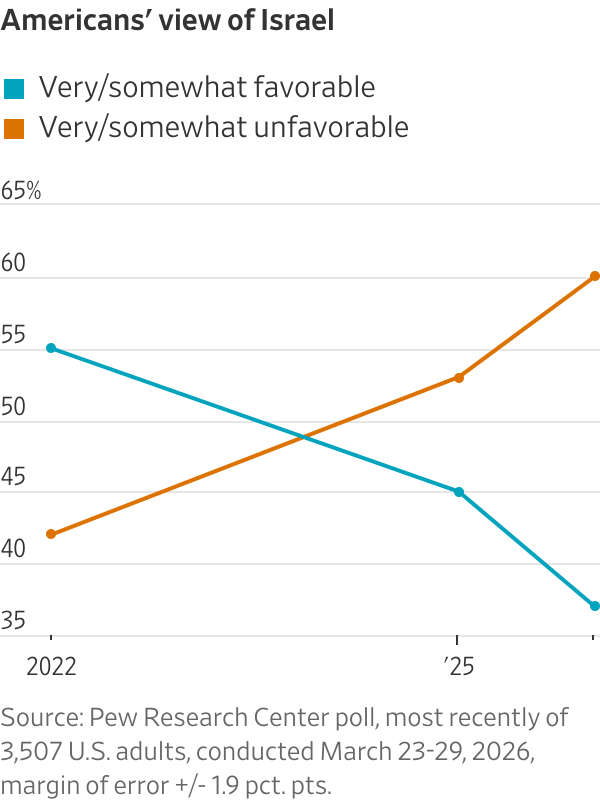
Even with Democrats taking control of the House and Senate , Israel retains significant support in Congress, including for providing weapons to Washington’s closest Middle East ally, analysts say. But the election results have swelled the ranks of Democrats who will be more inclined to try to block weapons or impose conditions on aid, they added.
“Future financial assistance could face greater restrictions, and Congress may demand much closer oversight of how American weapons and military aid are used, particularly in relation to Israeli policy toward the Palestinians,” said Danny Citrinowicz , a senior fellow at the Institute for National Security Studies, an Israel-based think tank.
The consequences could be more widespread and long-lasting than new financial limits. Future U.S. administrations are likely to be less willing to veto United Nations resolutions critical of Israel, block international initiatives or use their diplomatic influence to protect Israeli policies they disagree with, Citrinowicz said.
The U.S. also “could distinguish much more sharply between defending Israel against an attack and supporting military operations initiated by Israel,” he added.
After opposition member Yair Lapid said in a social-media post Wednesday that Israel needed to rebuild its political support with a “tour” of the U.S., Brad Lander , a Democratic congressman-elect from New York, responded in a post: “We aren’t starving for a barnstorming tour. We’re hungry to see respect for international law and human rights.”
The crisis stems from a collision between years of intense partisanship that defined Netanyahu’s tenure and a tsunami of Democratic midterm wins that handed the party majorities in both chambers of Congress. Throughout almost two decades in power, Netanyahu cultivated ties with Republicans, while critics of his government say it neglected to forge links with the Democratic Party.
Officials in both Israel and the U.S. recognized that their relationship needed reassessing. In particular, support among Democrats plummeted amid the devastating war in Gaza, which was sparked by the deadly Hamas-led attack on Israel on Oct. 7, 2023.
But events this week showed Israel’s troubles with the U.S. run deeper than the partisan divide. On Tuesday, as voters were still streaming into polling stations, Trump told Fox News that U.S. military aid to Israel would stop “by the end of this year,” catching officials in Israel by surprise. Trump said halting funding would deprive Democrats of a talking point, after candidates, such as Michigan’s Sen.-elect Abdul El-Sayed , campaigned on ending the assistance that they say takes taxpayer money to fund the war in Gaza.
When election results showed a stunning Republican defeat, Vice President JD Vance cited voter exasperation with the war in Iran and the U.S. relationship with Israel.
“Netanyahu is now poisoned to virtually every Democrat and many Republicans too, who, as Vance did, associate the war with their defeat,” said Daniel Shapiro , a former U.S. deputy assistant secretary of defense for the Middle East. “It’s almost a kind of an emergency situation for Israel—if they want to preserve this relationship, it can’t be with Netanyahu.”
Since its founding in 1948, Israel’s relationship with Washington has experienced turbulence. Krasna, the former diplomat, said the first major test came in 1956, when the Eisenhower administration threatened sanctions against Israel for its invasion of Egypt’s Sinai Peninsula over a crisis in the Suez Canal.
Iran has seized on the Suez crisis in recent days to draw comparisons with the current situation. A spokesman for Iran’s Islamic Revolutionary Guard Corps compared the U.S. position in the Strait of Hormuz to that faced by Britain, France and Israel in that failed military effort. “The 1956 Suez crisis unveiled the limits of British power; history sometimes turns in strategic chokepoints,” wrote Brig. Gen. Hossein Mohebbi.
Though the U.S. and Israel have had other major setbacks, the bonds between them have deepened as the years have passed, particularly in the 1970s under former President Richard Nixon. He saw Israel as a bulwark against Soviet influence in the Middle East even as his tapes later showed his disdain for Jewish people.
The U.S. later stood by its ally when efforts to build peace between Israel and Palestinians collapsed at the turn of the millennium, giving way to the violent second intifada uprising.
The gravity of this week’s shift dominated conversations in cafes and parks in Israel’s commercial hub of Tel Aviv. One Jewish American voter who lives in Israel said he was so afraid of the country’s sinking global stature that for the first time ever he voted not for the party he preferred but for the people he believed would best serve Israel, without saying who he voted for. Others, even progressive Israelis in the mostly liberal city, said they feared what a Democratic Congress might bring.

Former military chief Gadi Eisenkot, leader of the Yashar party, waves an Israeli flag following the exit polls at his party headquarters, on the evening of Israel’s national election, in Tel Aviv, Israel October 28, 2026. REUTERS/Shir Torem TPX IMAGES OF THE DAY
Eisenkot, Netanyahu’s challenger, promised to rebuild the relationship, which he said was more than an alliance.
“Under my leadership, we will renew and deepen that partnership, strengthen the bipartisan foundations that have long sustained it, and work with our allies to advance a Middle East defined not simply by the absence of conflict, but by the presence of opportunity and cooperation,” Eisenkot said.
Israel’s next leader has yet to be determined. The country’s president will choose either Netanyahu or Eisenkot to try to build a coalition after both their parties fell short of a majority. So far, Eisenkot appears likely to have the first shot because more lawmakers endorsed him, but obstacles remain, such as whether he will take on support from Arab or ultraorthodox parties .
A new Israeli administration will have to deal with an incoming Congress and a White House that both want to reset America’s relationship with Israel.
“On Oct. 7, we learned a hard lesson, that we need to listen to our enemies—just hear them and listen to them,” said Avner Golov , a former Israeli national-security official and now a vice president at MIND Israel, a think tank based in Tel Aviv. “Now we’ve learned that we need to do the same with our friends.”
Write to Feliz Solomon at feliz.solomon@wsj.com and David S. Cloud at david.cloud@wsj.com