 Μake us preferred on Google
The wage gap separating Greece from the rest of the European Union’s member states remains deep, with the exception of Bulgaria as usual. According to new Eurostat data, the annual full-time salary in the EU rose by 4.3% in 2025, while in Greece it remains stuck at the bottom of the list, contradicting the government’s narrative about Greeks’ “prosperity.”
Specifically, in 2025, the average annual full-time salary for workers in the EU reached 41,500 euros, up 4.3% from 39,800 euros in 2024. This represents a nominal increase of 1,700 euros in one year.
However, this increase does not account for the effect of inflation and therefore does not necessarily mean a corresponding boost in workers’ real purchasing power.
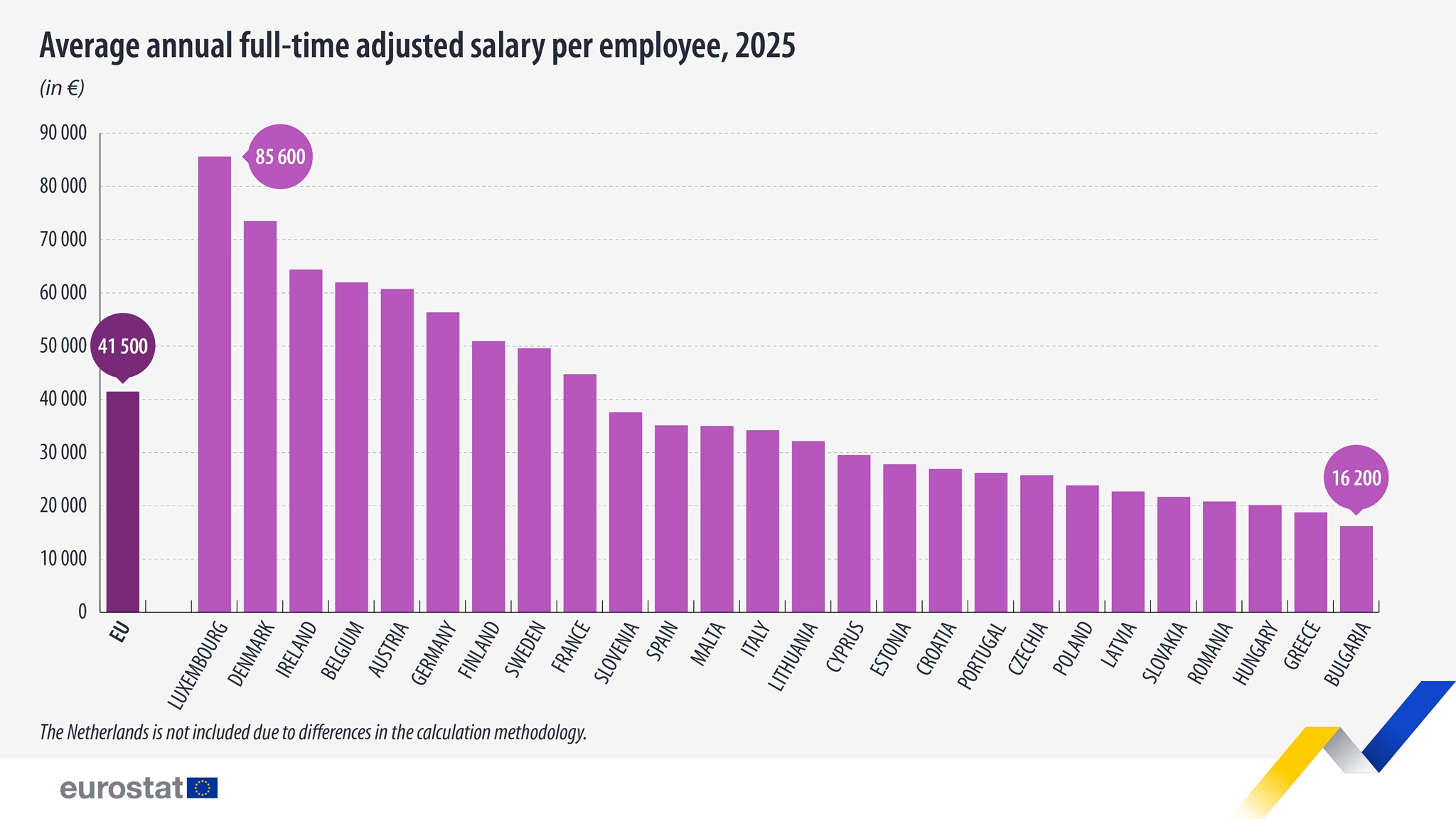
Among EU countries, the highest average annual full-time salary was recorded in Luxembourg (85,600 euros), followed by Denmark (73,500 euros) and Ireland (64,400 euros).
At the other end of the scale, the lowest average annual full-time salaries were recorded in Bulgaria (16,200 euros), Greece (18,800 euros) and Hungary (20,100 euros).
A 22,700-Euro Gap With the EU Average
Based on Eurostat data, the average full-time worker in Greece earns 22,700 euros less per year than the European average.
The average Greek salary is just 45.3% of the EU average, a gap of 54.7%.
In other words, the average salary in the EU is 120.7% higher than the Greek average, while a worker in Luxembourg earns more than 4.5 times as much as a worker in Athens or Sofia.
When Wages Don’t Cover the Basics
Although high prices are widespread and affect almost all of Europe, especially with the war in the Middle East and the surge in energy prices, in Greece, combined with low wages, they create an explosive mix that leaves citizens unable to cover even the essentials.
In Greece, headline inflation accelerated again in October 2026, climbing to 5.6% from 5.1% in September and driving significant increases in the prices of basic goods.
The impact of high prices on incomes in Greece is clearly reflected in ELSTAT’s 2025 Household Budget Survey. According to the survey, a household needs more than 1,820 euros a month to cover the basic expenses of a minimally decent standard of living, an increase of 5.5% compared with 2024.
The largest shares of the average household budget, at current prices, go to food and non-alcoholic beverages (20.4%), housing (14.7%) and transportation (13.6%). These three categories take up almost half of the monthly budget.
The smallest share of spending (2.0%) goes to insurance and financial services.
As for households that pay rent, they spend an average of 23.4% of their total monthly budget on housing, of which 17.3% goes toward rent.
Food Prices Remain Steep
At the same time, food prices remain “salty,” as average monthly household spending has increased since 2024 on the following items:
- Coffee, tea and cocoa (11.9%), meat (9.9%), fish (8.0%)
- Sugar, jams, honey, syrups and chocolate (6.5%), fruit (5.4%)
- Dairy products and eggs (4.9%)
- Mineral water, soft drinks and fruit and vegetable juices (2.0%), flour, bread and cereals (2.0%), and vegetables (0.6%)