
 Μake us preferred on Google
What is the general mood in Finland toward Russia after the invasion of Ukraine? Is fear dominant — and how different is the situation between the two countries today compared to before Moscow’s break with the West?
Russia’s annexation of Crimea back in 2014 was already a shock for Finland. It explains why, even then — considering the composition of the Finnish government at the time — Helsinki took the difficult decision to side with Germany and Sweden in supporting EU sanctions against Moscow. That move genuinely surprised the Kremlin.
Those events in 2014 triggered a reassessment of the post–Cold War balance, when Finnish foreign policy sought to maintain equally good relations with both Russia and the West. Then, in December 2021, came Russia’s so-called “telegram” to NATO — a document that effectively tried to dictate to European states, Finland included, what alliances they could or could not join.
So when Russia launched its full-scale invasion of Ukraine in 2022, Finnish society — which had long been cautious about NATO membership — shifted its position almost overnight and said yes to joining the Alliance. The consensus extended across almost the entire political spectrum.
At the same time, a new conviction took hold: that Ukrainians were fighting not only for their own country, but for the whole of Europe — and, by extension, for Finland as well. That belief translated into real action: Finland’s support for Ukraine has so far reached €3.7 billion, a remarkable sum for a country of its size.
A third development symbolising this change is the closure of the Finnish–Russian border, after Helsinki accused Moscow of weaponising migration flows. It’s a powerful symbol of how much has changed. At one time, there were 13 million annual crossings and around one million visas issued to Russian citizens. Now, the border is sealed.
There is much concern about Donald Trump’s attitude towards Russia and Vladimir Putin. How do Finnish officials and citizens view this peculiar relationship?
Yes, there is concern about how the American president might approach his Russian counterpart. In a sense, Putin has drawn a lucky card. But anyone who follows international affairs closely knows it would be simplistic to talk about a complete reversal of Russia’s relations with the West.
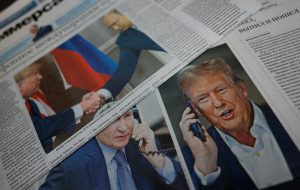
After the recent Putin–Trump meeting in Anchorage, no one can seriously claim the Kremlin is isolated. If the U.S. president is willing to talk to Putin, then anyone can.
At the same time, as long as Ukraine continues to fight, there is no need for panic — in Finland or elsewhere. Even if Russia were to win (and that outcome is by no means inevitable), the war would not immediately spill over into Finnish territory. It’s hard to imagine a Russia drained by war opening a new front against a country as determined and well-prepared to defend itself as Finland.
Remember, Finland has a culture of mandatory conscription and a largely homogeneous population. That leaves Russia with no opportunity to play the “ethnic minority” card — a tactic it used in Ukraine.
You’ve studied Vladimir Putin and his system for decades. Is there any room for him to change behaviour, or will he continue to respect only power as long as the war goes on?
It’s been more than 25 years since Putin entered politics. He worked in St. Petersburg, just a few hours from Helsinki, and had the chance to visit Finland and form impressions of it as early as the 1990s.
When we talk about Russian–Finnish relations, we must factor in psychology. Putin divides people and countries into three categories: friends, enemies, and traitors. From his point of view, Finland belongs to the last group — and therefore deserves punishment.
If at some point a peace agreement is reached in Ukraine, one of Putin’s next goals will be to make Finland “pay the price” for joining NATO.
At the same time, his invasion of Ukraine was an enormous mistake — diplomatically and economically. It drained Russia’s resources. From the beginning, I and others argued that the consequences for Russia would be entirely negative. What Putin is doing now is simply damage control.
There’s been intense debate about the Russian threat and the need to strengthen Europe’s defence. What’s your view?
There’s really no choice. Strengthening Europe’s defence industry and increasing defence spending is the only way forward.
Perhaps it should have happened years ago. But, as we’ve seen so many times, Europe tends to react slowly. We knew from the 2008 war in Georgia — and even from the 2008 NATO summit in Bucharest — what Putin was capable of. Then came Crimea and the Donbas.
Europe should long ago have built up the technical capacity to meet such challenges, instead of clinging to the illusion that Russia would “turn West” and that economic integration would somehow produce democratic institutions.
In 2016, the EU even adopted a policy of “sanctions and dialogue” — two inherently contradictory ideas. But Putin only understands power.
As for his narrative that NATO poses a threat: it doesn’t hold up. The Baltic states are geographically much closer to Russia than Ukraine ever was, and yet Moscow has not invaded them.
I believe the real reason for Putin’s aggression lies elsewhere — in the danger posed by a more Western-oriented Ukraine. For all its corruption, Ukraine was still a functioning democracy. That example, sitting on Russia’s border, was intolerable for Putin’s authoritarian system. A democratic Ukraine would expose the rot within the Kremlin’s power structure — and that, for Putin, is the real existential threat.