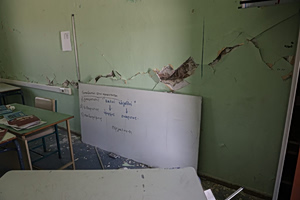
A magnitude 7.1 earthquake in Japan, hit Kyushu island on Tuesday morning. At least 50 people were injured and taken to hospitals. Buildings collapsed and fires broke out, according to Prime Minister Sanae Takaichi, who said officials are still assessing the full scope of injuries and damage, and that some areas lost power, saw fires break out, and had roads, bridges, and buildings damaged.
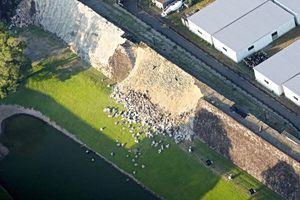
Images from Kumamoto Castle, one of Japan’s most significant historic landmarks, show sections of its stone walls collapsed after the quake. The castle also suffered extensive damage in the major 2016 earthquake, with repairs continuing for years afterward.

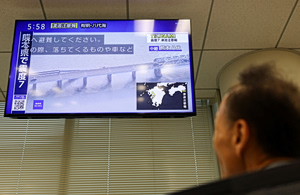
Footage circulating online shows major destruction in the Kumamoto area in southern Japan, near the quake’s epicenter, with damage to bridges and roads.
【地震】熊本 八代 道路の高架で被害か 上空からの映像https://t.co/tqoH08pfnT pic.twitter.com/gus4eczku1
— NHKニュース (@nhk_news) July 28, 2026
A few minutes ago: The stone walls of Kumamoto Castle collapsed following a magnitude 7.1 earthquake (地震 ) that struck 4 km southeast of Uki, Kumamoto Prefecture, Japan. pic.twitter.com/PwXwldRmIr
— Weather Monitor (@WeatherMonitors) July 28, 2026
More footage showing the shaking during the M6.8 earthquake that hit Japan earlier… pic.twitter.com/r4HkyDl3wM
— Volcaholic 🌋 (@volcaholic1) July 28, 2026
The tremor hit at 4:27 PM local time (10:27 AM in Greece) and registered the maximum level, 7, on Japan’s “shindo” intensity scale, which measures how strongly a quake is felt on the ground, according to the Japan Meteorological Agency (JMA).
The JMA initially issued a tsunami warning for waves up to one meter, later lifting it, according to public broadcaster NHK. The warning had urged anyone in the water or near the coast to leave immediately, given strong currents, and cautioned that tsunami heights in some areas could exceed initial estimates.
Japan’s government issued emergency earthquake alerts for the Kumamoto, Nagasaki, Kagoshima, Fukuoka, Saga, Oita, and Miyazaki prefectures, all on the southern island of Kyushu.
NOW: M7.1 Earthquake Near Uki, Japan#terremoto #地震 pic.twitter.com/nW2V9kGWkO
— Noteworthy News (@newsnoteworthy) July 28, 2026
Kyushu Electric Power reported that roughly 40,000 households lost power, though there were no reports of issues at the Sendai or Genkai nuclear plants. Rail operator JR Kyushu suspended its services.
The US Pacific Tsunami Warning Center said there was no risk to Hawaii or American Samoa.
Japan is one of the most seismically active countries in the world, sitting atop four major tectonic plates along the western edge of the Pacific “Ring of Fire.” The archipelago, home to roughly 125 million people, typically experiences hundreds of earthquakes each year.