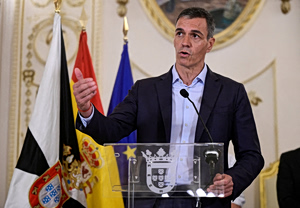
“A good crisis is like Schrodinger’s cat: you never know if it’s alive or dead,” El Pais wrote yesterday, referring to the migration crisis in Ceuta, when 72,000 migrants entered the Spanish enclave from Morocco in late July.
In theory, the crisis is over. Around 70,000 would-be migrants returned to Morocco, and “not a single migrant reached Europe,” according to Brussels. Still, an increasingly sharp ideological dispute over border security is unfolding, with Italy’s prime minister and her Spanish counterpart at the center of it. Meanwhile, Berlin has opened a new front, demanding the return of so-called “Dublin” migrants from both Italy and Greece.
Giorgia Meloni is not the only conservative EU leader facing pressure from her right flank. Friedrich Merz is dealing with polls showing the far-right AfD surging. His government has therefore decided to take a hard line on immigration.
For the first time in four years, on August 19 Germany will return an asylum seeker to Italy, the country through which she first entered the EU. The case involves a 22-year-old Somali woman, Abdirisak Warsame, who arrived in Germany in March. As Italy’s La Repubblica notes, this is only the beginning.
The Somali woman’s case
Under the Dublin Regulation, since Italy was the first EU country the 22-year-old Warsame entered, she should have applied for asylum there rather than in Germany. For nearly four years, however, the Meloni government refused to take back so-called “Dubliners,” citing a “national state of emergency.”
In December 2025, Rome and Berlin signed an agreement to settle old cases permanently. A spokesperson for Germany’s Interior Ministry told La Repubblica, though, that for Dubliners who arrived this year, Germany intends to apply European rules strictly.
“A functioning Dublin system is a precondition for the success of the reform of the Common European Asylum System (CEAS),” the spokesperson said. He also noted that in the fall of 2025, Italy and Greece “agreed, as part of bilateral deals with Germany,” to “reapply the Dublin Regulation once CEAS enters into force,” which happened on June 12.
“Germany expects transfers to Italy and Greece to resume as of that date,” he added. Germany’s Interior Ministry, led by Christian Social Union minister Alexander Dobrindt, is therefore expecting EU partners to provide “binding and enforceable transfer procedures, along with a detailed legal framework for voluntary transfers as an effective and bureaucracy-free return method.”
At a reception center
It is not yet clear how many people will be returned. The 22-year-old Somali woman, the first to be sent back to Italy, is living at a reception center in Niederwern, Bavaria. On June 25, she received a letter from the German Interior Ministry. “On Wednesday, August 19,” the document, obtained exclusively by La Repubblica, stated, “you will be transferred to Italy. The police will come to pick you up.”
The young woman, who had left Somalia to escape her father and a forced marriage, arrived in Germany on March 31 after first passing through Italy. Her mother, brother and other relatives were already living in Germany, and she applied for asylum there.
Germany’s Interior Ministry ruled, however, that the Somali woman “falls under Italy’s jurisdiction” and that “the conditions” for filing an asylum claim in Germany “are not met.” The request for Italian authorities to take her back had already been submitted in June. After the two-week deadline for a response passed, it was considered “tacitly accepted.”