A Prime Minister among the high streets
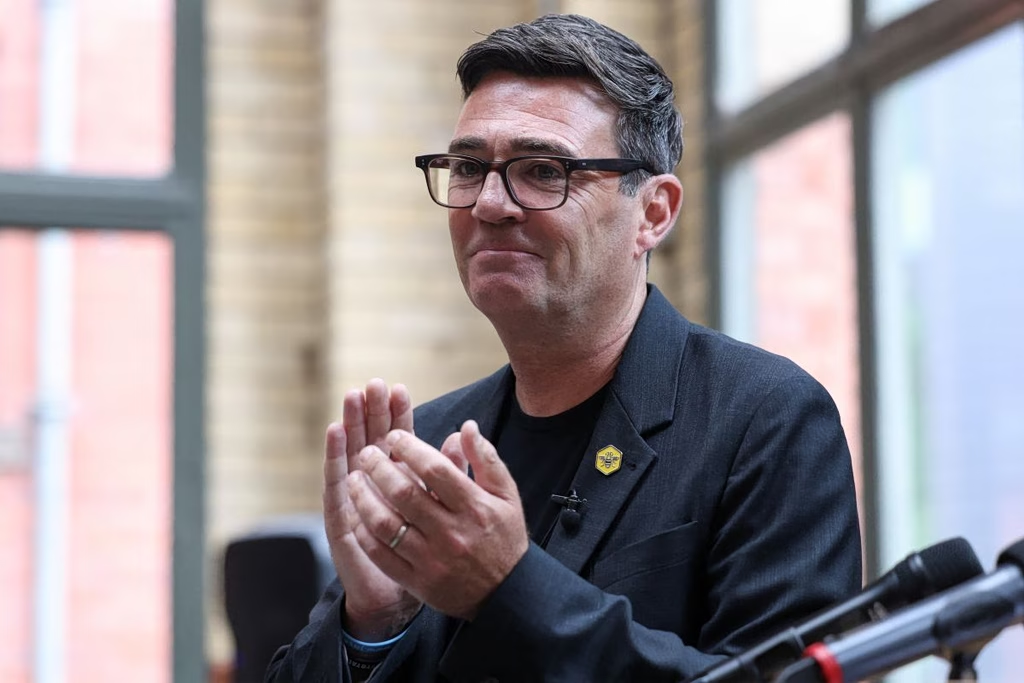
On a bright morning in Ilkeston, shoppers stopped in their tracks as Andy Burnham walked through the Albion Centre alongside Angela Rayner, heading towards Bath Street. The new Prime Minister was an unexpected sight in the Erewash town, where his first stop on a UK-wide “listening” tour brought cameras, curious residents and a succession of conversations about the cost of living.
Outside a coffee shop in the old Co-op building, Mr Burnham faced a blizzard of television interviews. His message was deliberately local: town centres, he argued, had been “hollowed out” by decades of decline and needed to be brought back to life.
A mother who spoke to him captured the novelty of the moment: “I couldn’t believe I got to shake the Prime Minister’s hand.”
The scene was a useful snapshot of the political strategy now unfolding around Britain’s new Labour leader: get out of Westminster, meet voters, listen and demonstrate that government can make a tangible difference to everyday life.
The tour, launched on Monday 10 August, is centred on the cost of living and on giving households facing financial pressure some “breathing space”. It comes at a particularly significant moment for Labour. After a difficult period in office, the party has begun to recover in the polls, with several surveys putting it ahead of Reform UK.
The question is whether this is the beginning of a genuine political realignment – or simply the temporary lift that traditionally accompanies a new leader.
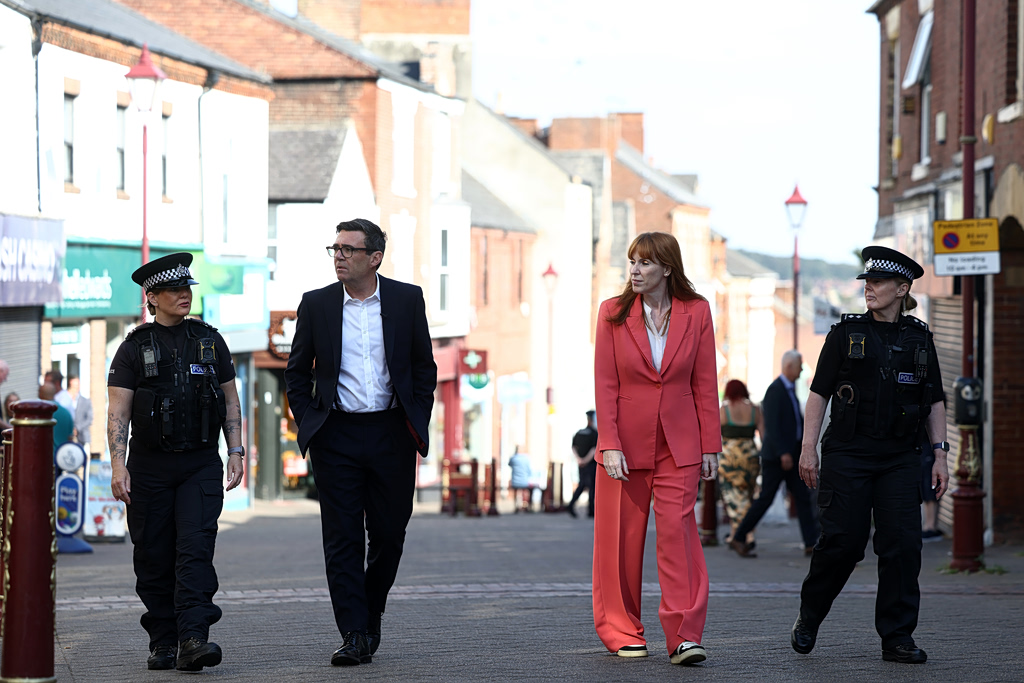
Britain’s Prime Minister Andy Burnham, 2nd left, and Britain’s Housing Secretary Angela Rayner, 2nd right, talk with police officers as they walk past shops in the town centre of Ilkeston, Derbyshire, England, Tuesday, Aug. 11, 2026. (Toby Shepheard/Pool Photo via AP)
The personal factor
For George Levy, Founder of UK innovator, a Manchester-based advisory supporting international entrepreneurs to establish and grow innovative businesses in the UK, Burnham’s instinct to meet people is not a manufactured political technique.
“I first met Andy in quite unusual circumstances, when I had the opportunity to spend a day with him, including playing alongside him at a charity football match,” Levy told TO VIMA. What struck him was the consistency of Burnham’s behaviour, both in public and away from the cameras.
“He was approachable, grounded and genuinely interested in people,” Levy said. “There didn’t seem to be a difference between his public persona and the person I spent time with away from the cameras.”
That quality, he believes, explains why the listening tour feels natural rather than staged.
“Getting out, meeting people and listening to them is very much his natural environment,” Levy said. “So the approach he is taking with this tour feels entirely consistent with the Andy I got to know that day.”
That personal connection is now reflected in the polling.
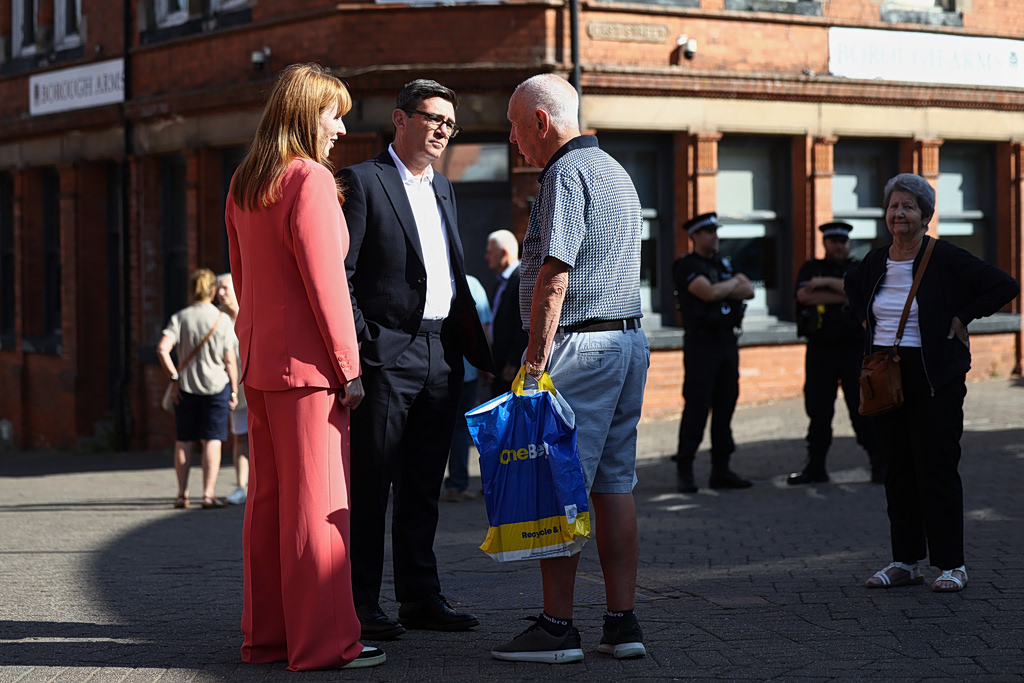
Britain’s Prime Minister Andy Burnham, 2nd left, and Britain’s Housing Secretary Angela Rayner, left, talk with members of the public during a visit to the town centre of Ilkeston, Derbyshire, England, Tuesday, Aug. 11, 2026. (Toby Shepheard/Pool Photo via AP)
A real bounce – but perhaps a temporary one
Dr Stuart Fox, Senior Lecturer in Politics at the University of Exeter, believes the improvement in Labour’s fortunes is genuine.
“Andy Burnham’s installment as Prime Minister unquestionably delivered a small boost to Labour’s polling,” he told TO VIMA. “The ‘Burnham bounce’ saw Reform knocked off top spot for the first time in over a year, and Labour overtake Reform in the polls for the first time in 18 months. The bounce is small, but it’s real.”
Burnham’s advantages are clear, Fox argues. He is not Keir Starmer, he communicates more effectively and he has announced eye-catching policies, including measures intended to make energy cheaper and reduce taxes on pubs.
But the fundamentals of government have not disappeared with the change of leadership.
Britain still faces high debt, weak economic growth, rising welfare costs, pressure over illegal migration and a shortage of housing. “There aren’t any easy solutions to these problems,” Fox warned, arguing that enthusiasm for Burnham’s political style will fade if voters do not see results.
There is another structural problem: the Labour Party itself has not changed simply because its leader has.
“The leader might have changed but the party hasn’t,” Fox said. Labour MPs who previously resisted politically difficult reforms remain in Parliament, creating a potential conflict between what voters demand and what Labour backbenchers are prepared to support.
Popularity is not the same as delivery
Dr Darren Lilleker, Professor of Political Communication at Bournemouth University, also sees the familiar “new leader” effect at work.
“It is often the case that a new leader gives his party a boost in the polls,” he said. Burnham’s political rise, his profile and his reputation as a communicator have given him an unusually strong platform from which to present a governmental reset.
But voters ultimately want something more concrete: “a better standard of living, from improved public services to more money in their pockets”.
The challenge, Lilleker said, is that major improvements take time. Burnham therefore faces a crucial test over the coming months: can he remain a compelling communicator while delivering enough tangible change to maintain public support?
The polling warning signs
Gideon Skinner, Senior Director of UK Politics in Public Affairs at Ipsos, points to a similar contradiction.
“There’s some long-awaited good news for Labour in the latest Ipsos UK poll,” Skinner told TO VIMA. Labour is in its strongest position for more than a year, helped by former Labour voters returning to the fold and by Burnham’s personal popularity.
Yet seven in ten people remain dissatisfied with the way the Labour government is running the country. Crucially, Skinner notes that Burnham’s first satisfaction rating as Prime Minister is actually lower than Starmer’s in July 2024.
“Burnham has removed much of the negativity towards Labour, but it has not yet been replaced by much enthusiasm,” he said.
That distinction may prove decisive. Some 24 per cent say they like Burnham but not the Labour Party – a group predominantly dissatisfied with government performance.
The challenge, therefore, is not merely to make people like Burnham. It is to persuade them that his government can work.
Has Burnham changed the political climate?
Author and Pollster Lord Ashcroft believes Labour has indeed been given a second chance.
“Labour have found themselves ahead in recent polls – a situation hard to imagine even a few weeks ago,” he said. Unlike his predecessor, Burnham “dominates the headlines with a blizzard of plans and policies”.
“The bounce is real enough,” Ashcroft said. His polling shows a four-point Labour lead, with former Labour voters who had drifted away now more willing to return. Burnham also leads Kemi Badenoch and Nigel Farage when voters are asked who would make the best Prime Minister.
Focus groups reveal a warmth towards the new leader. One voter described “a warmth about him that we haven’t had for a while”; another detected “a tad more common sense”.
But Ashcroft’s central question is whether Burnham has changed the political climate or merely the weather.
Voters may welcome measures such as capped bus fares and cheaper electricity, but they are already asking the harder question: where will the money come from?
Of 19 Burnham policies tested in Ashcroft’s poll, only six were judged by a majority to be both welcome and affordable. Meanwhile, the big unresolved issues remain: illegal migration, welfare, defence spending, taxes, debt, regulation, energy costs and economic competitiveness.
The second chance
For now, Burnham appears to have achieved something Labour desperately needed: he has reopened the conversation with voters.
His listening tour, his communication skills and his personal popularity have created political space where there was little only weeks ago. The “Burnham bounce” is therefore more than a statistical curiosity. It represents a second chance.
But it is also a warning.
As Lord Ashcroft put it, voters are willing to give Burnham some time, but they are “waiting for the other shoe to drop”. The new Prime Minister must eventually choose between disappointing some of his newfound supporters by confronting difficult issues and repeating the mistakes that damaged his predecessor.
The high streets can provide the picture of renewal. The polls can provide the early momentum. But only delivery will determine whether the Burnham bounce becomes a lasting Labour recovery – or another brief political honeymoon.