The United States has provided doses of an experimental antibody treatment for use in clinical trials as the Democratic Republic of Congo battles a widening Ebola outbreak caused by the Bundibugyo strain.
The move marks a shift in U.S. policy, with the treatment previously reserved only for Americans considered at high risk after exposure to the virus. The doses will now be used in Congo both for compassionate treatment and to support research that could guide future approval.
The U.S. Department of Health and Human Services confirmed the drug, known as MBP134 and developed by Mapp Biopharmaceutical, is being made available for the outbreak response.
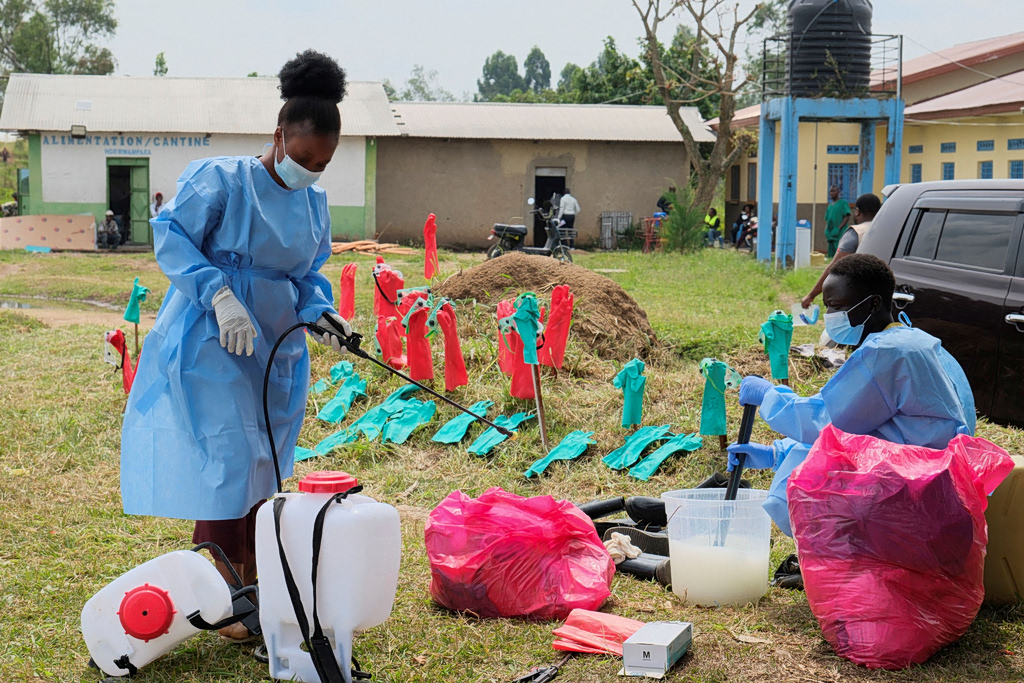
FILE PHOTO: Medical workers dressed in personal protective equipment (PPE) disinfect their equipment at an Ebola treatment centre during a ceremony to present recovery certificates to patients at the Rwambara General Reference Hospital in Bunia, eastern Democratic Republic of Congo, June 16, 2026. REUTERS/Gradel Muyisa Mumbere/File Photo
Ebola outbreak raises urgency for new treatments
The Bundibugyo strain of Ebola has infected more than 1,000 people in Congo, including more than 250 deaths. Cases and fatalities have also been reported in neighboring Uganda.
Unlike the Ebola Zaire strain, the Bundibugyo variant currently has no approved vaccines or treatments.
The World Health Organization said doses of the Mapp drug and other experimental therapies are already being shipped, while preparations are underway for clinical trials at health facilities in affected areas.
WHO Director-General Tedros Adhanom Ghebreyesus said treatment and prevention drug trials are expected to begin in the coming weeks.
The WHO has stressed that experimental treatments and vaccines must be tested through clinical trials before they can be widely used.
Mapp and Gilead drugs set for testing
Mapp’s MBP134 is expected to be among the first treatments tested in the current outbreak.
The antibody treatment will be studied both as a standalone therapy and alongside Gilead Sciences’ antiviral drug remdesivir, also known as Veklury, which was widely used during the COVID-19 pandemic.
The trial is sponsored by the WHO and led by the University of Oxford, working with the Congolese and Ugandan governments.
Another Gilead antiviral, obeldesivir, will also be tested as a possible preventive treatment. The trial will be led by Congo, Uganda, the Africa Centers for Disease Control and Prevention, and other health organizations.
The treatments have shown safety in earlier trials but have not yet been tested for effectiveness against the Bundibugyo strain.
Challenges facing Ebola trials
Health officials warned that conducting clinical trials in Congo will be difficult due to ongoing challenges, including conflict, disrupted supply chains, limited disease monitoring and attacks on healthcare workers.
Mistrust among communities and difficulties with testing and contact tracing could also complicate efforts.
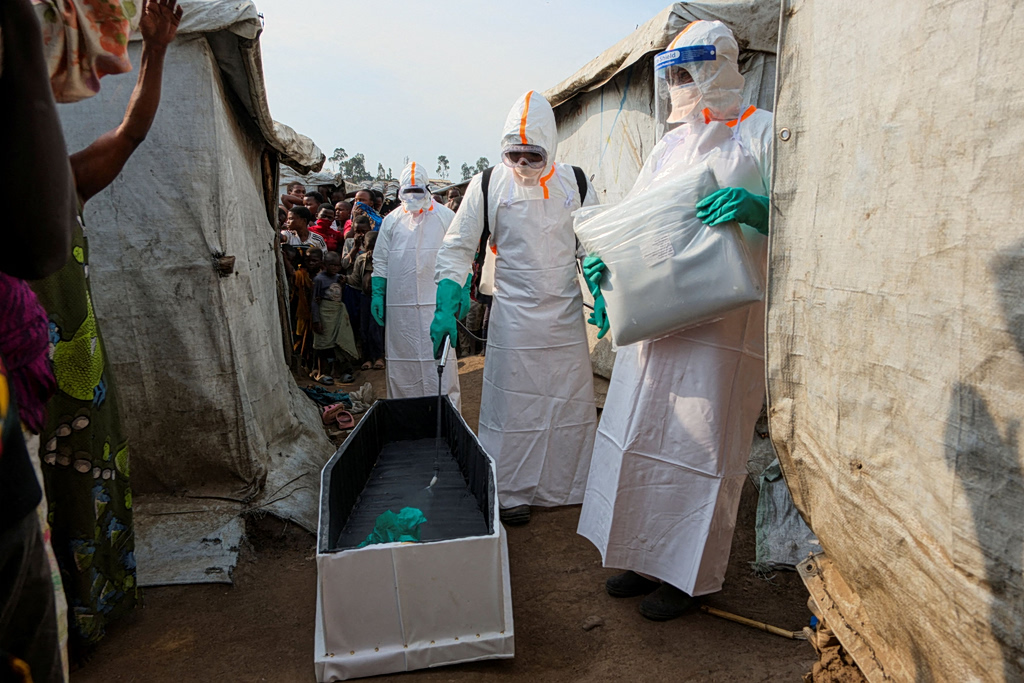
Health workers in full personal protective equipment (PPE) disinfect a coffin while preparing for the burial of suspected Ebola victims at the Kigonze displaced persons camp in Bunia, eastern Democratic Republic of Congo, on June 18, 2026, one month after the outbreak was declared. REUTERS/Gradel Muyisa Mumbere REFILE – CORRECTING INFORMATION TO ADD THAT THE VICTIMS WERE SUSPECTED EBOLA CASES
The WHO said ensuring that patients in affected countries can access treatments after the trials will be a priority if the drugs are proven safe and effective.
The U.S. has pledged hundreds of millions of dollars toward the Ebola response and is also building a quarantine center in Kenya for American citizens, saying the goal is to prevent the virus from reaching the United States.
Vaccine research moves more slowly
While drug trials are expected to begin soon, Ebola vaccine trials remain further away.
Tedros said vaccine doses need to be manufactured and tested for safety before they can be used in outbreak areas.
Richard Hatchett, chief executive of the Coalition for Epidemic Preparedness Innovations, said early-stage vaccine trials could begin in July, likely in the United Kingdom and possibly Uganda.
CEPI has supported four vaccine candidates, including one developed by Oxford and the Serum Institute of India, and another from U.S. vaccine maker Moderna based on mRNA technology.
Health officials said the next steps for later vaccine trials are still being worked out as the outbreak response continues.