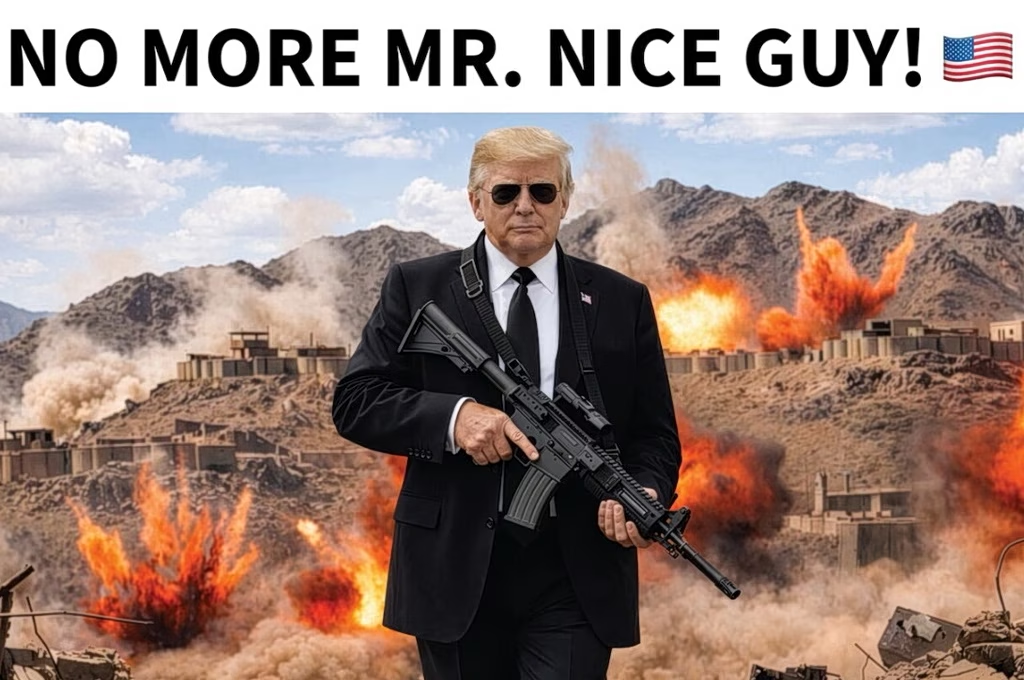
Iran is gaining ground in the information war with a succession of viral AI-made videos that aim to widen divisions in the U.S. and blur the line between entertainment and propaganda.
The clips, produced and distributed by pro-Iranian groups and the country’s diplomatic missions, typically mock America’s war aims with the help of a Lego-styled President Trump and a similarly rendered cast of supporting characters. A recent video portrayed Trump as a buccaneer in a Lego-themed take on the “Pirates of the Caribbean.” American forces are depicted struggling to open up the Strait of Hormuz and blockade Iranian ports, only to see their ships sink instead.
Others showed Trump sweating in fear as Iran launched a series of counterstrikes and depicted Israeli Prime Minister Benjamin Netanyahu as a puppet master pulling America’s strings, usually accompanied by insulting hip-hop lyrics.
The memes are timely, striking, and, often, antisemitic. They are part of a new kind of messaging coming from Iran since the start of the war that is showing the world a country both technologically adept and deeply familiar with the pop culture and politics of the West.
This content marks a shift from Tehran’s traditional communication strategy, which emphasized devotion to its Islamic revolution.
Many appear designed to exploit the fault lines in American politics and society, with the goal of dividing Trump from his base in the MAGA movement and driving a wedge between the U.S. and Israel.
The narrative they aim to promote is simple: Trump is Israel First, not America First, and Americans are paying the price for a war started to distract attention from the Epstein files .
“The content they are producing is using language and conversations that were already happening on both the left and right,” said Narges Bajoghli , an expert on Iranian media at Johns Hopkins University’s School of Advanced International Studies. “They found that if they are funny enough and clever enough they can go viral.”
The White House said the Iranian propaganda “clearly has no basis in reality.”
The Lego-themed content coming out of Iran has nothing to do with the Danish company that makes Lego. But by using artificial intelligence to produce Lego-styled Trumps or Netanyahus, the people behind the videos are tapping in to a universal design language.
It allows them to get their message to a large international audience who are familiar with the toy and might have seen the “The Lego Movie” and other animated spinoffs such as “The Lego Batman Movie” a decade or so ago.
Many of the Lego-style videos are put out by an entity that initially called itself Akhbar Enfejari, Persian for Explosive News, before switching to the English-language Explosive Media. It has said on its social-media channels that it produces its content without outside interference. But it appears to be operating with the blessing of Iran’s rulers, and with a degree of financial help from the government.
The media is severely restricted in Iran, and only selected, pro-government individuals and companies have been allowed internet access since the regime imposed a near-total internet blackout at the start of the war. Iranian embassies and other state-run entities helped spread their work on social media, as did a news site affiliated with the Islamic Revolutionary Guard Corps, Iran’s dominant political and military force.
Either way, in Explosive Media, the Iranian authorities appear to have a hit on their hands, and it could be the answer to a problem that has long eluded the regime.
A new strategy
For years, Iran had trouble communicating what it stands for to a Western audience. It used to rely on a more serious narrative drawing from the martyrdom iconography so deeply rooted in Shia Islam and the Soviet-style, anti-American symbolism of the 1979 revolution.
It didn’t travel well. Iran’s leaders realized their messaging style wasn’t working and the Revolutionary Guard began investing in media production companies around a decade ago with the goal of generating pro-Iran content more in tune with a younger, more globalized audience, said Bajoghli, the Iranian media expert.
This approach met some resistance from the old guard, but that quickly disappeared with the start of the war at the end of February and the killing of Iran’s older generation of leaders, she said.
“This time around the green light has been fully given to a younger generation to put this content out. And they are using global pop culture to do so,” said Bajoghli.
Before the war, Iranian embassies around the world mostly used their social-media accounts to churn out the kind of dry, low-engagement content one might expect from diplomats, such as the arrival of trade delegations or new agricultural programs. That changed with the start of the conflict. Some embassies, in Ghana, Zimbabwe and a handful of other places, began publishing posts on X that quickly went viral.
Many of them poked fun at Trump in a derisive, mocking tone. The Iranian Embassy in Thailand posted a clip of Trump appearing to fall asleep while sitting at his desk in the Oval Office. “Open the strait or I will covfefe. Thank you for your attention to this matter,” says another X post by the same embassy, referring to a curious tweet the president made during his first term.
A wise man once said, “Open the strait or I will covfefe”.
Thank you for your attention to this matter.— Iran Embassy in Thailand ☫ (@IranInThailand) April 13, 2026
One video, shared by the Iranian Embassy in the Netherlands, casts Netanyahu as a boy in the movie “Toy Story” playing with a Trump-shaped doll, a modern spin on an antisemitic trope. “You are my favorite toy. You do everything I say,” the boy says.
“We are seeing those accounts getting the traction you would expect from high-profile individuals,” said Bret Schafer , a senior director at the Institute for Strategic Dialogue, a think tank that is tracking pro-Iran activity online. Their online engagements have gone up 30 times since before the war began, it found.
“It’s all rooted in the strategy of trolling Trump and the U.S. They are not taking communications too seriously,” Schafer said.