
 Μake us preferred on Google
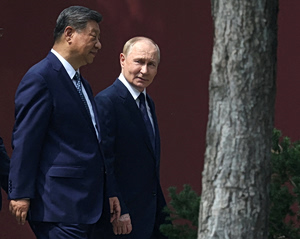
 When Vladimir Putin was captured by a hot mic telling Xi Jinping that humans could achieve immortality by replacing their organs, some dismissed the exchange as eccentric small talk between aging autocrats.
In fact, during the conversation at a Beijing military parade last September, Putin appeared to be describing a Kremlin-backed longevity initiative that has become one of Russia’s flagship scientific projects.
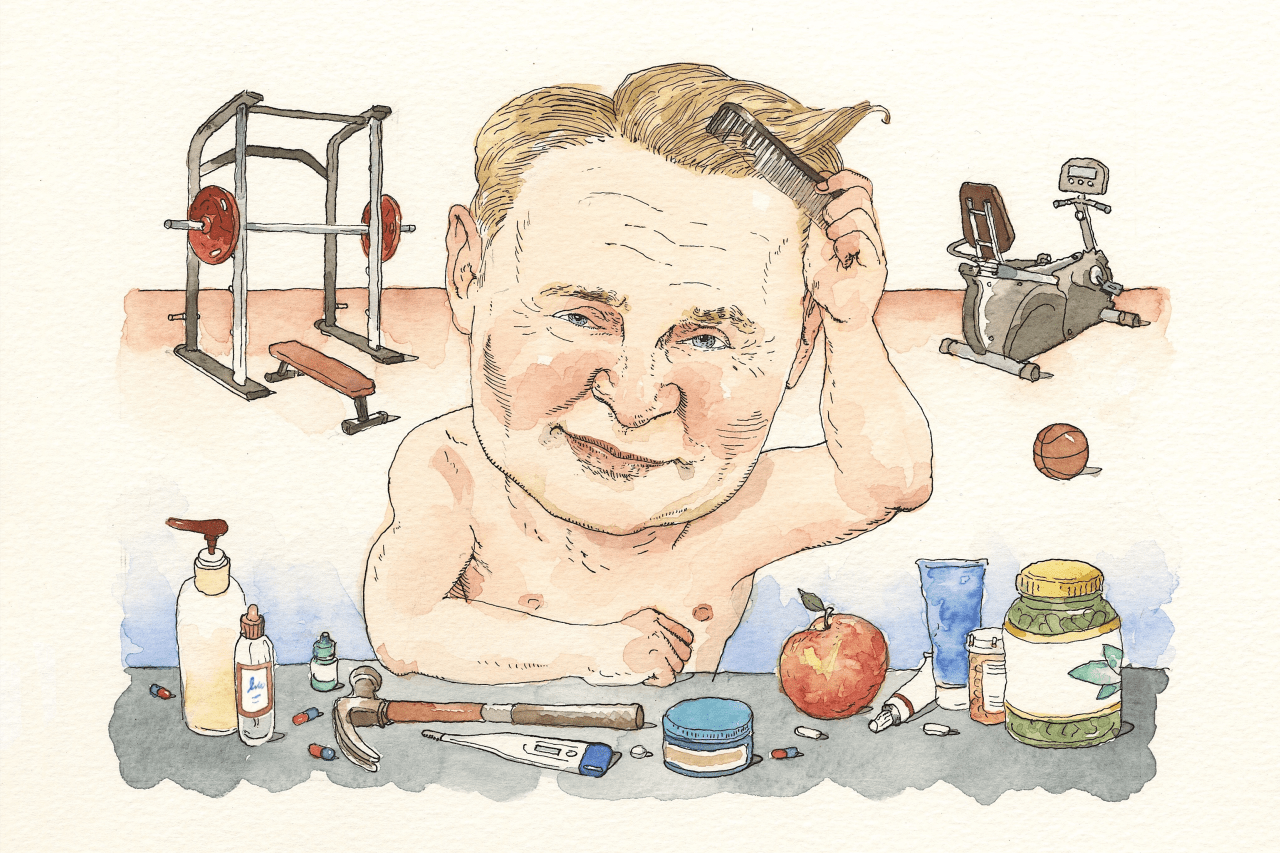
Like Silicon Valley billionaires including Jeff Bezos, Sam Altman and Peter Thiel, Putin has long been fascinated with antiaging research. But in Russia, Putin’s quest to stave off decline is now a state priority relying on methods as wide-ranging as organ printing, harvesting mini-pigs and exposure to ultralow temperatures.
Last month, Russia’s government announced that scientists are developing a gene-therapy treatment aimed at slowing cellular aging as part of “New Health Preservation Technologies,” Putin’s $26 billion longevity initiative.
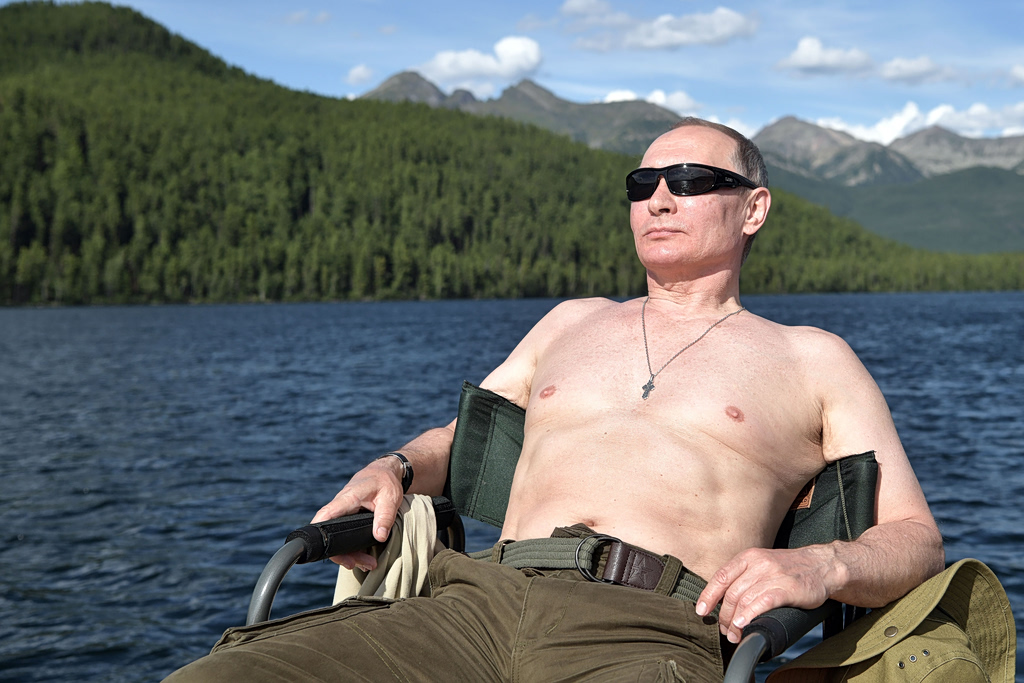
File Photo: Russian President Vladimir Putin during a fishing trip at the cascade of mountain lakes during his vacation on 01-03 August 2017, in the Tyva Republic in the southern Siberia, Russia. EPA/ALEXEI NIKOLSKY / SPUTNIK / KREMLIN POOL
The drug “represents one of the most promising avenues in the fight against aging,” Deputy Science Minister Denis Sekirinsky said on April 23.
Another auspicious avenue? Creating human organs in a lab for transplantation, one of the lifespan-extending innovations Putin likewise spoke about in Beijing. All these efforts are part of the national longevity initiative he unveiled in 2024, which promises to save 175,000 lives by the end of the decade (the figure had an awkward wartime echo, roughly matching independent estimates of Russian troop losses in the invasion of Ukraine, as critics noted at the time).
Russian state scientists appointed by Putin have focused on two key technologies: bioprinting, or 3D-printing living tissue, and xenotransplantation, or growing human organs inside mini-pigs, a porcine breed deemed genetically compatible to humans. Russian scientists working with government agencies claim to have bioprinted human cartilage tissue and a mouse thyroid gland, with the aim of achieving human organ replacement by 2030. A similar timeline has been discussed for growing organs inside pigs.
“In the Russian Federation, work is under way on a whole range of scientific programs in this field,” the Kremlin press service said in an email. “These projects are supported by the state, and many scientific and research institutions are taking part in them.”
Russia’s longevity initiative is spearheaded by two figures close to Putin: his daughter Maria Vorontsova , an endocrinologist overseeing state-backed genetics programs, and physicist Mikhail Kovalchuk, head of the Kurchatov Institute, the Soviet-era nuclear research center.
Kovalchuk—the brother of Putin’s close ally Yuri Kovalchuk , a banker and media investor—has become the intellectual architect of the Kremlin’s longevity drive. He has argued that science will soon allow humans to repair and replace body parts indefinitely.
“It is difficult to discuss immortality, but the ability to repair man will undoubtedly increase,” Kovalchuk told Russian media.
Unlike similar research funded by Bezos, Altman or Thiel, the work promoted by Putin’s circle has produced little peer-reviewed research in major international journals.
“If there are no publications then there are no real results, and their statements should probably be taken as aspirations, not to say dreams,” said Alexander Ostrovskiy, a Russian scientist who pioneered bioprinting in the country.
Ostrovskiy left Russia after the full-scale invasion of Ukraine and sold his company, which now collaborates with the government. “It’s impossible to do science in isolation,” Ostrovskiy said, referring to the sanctions that cut off Russian research from the West. “They are probably telling Putin what he wants to hear to secure funding.”
Kovalchuk has also fused longevity science with the Kremlin’s broader worldview of civilizational struggle with the West. In a notorious 2015 speech, Kovalchuk warned that the West was moving toward the creation of “servant humans”—controllable people with limited self-awareness and manipulated reproduction. He’s also suggested the U.S. was behind the Covid pandemic.
Putin has long shown sympathy for similar themes. Kovalchuk publicly praised the 1968 Soviet movie “Dead Season,” in which the CIA conspires with former Nazi doctors to control humanity. Putin has said the movie inspired him to join the KGB.
Another influence was Vladimir Khavinson, dubbed “Putin’s gerontologist” by Russian media, who promoted peptide-based antiaging therapies derived from calf tissue.
Peptides—short chains of amino acids marketed for recovery, muscle growth and antiaging—have become popular among U.S. wellness figures including Robert F. Kennedy Jr . and Joe Rogan, despite limited evidence for many of their claimed benefits.
Khavinson, who received one of Russia’s highest state awards from Putin for achievements in medicine, said in interviews that he sought to prolong the life of a leader whose departure would throw Russia into crisis. He also argued that human beings were meant to live to 120 years, citing biblical scripture.
Khavinson died in 2024, at 77.
While unorthodox, both Khavinson and Kovalchuk are highly credentialed scientists. Putin has also shown an openness to far less credentialed approaches.
During a meeting at the Kremlin in 2018, Putin advised then Austrian Chancellor Sebastian Kurz to try a cryotherapy chamber—a kind of reverse sauna where the body is exposed to temperatures as low as minus 170 degrees Fahrenheit. Kurz later recalled his surprise when Putin enthusiastically explained the benefits of regularly standing naked in the freezing chamber.
Putin, who is 73, has spent decades cultivating an image of physical vigor through staged displays of masculinity—hunting shirtless, playing hockey and riding Harley-Davidson motorcycles in tight black outfits to project the stamina of an ageless strongman.
But behind the staged virility lies a ruler unusually preoccupied with bodily decline. During the Covid pandemic, Putin imposed elaborate quarantine protocols, including disinfection tunnels and lengthy isolation requirements for visitors. His famously long tables became symbols of both political distance and germophobia.
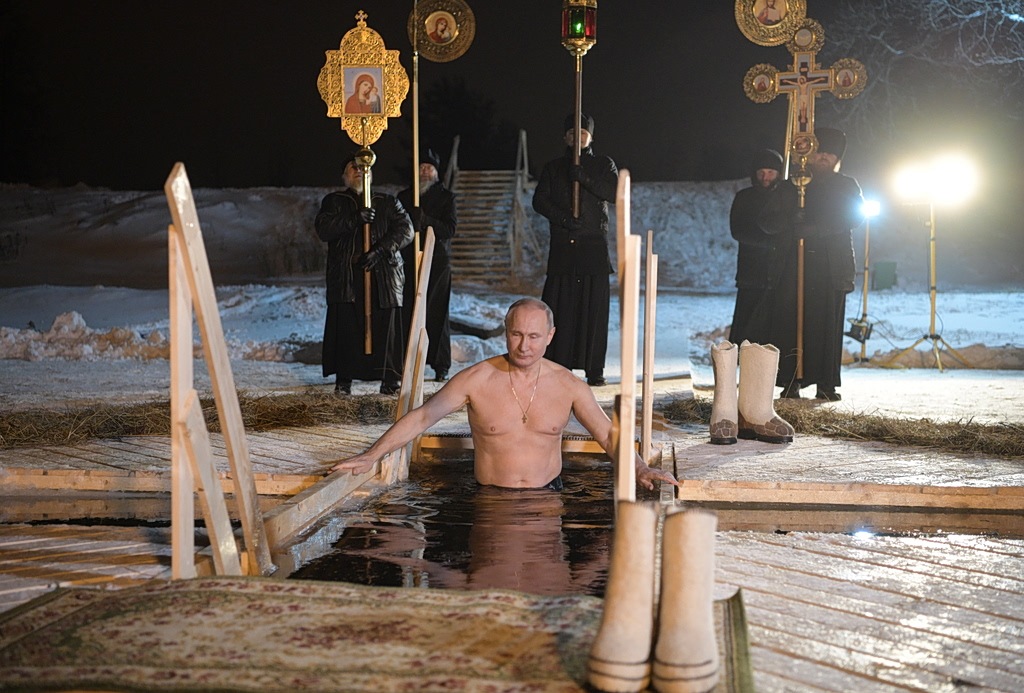
File Photo: Russian President Vladimir Putin takes a dip in the ice cold water of Lake Seliger during the celebrations of the Epiphany Orthodox holiday at the Nilov Monastery on Stolobny Island in Russia, 19 January 2018. EPA/ALEXEI DRUZHININ / SPUTNIK / KREMLIN POOL
Russian and Western media have also speculated about cosmetic procedures as Putin’s appearance has grown visibly smoother with age.
Most of Putin’s closest aides and allies are also in their 70s, including the Kovalchuks, and figures central to the state such as Yuri Ushakov, Sergei Chemezov and Nikolai Patrushev. Putin’s bid to escape decline, and his openness to unorthodox science, reflects a much older tradition among Russian autocrats.
In the 1920s, Soviet polymath Alexander Bogdanov’s experiments with rejuvenating blood transfusions attracted the Kremlin’s attention—before he died as a consequence of his self-inflicted treatments, at the age of 55. A decade later, physician Oleksandr Bogomolets organized the world’s first longevity conference and won Joseph Stalin’s praise for research claiming humans could live to 150. Bogomolets died at 65.
Russia remains marked by some of the developed world’s harshest mortality rates. Average male life expectancy in Russia today is about 68 years, according to official statistics, compared with roughly 76 in the U.S. and over 80 across much of Western Europe.
Death, unlike elections, remains difficult to manage even for the Kremlin.
Write to Bojan Pancevski at bojan.pancevski@wsj.com