 Μake us preferred on Google
 Iran signaled Wednesday it was preparing to conduct swift trials and the execution of antigovernment protesters, defying a warning from President Trump as it intensifies a crackdown on nationwide demonstrations.
Iran’s judiciary chief, Gholamhossein Mohseni-Ejei, said that the courts should act quickly against protesters. “If we want to do a job, we should do it now. If we want to do something, we have to do it quickly,” he said in a video released by Iranian state television.
The threat of speedy verdicts and capital punishment indicates that the regime is turning to intimidation tactics that it has used in the past to tamp down antigovernment protests, along with street crackdowns by security services and warnings of foreign interference.
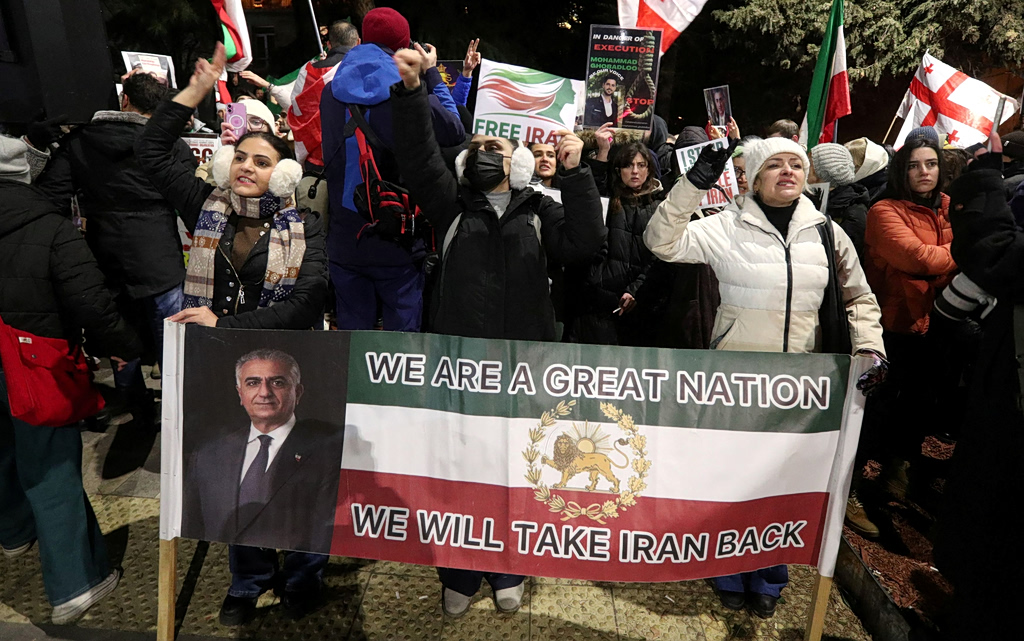
People hold a banner displaying a portrait of Reza Pahlavi, the exiled son of Iran’s last shah and a prominent leader of the opposition movement, during a rally in support of ongoing protests in Iran against the country’s government and the Islamic Republic’s clerical rule, near the Iranian embassy in Tbilisi, Georgia, January 14, 2026. REUTERS/Irakli Gedenidze
The group Human Rights Activists in Iran said Wednesday that the death toll had surpassed 2,400, as the regime has moved to crush the demonstrations. It said more than 140 members of the government security forces had been killed and that more than 18,000 people had been detained.
Human-rights groups say detainees are at high risk of torture and execution. Information about the protests and potential prosecutions has been scarce after the regime cut off the internet last week, causing a near-total communications blackout.
Human rights activists say they believe the first execution of a prisoner arrested and convicted in connection with the protests is imminent. The family of Erfan Soltani, who was arrested on Jan. 8, was told his death sentence would be carried out on Wednesday, according to Awyer Shekhi of Hengaw Organization for Human Rights, a Norway-based nonprofit.
The unmarried 26-year-old runs a clothing shop in the city of Karaj, northwest of Tehran, where he was detained, Shekhi said. His family said he had no previous involvement in political activism, according to Shekhi, who added that his relatives haven’t received details about the charges brought against him or whether he was convicted in court.
He was being held in Ghezel Hesar Prison in the Iranian city of Karaj and his family was told they could meet him for a final visit before his execution. As of Tuesday night, they hadn’t been able to make contact with him since his arrest, Shekhi said.
“The signal that authorities keep sending is that they have ordered extraordinary measures by the courts,” said Mahmood Amiry-Moghaddam, director of the Oslo-based Iran Human Rights NGO.
Trump warned on Tuesday that the U.S. would take action against Tehran if it put antigovernment prisoners to death by hanging, a common form of capital punishment in Iran. “If they hang them, you’re going to see some things,” he said in an interview with CBS News. “We will take very strong action if they do such a thing.”
He also called for protesters to defy regime efforts to quell their demonstrations, urging them to take over state institutions. “HELP IS ON ITS WAY,” he posted on his Truth Social platform.
Tehran’s chief prosecutor, Ali Salehi, said Friday that protesters could face the death penalty, according to the semiofficial news agency Tasnim. Acts of vandalism against public property would be considered “moharebeh,” a Farsi word meaning “waging war against God.” The punishment for such offenses includes execution.
After large antigovernment protests in 2022, Iranian authorities carried out public hangings of multiple people who they said were convicted of committing violent acts. In 2025, Amnesty International said Iran had executed 11 individuals in connection with the 2022 protests after what the rights group called “unfair sham trials.”
Mohseni-Ejei, the judiciary chief, made his comments about expediting prosecutions during a visit to a Tehran prison holding protest detainees. “What the people are expecting,” he said, “is that we do something about the people who beheaded, burned, and set fires.”