TEL AVIV—Israel’s military is targeting the Iranian police state that brutally suppressed protests and killed thousands of people, with the hope of clearing the way for a popular revolt to overthrow the Islamic government.
Israeli airstrikes have targeted people responsible for internal security, from members of the Basij paramilitary force to senior intelligence officials, the Israeli military said. The U.S. has also hit some domestic-security agencies, including the Tehran headquarters of the Islamic Revolutionary Guard Corps, the powerful group responsible for defending and perpetuating the regime .
The Revolutionary Guard and Basij militants were the main perpetrators of the bloody crackdown against antigovernment protesters in January. They opened fire on crowds, killing thousands in one of the deadliest acts of political crackdowns worldwide in decades. Police units and intelligence services also suppressed rallies and arrested protesters en masse.
Israeli officials have made it clear they are looking to do enough damage to Iran’s police state from the air that the people can take over on the ground. While Israel has long been content to weaken Tehran with military action or covert operations, Israeli officials have concluded they now must push for regime change .
That won’t be easy through air power alone, say Iranian analysts.
“If the bet is that airstrikes will finish the job from above while Iranians complete it from below, it’s a bet that rests on no clear historical model,” said Ali Vaez , director of the Iran project at the International Crisis Group. “It also ignores the resilience of entrenched authoritarian systems like the Islamic Republic.”
Among the targets in recent days was the IRGC’s Tharallah headquarters on Sunday, a central cog in the forces’ protest-suppression machine. During times of unrest, Tharallah coordinates intelligence, policing and the Basij, as well as psychological warfare.
Israeli jet fighters also hit the special-units headquarters of the Iranian police command, known as Faraja, which is responsible for controlling riots and suppressing civil unrest. Iran later acknowledged the death of Faraja’s intelligence chief, Golamreza Rezaian.
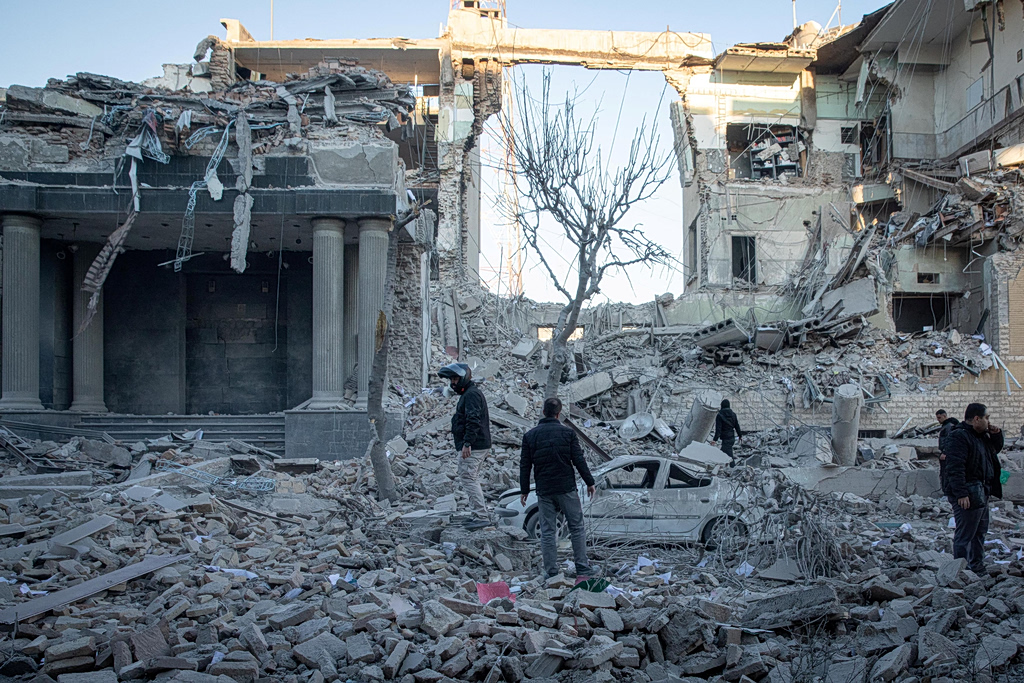
People inspect the site of an Israel and U.S. strike on a police station in Tehran, Iran, March 3, 2026. Majid Khahi/ISNA/WANA (West Asia News Agency)
“These bodies were responsible for, among other things, suppressing protests against the regime through violent measures and civilian arrests,” said the Israeli military.
Joint U.S.-Israeli military operations also took aim at security organizations in western Iran’s Kurdish areas, which are traditional antiregime strongholds.
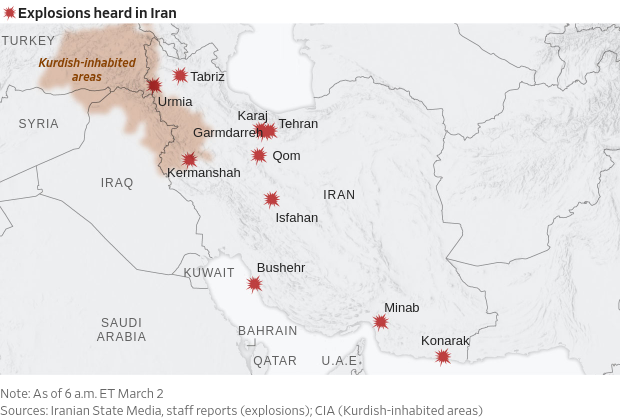
In the Kurdish city of Sanandaj, attacks on Monday targeted police stations and detention centers controlled by the intelligence service and the Revolutionary Guard, according to Hengaw Organization for Human Rights, a Norway-based rights group that focuses on Iran’s Kurdish population. The Iranian government acknowledged strikes in Sanandaj but said they hit residential areas, according to state-run media.
Kurdish and other ethnic minorities represent a particular kind of threat to the Islamic Republic. They have a strong sense of community, they are in border areas, and they are often armed. There are also Iranian Kurdish fighters in Iraq that could cross into Iran should border security weaken.
President Trump is open to supporting groups in Iran willing to take up arms to dislodge the regime , U.S. officials said, an idea that could turn Iranian factions into ground forces at least rhetorically backed by Washington. Trump spoke Sunday with Kurdish leaders, officials said.
Iranian security forces have often deployed in large numbers in Kurdish areas, and violently suppressed protests in Sanandaj in January. On Monday, the IRGC sent messages to mobile-phone users in the city asking locals to report any movement of weapons or military activity, according to a copy of the message shared by Hengaw.
Iran has been simmering with popular discontent for two months, fueled by ongoing economic problems, longstanding opposition to the Islamic Republic’s political and social rules and anger over the killing of protesters in January. Over 7,000 people have been confirmed dead by Human Rights Activists in Iran, a U.S.-based nonprofit.
Even if Israeli airstrikes weaken Tehran, the regime still maintains a monopoly on weapons in most of the country. Basij militants are still patrolling Iranian streets. A foreign military intervention could help boost the popularity of the Basij and IRGC, especially as civilian deaths continue to rise.
Over 1,000 civilians have died in the war, according to Human Rights Activists in Iran, a U.S.-based rights group that monitors the country. That includes 180 children, most of them schoolgirls, who Iranian state media said were killed at a primary school.
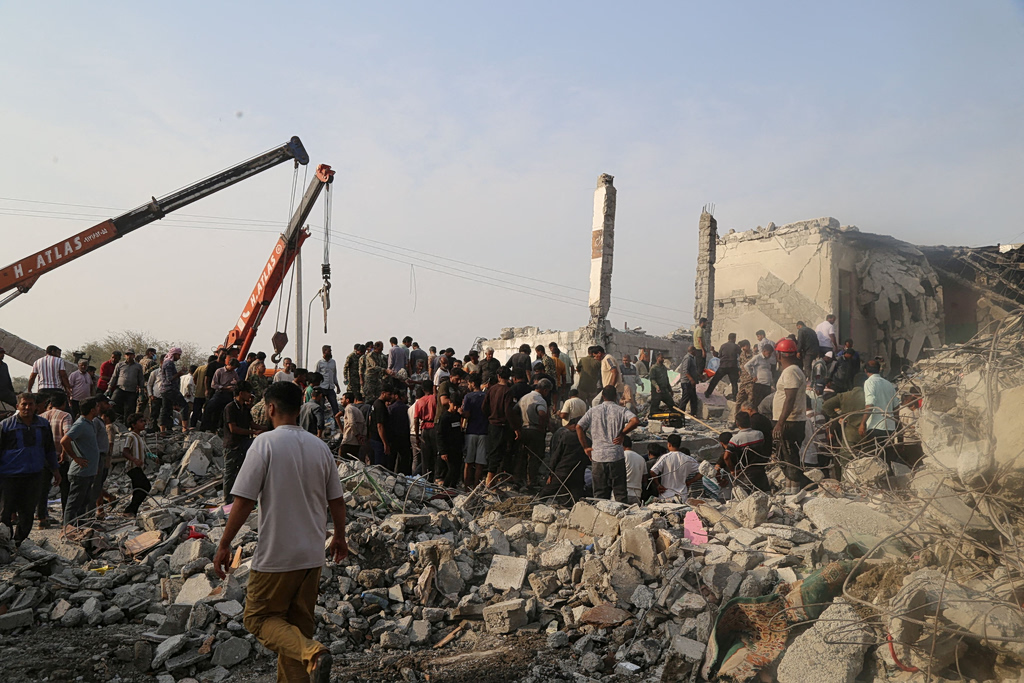
People and rescue forces work following a reported strike on a school in Minab, Iran, February 28, 2026. Abbas Zakeri/Mehr News/WANA (West Asia News Agency)
Mass defections from the regime, should they happen, could change the equation.
Trump appealed to members of Iran’s security forces to defect, and said thousands had already reached out to the U.S. government. “I urge the IRGC, Iranian military, police to lay down your arms and receive full immunity or face certain death,” he said on Sunday. “It will be certain death.”
Write to Benoit Faucon at benoit.faucon@wsj.com , Margherita Stancati at margherita.stancati@wsj.com and Dov Lieber at dov.lieber@wsj.com