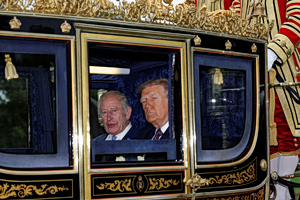
WASHINGTON— King Charles III arrives in Washington on Monday to publicly celebrate 250 years since a nascent U.S. republic ousted his forebears, and privately ensure that a fraying trans-Atlantic relationship can cope with another two-plus years of President Trump .
The four day visit—billed as Charles’s most high-wire diplomatic act since coming to the throne—will include a speech to Congress, the first time a British monarch has spoken there since 1991, a private audience with Trump and state dinner in Washington, as well as trips to New York and Virginia.
The attempted attack at the White House Correspondents’ Dinner cast a shadow over the visit. Buckingham Palace on Sunday said that it was in touch with U.S. security officials to determine whether any changes to the king’s schedule were necessary.
A palace official also said that Charles reached out to Trump to express his sympathies to all affected.
Trump is excited to welcome the 77-year-old king, saying in recent days that “we’re going to have a great time.”
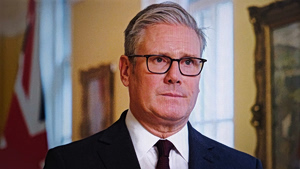
Much is at stake. The “Special Relationship” between the U.S. and its mother country is at a generational low, thanks to growing frictions over everything from trade to the war in Ukraine to Trump’s threats to seize Greenland. The U.S. attack on Iran has also caused energy prices to jump, damaging the British economy and exasperating the British government, which thinks the war is illegal and unwise. Trump, meanwhile, regularly harangues British Prime Minister Keir Starmer on social media for not supporting his military endeavors in the Middle East and for the U.K. government’s penchant for wind-powered energy, which he hates.
Reports that the Pentagon is drawing up plans to punish NATO allies by reviewing support for their “imperial possessions,” including Britain’s control of the Falkland Islands near Argentina, further ratcheted up tensions.
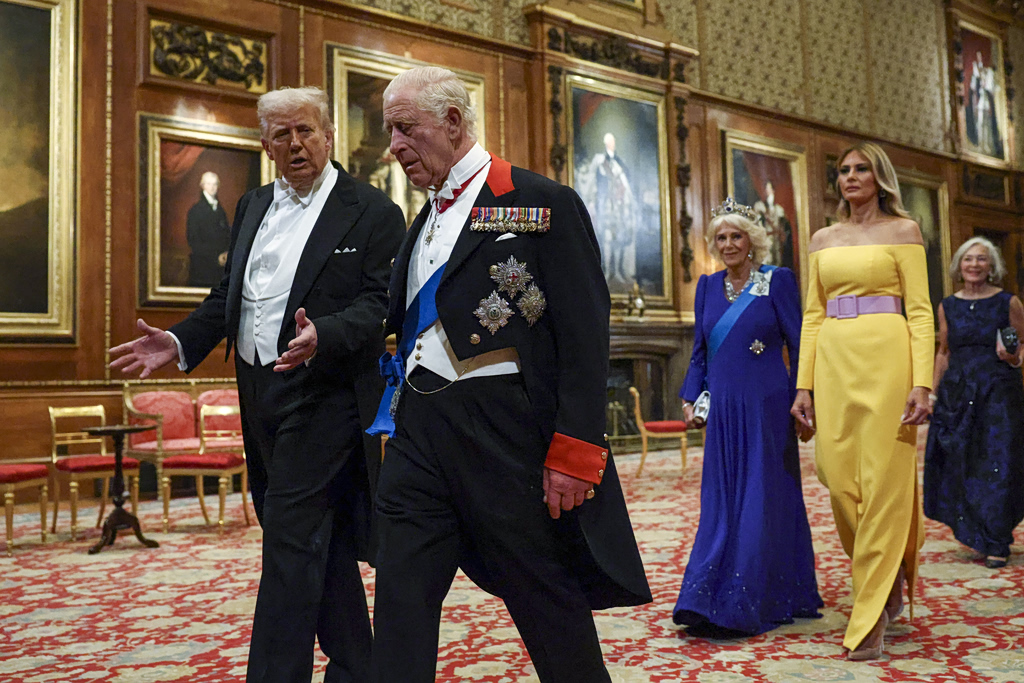
From left, President Donald Trump, Britain’s King Charles III, Queen Camilla and First Lady Melania Trump arrive for a State Banquet at Windsor Castle, in Windsor, England, Sept. 17, 2025. (Kevin Lamarque/Pool Photo via AP)
Charles—traveling with Queen Camilla—is being deployed as something of a diplomatic Hail Mary by the British government, to not only lighten the mood music between the president and prime minister but also to quietly ram home to Trump the importance of allies, including the North Atlantic Treaty Organization and other multilateral institutions that underpin European security.
“Usually these visits are a glorified patting on the back,” said Andrew Roberts , a British historian and royal biographer. “This is much more serious than that.”
The irony that trans-Atlantic ties now rest on the performance of King George III’s great-great-great-great-great-grandson won’t be lost on the palace, said Roberts, adding that the monarch will likely tackle the elephant in the room in the most British way possible: with bone dry humor. Indeed, when Queen Elizabeth II visited in 1976 to celebrate two centuries of U.S. independence, she made a speech stating it was “with a particular personal interest that I view those events which took place 200 years ago.”
In Charles, the British government has one of the few bona fide Trump whisperers still standing in Europe after a tumultuous second term. Trump has a well-known soft spot for the British monarchy, which his mother greatly respected, and is the only U.S. president to have been invited on two royal state visits to the U.K.
The lead up to the visit, however, hasn’t been smooth. Several British lawmakers urged the U.K. government, which orchestrates such visits, to cancel it to spare the king from the embarrassment of having to cozy up to a U.S. president who is deeply unpopular with Britons. In response, U.S. government officials relayed messages to Downing Street that any cancellation would be extremely badly received by Trump, according to people familiar with the matter. So the visit is going ahead.
There is also jeopardy on another front for the royal family, via Charles’s brother Andrew and his ties to the late sex-offender Jeffrey Epstein . Buckingham Palace officials say the monarch can’t meet survivors of Epstein’s abuse as police inquiries in the U.K. are ongoing into Andrew’s links to the former financier. Andrew, who has had his princely titles removed by Charles, has previously denied wrongdoing.
“This is a much trickier royal trip than anything that his mother was asked to undertake throughout her whole 70-year reign in terms of visits to the U.S.,” said David Charter , author of “Royal Audience: 70 Years, 13 Presidents—One Queen’s Special Relationship with America.”
Charles has already done his fair share to patch up the special relationship with Trump. He hosted the president last year in Windsor Castle, laying on an epic display of pageantry tailored to the president’s tastes, which included sitting through a display of bearskin-hatted soldiers marching to a military band playing “YMCA.” Trump called the event the honor of a lifetime.
U.K. officials fret, though, that the half-life of the regal glow is diminishing fast. A favorable tariff deal granted to the U.K. by Trump has been watered down and billions of promised investment from the U.S., a deal signed by Trump during a glitzy ceremony in the English countryside, hasn’t materialized. Meanwhile, relations between the two governments have cratered.
Trump said that NATO allies avoided front-line combat during the war in Afghanistan, which caused particular upset in the U.K. where 457 soldiers lost their lives in that conflict. Trump later retracted the statement and said he loved the U.K. And in the early hours of the Iran war, the British government initially refused to allow the U.S. to use U.K. military bases to launch the assault. “This is not Winston Churchill we are dealing with,” Trump said when asked about Starmer’s decision.
While Trump has derided the government, he has continued to heap praise on Charles. “I’ve known him for a long time. He’s a wonderful, wonderful person,” the U.S. president told Sky News earlier this month. Trump insisted his strained relationship with Starmer would “not at all” overshadow the royal visit.
Historians take heart from the fact British monarchs have in the past successfully navigated tensions with America. In 1957, a young Queen Elizabeth was sent to New York to placate a furious President Dwight D. Eisenhower after Britain, along with Israel and France, invaded Egypt without informing the U.S. She was met with rapturous crowds and Eisenhower was wooed.
Even George III, the American colonies’ last king, made peace with his former subjects. “I will be very frank with you. I was the last to consent to the Separation,” King George stated to John Adams in 1785. “But the Separation having been made and having become inevitable, I have always said, as I say now, that I would be the first to meet the Friendship of the United States as an independent Power.”